
'THE UNIVERSAL HISTORY OF US'
Science is not merely a search for answers but a continual journey of questioning and exploration.
Roshini Raj
17.10.24
|
Compiled from Tim Coulson’s talk at the Oxford Martin School, University of Oxford on 15th October 2024 |
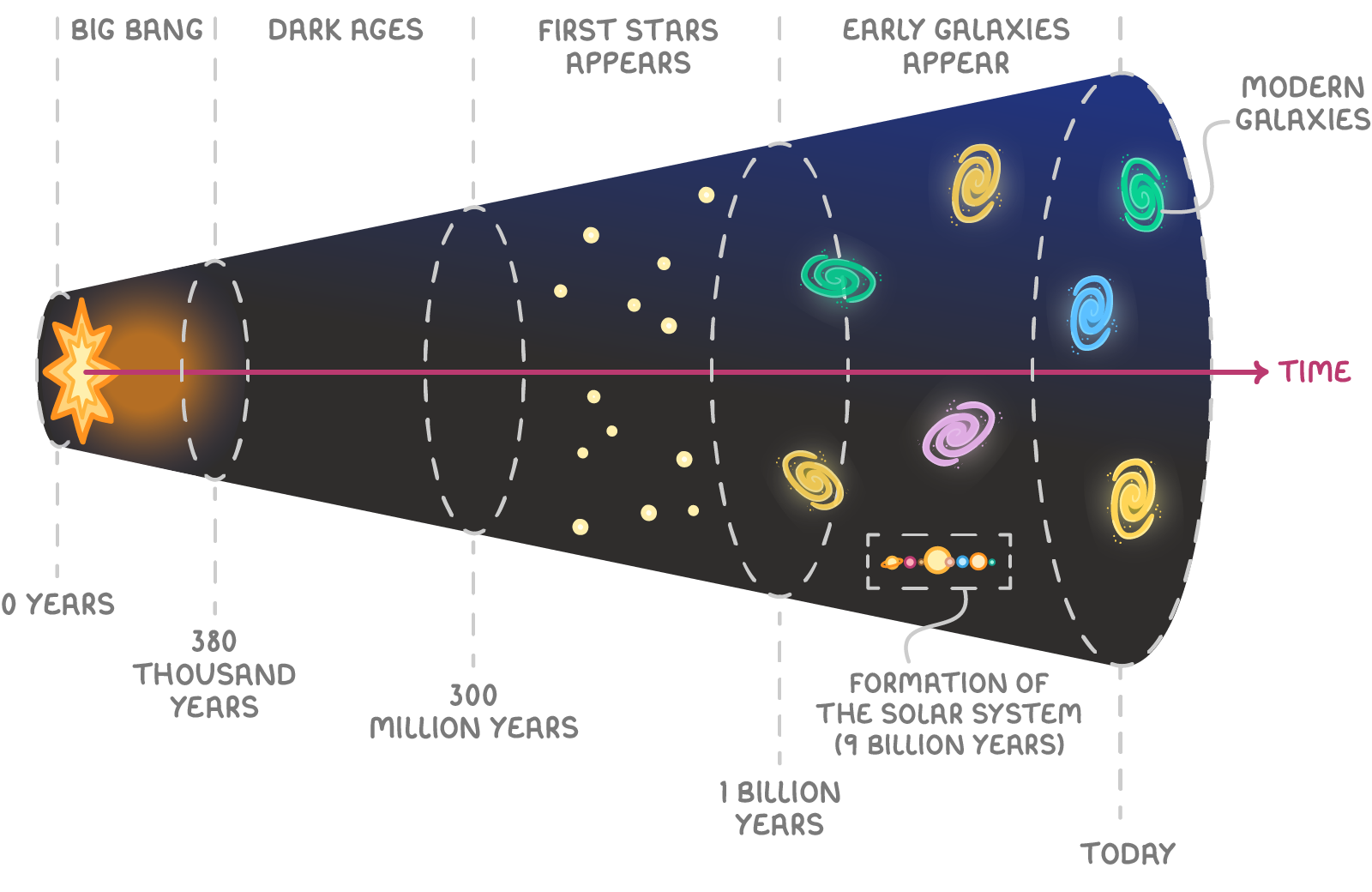
The Book “The Universal History of Us” by Tim Coulson offers a literary exploration of the history of the universe, from the Big Bang to the emergence of humanity.
Coulson, a professor of zoology at Oxford, microprocesses insights from biochemistry, physics and evolution, weaving them into a narrative that captures the intricate and often surprising events that made life and consciousness possible.Through his book, he explores the foundational questions concerning the genesis of the universe, reasons for evolution and more.
It is interesting to analyse Tim Coulson’s thoughts on the evolutionary processes briefly explained in succeeding paragraphs.
Bridging Disciplinary Silos
In contemporary times, there are dynamic interdisciplinary exchanges in R& D programmes. This complex phenomenon is expressed by the interweaving of evolutionary biology, modern cosmology and human consciousness studies, which traditional experts in a single discipline would fail to comprehend. This evolution is akin to consilience, a conceptual idea proposed by biologist E.O. Wilson to express the importance of converging deep insights and knowledge across multiple disciplines.
Old habits steer most population biologist to narrow their focus on ecosystems and the evolutionary processes. However, inquiry must expand to cosmological origins, a sliver of philosophy that adds to our combined human consciousness. Theories like the ‘Many-Worlds interpretation’ of quantum mechanics have certain limitations that science and scientists have yet to authenticate and verify empirically. This also indicates the underlying tension of balancing rigorous empirical enquiry with speculative thought, a vital quality for synthesising knowledge gaps within and across fields.
Humility and Limitations
Humanity's greatest achievement is emphasising the 'scientific method of research and reasoning'. To follow this, your approach must be rooted in humanity, acknowledging that despite futuristic advances, the vast unknowns in consciousness studies, biology and physics persist. Philosopher Karl Popper famously argued that science progressed through falsification rather than verification. Historian and philosopher Thomas Kuhn’s views on paradigm shifts, further insist that the nature of science is not a linear journey in search of truth but rather dynamic layers of revision and discovery.
"Deep Edge Questions," like the origin of life and the nature of the human consciousness, continue to evade scientific understanding, forcing researchers to grapple with uncertainty.
Chance, Determinism, and Scientific Uncertainty
If the universe’s clock were reset, would events unfold identically? This inquiry intersects with both cosmology and evolutionary biology, where randomness and determinism shape the development of systems.
PhysicistSean Carrollargued that quantum mechanics introduces randomness, complicating deterministic models of the universe. In biology, there is an interplay between chance and necessity in the evolution of life.
Theoretical Boundaries of Science
Coulson’s brief exploration of the ‘Many-Worlds Theory’ exemplifies his openness to engaging with abstract theories, even those outside his primary expertise. While the Many-Worlds theory offers an elegant interpretation of quantum phenomena, Coulson acknowledges its speculative nature and difficultysubjecting it to empirical testing.
This tension between theoretical elegance and experimental validation reflects a broader debate within the scientific community. Coulson's cautious stance aligns with the views of physicists like Richard Feynman, who emphasised that theories must be grounded in empirical evidence to be meaningful. Coulson’s scepticism reveals his belief in balancing scientific creativity and methodological rigour.
Origins of Life
The question of how life emerged on Earth has always been a source of research. As per Coulson, life began approximately 3.9 billion years ago, shortly after the planet's conditions became favourable. This suggests that life might not be an extraordinary event but a natural outcome of favourable conditions. Coulson raises the possibility that life could emerge multiple times, perhaps even on other planets such as Europa.
He presents the origin of life as a synthesis of autocatalytic molecules, energy metabolism, and protective membranes—the foundational components of self-replicating systems. While deterministic perspectives suggest that life will emerge given the right conditions, Coulson acknowledges that randomness is crucial in creating those conditions.
The Carbon Bias
Coulson explores the likelihood that extraterrestrial life if it exists, would also be carbon-based due to carbon’s unique chemical versatility. While silicon-based life forms are theoretically possible, Coulson argues that carbon’s ability to form complex, stable bonds makes it the most probable medium for life.
He speculates that even if life exists elsewhere, it might not rely on DNA or RNA but on entirely different genetic mechanisms. This discussion hints at the imaginative potential of science and science fiction, drawing on speculative works such as Fred Hoyle’s The Black Cloud, which envision life forms vastly different from those on Earth.
Case Studies vs Universal Laws
Biological systems are far more complex than the more predictable systems studied in physics. Martin John Rees, a British cosmologist and astrophysicist, has observed that physics is “easier” than ecology, noting that while physical laws govern particles uniformly, genes behave differently depending on their environmental context.
This variability in biological systems presents analytical challenges, as biology often relies on case studies rather than universal laws. However, biology will eventually develop general principles, particularly in evolutionary theory, where foundational laws like natural selection and genetic fitness exist.
Case based studies must be given greater emphasis over universal laws, especially in conservation biology. This has been vindicated by the successful experiment of the reintroduction of wolves to Yellowstone, illustrating how top predators can reshape ecosystems.
When predator-driven systems are compared with ecosystems driven by primary producers, ecology may eventually uncover general principles. However, the inherent complexity of biological systems makes it difficult to develop simple, universal laws, suggesting that science advances incrementally through case-based insights.
Human Evolution
Recent advances in human evolutionary studies, focusing on molecular biology, have transformed the understanding of ancient hominins. While exploring the interplay between Homo sapiens, Neanderthals, and Denisovans, it has been noted that these species were not primitive but exhibited intelligence, culture, and possibly language.
The sequencing of Neanderthal and Denisovan genomes has blurred the distinction between them and modern humans, challenging earlier assumptions about human uniqueness. Coulson suggests that climate change may have influenced evolutionary outcomes, reinforcing the theme of contingency in the evolution of life.
Conclusion
The beauty and challenges of scientific inquiry are immense. However, all knowledge is interconnected, from the Big Bang Theory to the Evolution of Humans.
However, science is far from "all-knowing," and its limitations must be acknowledged. Uncertainty must be embraced as a natural occurrence and should be viewed not as an obstacle but as an opportunity for discovery.
In an age increasingly dominated by specialisation, we must think beyond disciplinary boundaries, remain curious and appreciate the mysteries that science has yet to unravel. , and to view science not merely as a search for answers but as a continual journey of questioning and exploration.
|
“Science doesn’t have all the answers; we’re not done with our work yet. There is still plenty to do. But what science has done is it’s come an astonishingly long way, and that’s what I want to champion. I don’t have all the answers; science doesn’t have all the answers, and that’s the great thing about science’s progress. It means we can collect new data and have to completely rethink the way that we thought before, and I think that’s a wonderful way of finding out facts and progressing our understanding”. Prof Tim Coulson |
Tags
# Tim Coulson, Universal Laws, # case based studies
References
https://www.youtube.com/watch?v=huVZpbGwUcQ
Expert Comment
Images Cover
Or
Cartoon
https://as1.ftcdn.net/v2/jpg/04/05/18/22/1000_F_405182246_7G2ceMsQUtk9swfvWevqwoFYHC5vcfaa.jpg