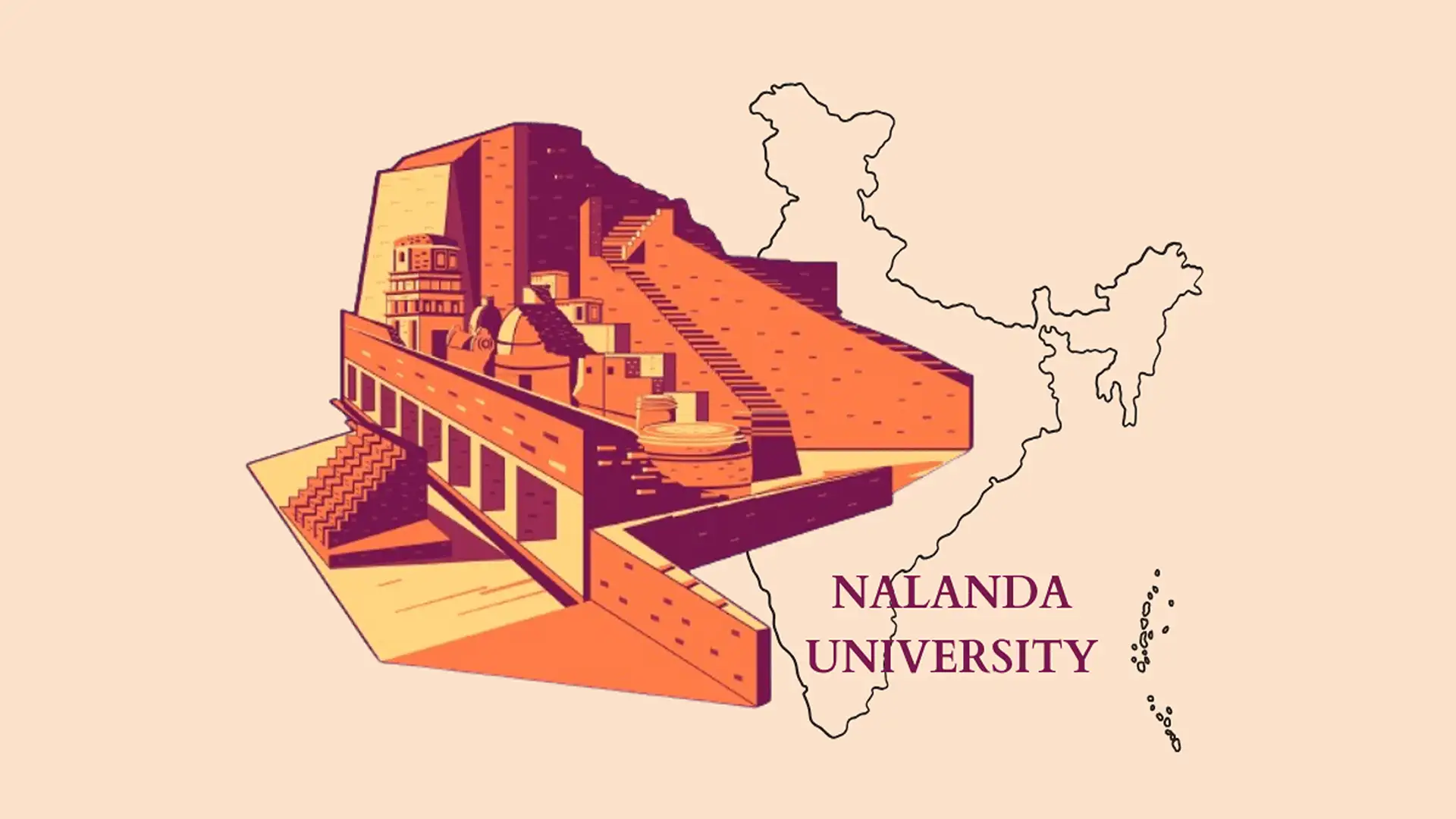

Building Nalanda into a key centre for negotiation, dispute resolution, and arbitration is important.
The genesis of Nalanda University is traceable back to the devastating Kalinga Warfought between the Mauryan Empire under Ashoka and the independent state of Kalinga. According to historical accounts, 150,000 people were killed, another 150,000 were taken as prisoners, and countless others suffered from the destruction and displacement caused by the conflict. Witnessing the bloodshed, anguish, and devastation, Ashoka experienced deep remorse and sorrow. This moral reckoning led Ashoka to renounce violence and warfare and embrace Buddhism as a path of peace, compassion, and non-violence. Ashoka dedicated the rest of his reign to the promotion of dharma (righteousness) and the welfare of his people.
Ashoka’s shift towards Buddhism and his emphasis on education and moral governance laid the intellectual and spiritual groundwork that would later inspire the creation of Nalanda, one of the greatest centres of learning in the ancient.
Ashoka then sent his daughter and son, Mahinda and Sanghamitra, known as Sanghamitra and Mahendra, to Sri Lanka as emissaries of Buddhism.Not only did he send his son and daughter, his most precious treasures in his family, but he also sent many other emissaries around the world.
A Glimpse into the Past
Ancient Nalanda University had an architecture and an engineering faculty, and metallurgy was one of those topics that attracted global attention.In the first phase of Nalanda, the residents and scholars were monks. They were monastic. But later, they transformed into scholars and laypeople. By embracing this broader mission, Nalanda could become a vibrant, globally respected institution, echoing the intellectual diversity that symbolised excellence in its golden era.
The relevance of the University of Nalanda goes far beyond being only one of Buddhist studies. Historically, Nalanda covered a wide range of faculties, including a dedicated faculty for medicine. Given this rich history, a modern Nalanda University should reflect its ancient predecessor's spirit of diversity and inclusiveness. It should encompass various academic faculties, encouraging multidisciplinary research and fostering dialogue between ancient wisdom and modern science.
Rather than being confined to Buddhist studies, it should invite engagement across various fields, such as the humanities, sciences, social sciences, and emerging technologies. This approach would honour its historical essence as a global hub for knowledge exchange and inquiry while remaining relevant to the challenges of today's world.
Before Nalanda was created, there were at least five or six universities in this region. This was a knowledge hub like Oxford, Cambridge, and St. Andrews.
China Connection
Before the very creation of Nalanda, a Chinese monk named Fa Hien visited Rajgir in this region. As a devoted Buddhist, he was deeply concerned about the incomplete and inaccurate Buddhist texts in China at the time.
Motivated by a desire to obtain authentic Buddhist scriptures, especially those relating to monastic discipline (the Vinaya), he embarked on a daring pilgrimage to India, considered Buddhism's homeland. Fa Hsien visited here before the creation of Nalanda; he collected several manuscripts from this region, which was very well known for copying manuscripts.At that time, there was no printing press for translating manuscripts, so he collected many manuscripts and went to Sri Lanka. In Sri Lanka, he collected more manuscripts and travelled on the Porcelain Road maritime route. While passing the coast of Sumatra, his ship was caught in a deadly storm. To lighten the load and stabilise the ship, the panicked ship captain wanted to throw the heavy manuscripts into the sea. And at that point, Fa Hien said, “Throw me to the ocean.Don't throw the manuscripts because they are precious treasures—knowledge and understanding.” But just then, the tornado ceased, and the manuscript survived.
These manuscripts were then taken to Xi'an, the city of the world-famous terracotta warriors. Xi'an is China's greatest historical site, and those manuscripts are still preserved there. So many Chinese scholars have written about Nalanda and the other universities that existed here.
Fa Hientook a very important text, the text on discipline. The text was primarily for the monastic order because the Buddhists had a strict code of discipline, which influenced Christianity in many ways.So, when Fa Hien took the Vinaya Pitaka, a different Pitaka from the Abhidhamma Pitaka, it formed the foundation for Chinese discipline, making China a great nation until communism. Communism brought a different discipline, which may not be the discipline we all like.
It is a pity that India is now ranged against China along with the U.S. China and India were friends until the 1962 border war; they had a friendship for two to three thousand years.Nalanda itself is a witness to it. How many Chinese came here to study? How many Taoists came here to study? How many Confucius monks and laymen came here to study?
Leading into the 21st Century
Bihar, the home state of Nalanda, has a great deal of scope to develop, and Nalanda could be a huge catalyst for intellectual and economic development. The subjects that were taught at Nalanda of the pastwere considered not only the arts but also the sciences.
Building world-class educational facilities requires investments in roads, transportation networks, housing, and utilities, which could spur broader infrastructure development in the surrounding areas. Improved infrastructure would benefit the university and the local communities, attracting domestic and international tourists, researchers, and students. Modern amenities such as smart city initiatives and better public services could transform the region into an education and research hub.
The emphasis should be on academic excellence, the exchange of ideas, and a commitment to addressing the world's pressing issues through the lens of both ancient wisdom and modern innovation. That should be the spirit of Nalanda.
Building Nalanda into a key centre for negotiation, dispute resolution, and arbitration is important. This can be a very important centre for the world. Nalanda University should not be a Buddhist university. If you are a Buddhist university, your reach will be limited to the Buddhist community. But if you are not a Buddhist university, you will be able to reach a wider population and influence them.
In Singapore, there is a common religious space. We look at all the great religions and take what is common from them. Here, we follow the golden rule, "Don't do to others what you don't want to happen to you." This rule is followed in Buddhism, Zoroastrianism, Manichaeism, Jainism, and even the Baha'i faith. We must create a specialist capability to look at what is common to all these faiths, including Islam. Then, we can invite to Nalanda those who are the predecessors of Bhaktia who are in Afghanistan.Invite them to come and study here. It will cause some cognitive dissonance in them. We must reach out to our friends and enemies, opponents, adversaries, and those on the fence.
Diplomacy is traditionally understood as a complex interplay of politics, economics, and defence. These pillars have long shaped the relationships between nations, with negotiations, trade agreements, and strategic alliances forming the core of international diplomacy.However, in a rapidly globalising world, where cultural identity, shared values, and spiritual traditions are becoming increasingly important, the role of diplomacy is evolving.With its rich historical and cultural legacy, Nalanda University is uniquely positioned to lead this transformation and redefine the contours of modern diplomacy.
The new face of diplomacy that Nalanda can spearhead should be based on culture, religion, and common values. It should transcend the traditional focus on power, economic interests, and military strength. Instead, it should be based on the softer yet equally powerful pillars of culture, religion, and common values. These elements can serve as bridges that unite people across borders, fostering mutual understanding, respect, and collaboration in ways that hard diplomacy often fails to achieve.
Nalanda University can offer a new vision for diplomacy in the 21st Century that moves beyond traditional geopolitical frameworks' limitations. By focusing on culture, religion, and common values, it can facilitate deeper connections between nations and peoples, promoting peace, cooperation, and mutual understanding in a world that desperately needs it. This new model of diplomacy, rooted in the human spirit, could serve as a powerful tool for addressing both the challenges and opportunities of our interconnected world.
|
“The emphasis should be on academic excellence, the exchange of ideas, and a commitment to addressing the world's pressing issues through the lens of both ancient wisdom and modern innovation. That should be the spirit of Nalanda”. |