
AN ENDURING PARTNERSHIP
Is Thailand the barometer of success for India’s Act East policy?
With over 2000 miles of the Bay of Bengal and the Andaman Sea separating the land masses of India and Thailand, the geographical proximity of the two nations plays an important part in their relationship. Both nations are important littorals of the Northern Indian Ocean and can influence commerce plying these waterways. In times of hostilities, Thailand would be of value to India's defence of its island territories, which lie closer to Thailand than the Indian peninsula. That Thailand guards the mouth of the Malacca Straits, a key maritime chokepoint, is of no little significance for India’s maritime strategists.
Culturally, the relationship has a legacy that goes back to 500 BCE with evidence of sea-borne commerce between South India and Thailand (such as etched carnelian beads and Indo-Pacific beads). Trade in spices, aromatic wood, and gold flourished between the two regions.
While Thailand is predominantly Buddhist, many Hindu temples house Buddhist and Hindu deities side by side, including Ganesha, Brahma, Vishnu, Shiva, and Indra. The Hindu epic Ramayana has profoundly influenced Thai culture and life, and it is known as Ramakien in Thailand. Brahmin priests from India have provided a cultural link between the two countries since 1500 BCE. These priests, along with Indian merchants, scholars and adventurers, played a key role in transmitting Indian religion, culture, traditions and philosophy to Thailand.
Buddhism, Thailand’s principal religion today, also has an Indian connection. It was carried to Thailand in the 3rd Century BCE by Ashoka the Great through Buddhist monks acting as his emissaries. Over time, it was adopted as the state religion and profoundly influenced Thai culture and life. The Thai language borrows a substantial share of its vocabulary from Sanskrit, India's classical language. Pali, the Magadha language and Theravada Buddhism's medium is another important root of Thai vocabulary.
The Thais are proud that they have never been colonised, even though they paid tributes to the Chinese empire at various times in their history. Called Siam (from the Sanskrit word, syam), the country was renamed Thailand in 1939.
Current State of Relations
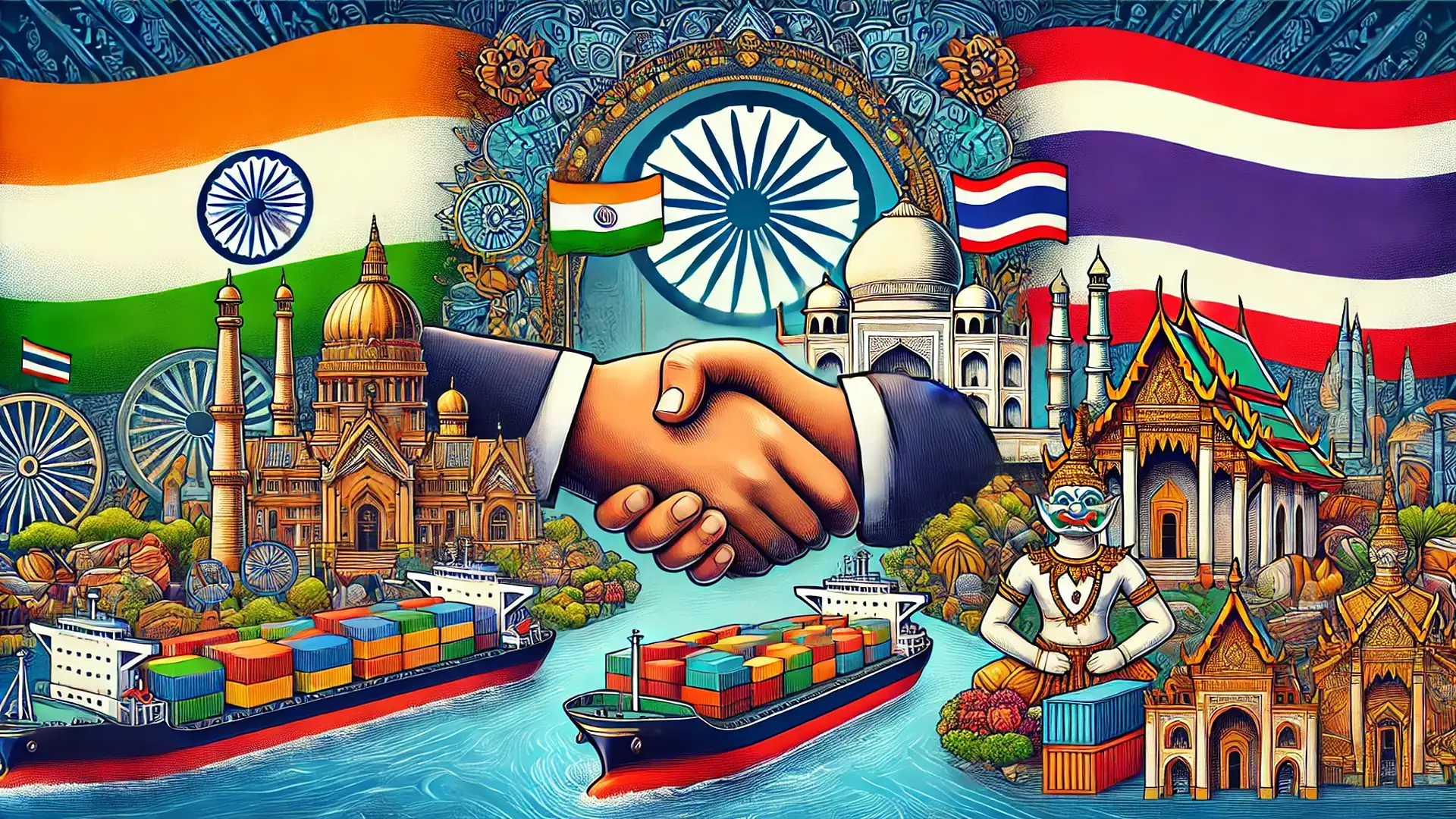
Immediately after Indian independence, both nations established diplomatic relations. However, the real push has been given by India’s ‘Look East’ policy (since 1993) and Thailand's 'Look West' policy (since 1996), which has now metamorphosed into India’s ‘Act East’ and Thailand’s ‘Act West.”
Diplomatically, Thailand's real value lies in Bangkok's influence in regional and sub-regional groupings like ASEAN, EAS, BIMSTEC, MGC and IORA. Thailand's support is crucial for India's Indo-Pacific strategy, which emphasises ASEAN centrality. In fact, India and Thailand are complementing each other's "Act East" and "Act West" policies.
In the security domain, it is natural for both nations to draw closer. Over time, they have expanded defence engagements, including defence dialogues and military exercises like MAITREE and SIAM BHARAT. The two navies take the lead in regular naval manoeuvres and joint in the Indian Ocean and Andaman Sea. The two countries have signed an MoU on Defence Cooperation and participate in multilateral exercises like COBRA GOLD. Enhancing naval cooperation is contributing to maritime security in the region.
Taking off from maritime trade established as far back as 500 BCE, India-Thailand bilateral trade reached an all-time high of $17.7 billion in 2022, making Thailand India’s 5th largest trading partner in ASEAN. The tax regime agreed under the ASEAN -India Free Trade Agreement has proved mutually beneficial. Major Thai companies have an active and growing business presence in India, especially in agro-processing, construction, automotive, engineering and banking.
Thailand's central location makes it a gateway for India to Southeast Asia and beyond. Bilateral trade has the potential to rise even more dramatically if the envisaged connectivity projects, like the India-Myanmar-Thailand Trilateral Highway to link Northeast India and Thailand via Myanmar, become a reality. This Trilateral Highway is the first-ever cross-border facilitation agreement between South and Southeast Asia and is imperative not only for regional connectivity but for the Dawei Project as well. Dawei is a port city in Myanmar that is being developed as a deep-sea port and special economic zone. This major regional project is of great interest to Thailand, as it will change the direction of regional logistics and is expected to unleash Thailand's true potential as a trading hub for ASEAN. India is also planning to connect the port with Chennai. It will provide an alternative sea route to Southeast Asia and reduce dependency on the congested Strait of Malacca, cutting transport time.
Thailand's ancient connection with Indian culture and religion makes it a popular destination for Indian tourists. India is one of Thailand's most important source markets and the fastest-growing. In 2023, over 1.6 million Indian travellers visited Thailand, making the country the fourth-largest source market for Thailand. These tourists spent more than THB 63 billion ($1.7 billion). Approximately 2,00,000 Thai tourists toured India, mainly the Buddhist pilgrimage sites.
Dragon in the Room!
Just as India factors Thailand’s strategic location into its geopolitical calculus, so does our rival China;Thailand is important to China for all the identical reasons. Being a major trade partner of ASEAN, Beijing has an even greater footprint in the Thai economy, a fact that India is hard-pressed to match.
Strategically, Thailand’s dominance over the Malacca Straits, through which the bulk of Chinese oil and trade is passed, makes good relations with the Kingdom a priority for Chinese foreign policy in the region. Unlike India, China shares a physical border with Thailand alongthe Mekong and Salween rivers originating in Tibet, affecting Thailand's rural economy.
Amidst rising differences between China and ASEAN Members on the South China Sea, China is using its One Belt, One Road initiative and making ever-increasing efforts to make its presence and power felt in the region. One such case is investing in high-speed rail links to connect Laos, Thailand with Southern China.
Thailand would like to balance its ties to both India and China without raising hackles in either, which is a major challenge in itself. India must keep in mind thatChina is Thailand's largest trading partner, with bilateral trade reaching $135 billion in 2023. Thailand is a major destination for Chinese investment, especially in infrastructure projects under the Belt and Road Initiative. Chinese tourists are also crucial to Thailand's tourism sector, contributing an estimated 12 per cent of GDP at its peak.
Thailand has the largest overseas Chinese population (at least 11 per cent of the Thai population) in the world and maintains deep cultural and historical ties to China dating back centuries. The two countries often describe their people as part of "one family".China sees Thailand as a key Southeast Asian ally to counter U.S. influence. After the 2014 coup, Thailand turned to China for support when Western democracies ostracised it. China's growing influence in Thailand has implications for the US-Thai alliance.
Challenges For Both
Countering international terrorism, man-made disasters, maritime boundaries, arms trafficking, and mutual security concerns over insurgent groups using Thailand as a territory for shipment of small arms, as well as planning and recruitment for terrorist activities, have been common challenges for both countries.Both countries need to further engage in intense military cooperation to combat the challenge.
In the current global context of ongoing U.S.-China rivalry, the Bay of Bengal is emerging as a potentially contested maritime space between regional and global maritime powers operating in the Indian Ocean. The Bay hosts over 1.5 billion people, and important sea lanes of communications traverse its surface. For India, the challenge is to bring together smaller nations of the region through closer economic integration connectivity to strengthen the region as a whole. Only through such collaboration and cooperation can meddling by big powers like the U.S. and China be evaded.
However, the huge cost of joint projects has proved daunting and posed massive challenges in terms of lag in completing infrastructure projects.Inadequate attention is paid towards enhancing maritime security cooperation in the Andaman Sea and the Bay of Bengal.Diversifying the trade basket beyond traditional items is also long-due.
Grabbing Opportunities
The scope for leveraging complementary "Act East" and "Act West" policies to deepen strategic partnerships is immense.
Expanding cooperation in trade, the defence industry, maritime security including multilateral exercises are some low-hanging fruits.
Promoting greater people-to-people exchanges and cultural linkages with regular visits of Indian cultural troupes, festivals, and events.An Indian Cultural Centre, known as the Swami Vivekananda Culture Centre, was established in Bangkok in 2009.The 550th birth anniversary of Sri Guru Nanak Dev Ji was also celebrated in Thailand with various events and a grand Nagar Kirtan procession in Bangkok.
To speed up the connectivity projects, emphasis should be given to minimising delays and resolving roadblocks while completing infrastructure projects.Building new trade and transport linkages by promoting additional sea and air connectivity and increased maritime connectivity would provide lower logistics costs and increase the trade of goods and services. Expanding air links to support increased tourism and business will also help strengthen stronger strategic and security ties.
Along with economic relations, enhanced interdependence makes co-existence of the two nations and the region feasible through focused efforts in this direction. This will also aid in providing an effective counter to China's growing dominance, power imbalance and tapping Thailand's huge opportunities in the context of BIMSTEC, ASEAN, APEC, IORA, and ACD for India in the manufacturing and services sector.Various new initiatives, such as the Eastern Economic Corridor, offer new opportunities in the next-generation automobile, aviation, smart electronics, robotics, digital economy, healthcare, biotechnology, biofuels, and chemicals.
Blue Print for the Future
India and Thailand
should address
on priority
issues
related to
trade barriers and reduce import duty charges through bilateral engagements to expand trade and investments.
Collaboration opportunities between India's start-up ecosystem and Thailand should be explored.
The two countries
must
work together to bridge supply chain gaps by investing in each other's markets
, including impetus to be given to expedite connectivity projects.
Strengthening strategic and security cooperation through defen
c
e engagements, military-to-military exchanges, and joint exercises is
imperative
.
Both countries hav
ing
faced the wrath of terrorism in the past
and
with the threats looming in the future
,
both nations
must
acknowledge the necessity of a strong and practical counter-terrorism approach.
In summary, Thailand's strategic location, security cooperation, connectivity projects, economic ties and regional influence make it an enduring long-termpartner for India in advancing its Indo-Pacific vision of a free, open and inclusive region.