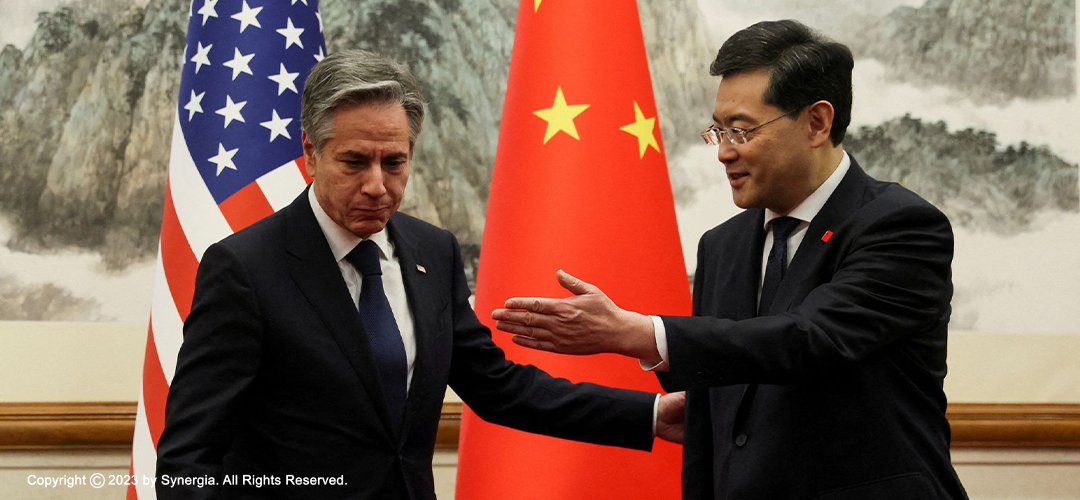

The sudden visit of the U.S. Secretary of State to Beijing and being provided unprecedented access to President Xi Jinping has caused a great deal of speculation.
What is being called the first high-level meeting between U.S. officials and their Chinese counterparts since 2018, the recent U.S. Secretary of State visit attracted a great deal of attention. Clearly, it was not a routine visit of a minister to another country- both superpowers are obviously taking a step back from their rapidly escalating war of words to try to cool down tempers and restore the geopolitical equilibrium to the extent possible.
Nothing much was expected from such a short trip as the post-meeting statements did not hint at any breakthrough during Secretary Blinken’s discussion in Beijing. Yes, the welcome accorded to him by President Xi Jinping at the Great Hall of the People, normally extended to heads of state, made for a good photo opportunity to convey the value the Chinese extended to this extension of the olive branch by Washington.
One positive fallout was an agreement between the two rivals to rein in and stabilise the intense contestation threatening to go out of control, whether over technology issues or Taiwan. Both sides and the rest of the globe, can ill afford a military contest between these superpowers.
Background
China-U.S. equation was based on both sides seeking advantages from their narrow perspectives, and hence the relationship was not destined to last. The U.S. believed that the incorporation of the massive manufacturing potential of China into the global economy would eventually make Beijing a reformed and peaceful nation with no ambitions for global primacy and, even worse, not a challenger to American hegemony. As things turned out, the U.S. was proved wrong on both accounts. As regards China, it bid its time as it gained national power and built up momentum towards its historical dream of becoming the Middle Empire or the centre of this world. To be fair to the Chinese, this ambition was neither concealed nor twisted by their leadership at any point during the nearly 75 years of the existence of the PRC under the current political system. If this trajectory of China was overlooked, advertently or inadvertently, by the West, the fault is not that of China.
Both sides ultimately benefitted from this arrangement. The Chinese received Western know-how and assistance at all kinds of levels. They were finally able to give up on sclerotic socialist doctrines, which had come to a dead end. The West was no longer the imperialist enemy but the entrepreneurial ally. Capitalism ceased to be seen as suspicious. Instead, it was regarded as necessary for China’s future. Western businesses also accessed the huge unexploited Chinese market.
This mutually beneficial relationship continued for a long time. One of the first steps taken to cement this new relationship was the establishment of official relations between Western countries led by the United States and the People’s Republic of China. There was, of course, one party that lost out in this equation. This was the tiny island of Taiwan ruled by forces opposing the Chinese Communists. They were not consulted in this radical change. The new status quo just had to be accepted by them. Previously they held the official position as the diplomatic representatives of China in the United Nations. Now this position was taken over by Beijing. A new policy of the One China Principle was established. Under this policy, as the rulers of the real China, the Communist Party had a natural claim over Taiwan. This was despite the fact that the Communists had never actually ruled this island before.
As the Chinese economy began to open up more and more, it began to develop further. The self-confidence of China slowly began to increase. It gradually started to understand the nuances of the international economic system. The Chinese wholly embraced Western business practices and culture. With the collapse of the Soviet Union, left-wing ideology officially lost its resonance. Something had to replace this ideology. This increasingly came in the form of Chinese nationalism.
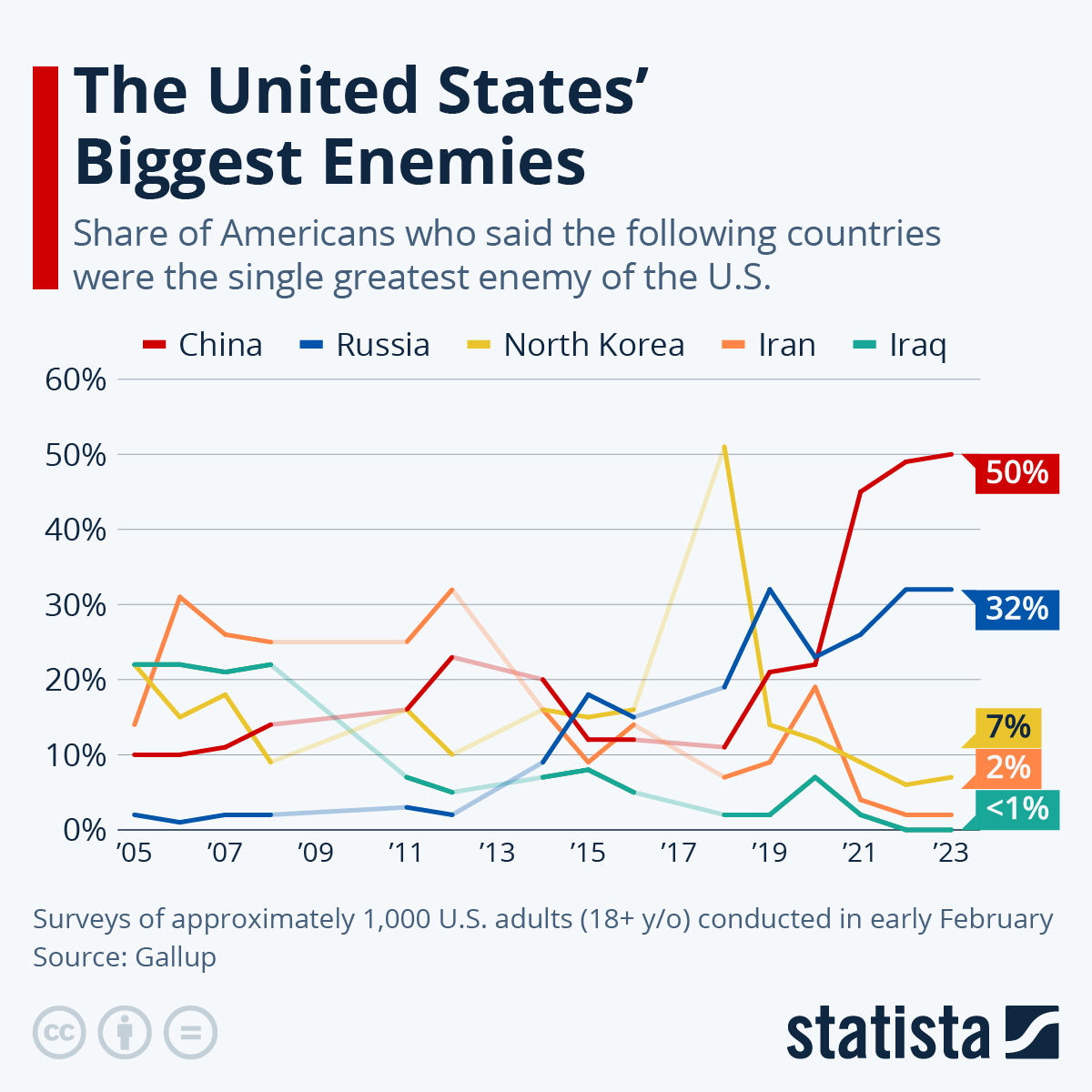
This “peaceful rise of China” continued throughout the 1990s and the first decade of the 21st century. Things began to change when Xi Jinping took power in 2013. A new, more assertive China has emerged based on “wolf-warrior” diplomacy. Beijing was ready to challenge the U.S. on Taiwan, trade and security issues. Then Russia invaded Ukraine in 2022, and things took a real downturn.
Analysis
This visit was necessary for several reasons. First, open hostility between Beijing and Washington has been steadily rising recently. Hard-liners on both sides view the other as an existential evil. Subtlety and nuance have gone out of the window. The West is increasingly trying to encircle China in more ways than one. The Chinese are trying to portray themselves as the new leaders of the non-Western world.
This is not a sustainable situation. The dangers of misunderstandings are extremely high. Both powers are nuclear. Any such miscommunications could have dangerous consequences in this regard. Other than this, being the two largest economies in the world closely intertwined, they have to live with each other.
This is not Cold War 2.0. The Chinese are not spreading some new ideology though some in the West think so. Convergences remain in some areas.
But the question remains whether either side is willing to compromise. Compromise is being seen as capitulation by both sides.
International relations theory has a clear explanation for this. This is the inevitable conflict between a rising power and a status quo power. This happened during the Second World War. Germany was the rising power, as was Imperial Japan. The other Western European colonial empires were the declining powers. It did not end well for the rising powers in this case. This is what both the U.S. and China have to keep in mind. There will be no winners if an all-out conflict breaks out. Both parties will lose.
What is required is a system of managed competition. There need not be agreement on everything. But work can still be carried out on common interests. It does not have to be a zero-sum game. There is enough room in the world for two large powers. A rising power does not necessarily have to displace its predecessor. There is scope for compromise.
The optics of this visit has become hugely significant. The U.S. Secretary of State has come calling to Beijing, not the other way round. The Chinese wanted the commerce and treasury secretaries to come first. However, the United States put its foot down on this. The commerce and treasury secretaries will visit later.
No matter what the optics, the fact remains that the Chinese economy is in dire straits. They need the United States more than ever before. Sensitive technologies like semiconductors are the key to the future. Here the U.S. is playing hardball. But the Chinese require this technology and many other similar things. And they are desperate.
Not much was expected from this visit. Still, there were some major developments. Secretary Blinken officially stated during the visit that “We do not support Taiwan’s independence. We remain opposed to any unilateral changes to the status quo by either side” This was expected. With an ongoing unresolved crisis in Ukraine, the U.S. does not want to open up a second front in Asia. The visit failed to re-open military communication between Beijing and Washington. Again, there is a reason behind this. The Americans continue to sanction Li Shangfu, the Chinese defence minister. So, despite the long discussions that have taken place during this visit, the net result has not been substantial.
Assessment
- This visit is only the first step in a long process. A basic level of mutual trust has to be established for both sides to work together.
- Common challenges like climate change remain where the U.S. and China face similar threats. China is not a totally revisionist power like Russia. It knows its limits. So a degree of compromise is possible between the two powers despite the shrill rhetoric being pandered by their respective nationalistic media.
- The rest of the world has to be cautious about aligning with either the U.S. or China in their competition, lest they, too, get pulled into a competition that no nation can afford at this juncture.