What to expect from the Summit that was awaited with much hope in Europe.
Standing up to its reputation as a historically neutral nation, it was befitting that the first significant peace summit on the Ukraine conflict should be held in Switzerland.
Of course, Russia’s absence and the lukewarm response of many major nations to the final resolution did act as a damper. Apparently, Russia was not invited, and China, with possible sympathy, decided to stay away, too.
The Russian camp questioned the credibility of Switzerland as an honest broker in the dispute. Abandoning its much-celebrated neutrality, Switzerland has openly sided with Ukraine, joining in the Western sanctions on Russia and banning overflights of Russian aircraft over its airspace.
Background
The Swiss and the Ukrainians have been closely cooperating to find a breakthrough in the ongoing impasse in the ongoing conflict. Organising a high-level summit in Switzerland appeared to be an attractive idea considering the Swiss reputation as a neutral. Bern claimed it was open to extending an invitation to Russia for the Summit, but Moscow conveyed that it was not interested. Therefore, no official invitation was sent to Russia.
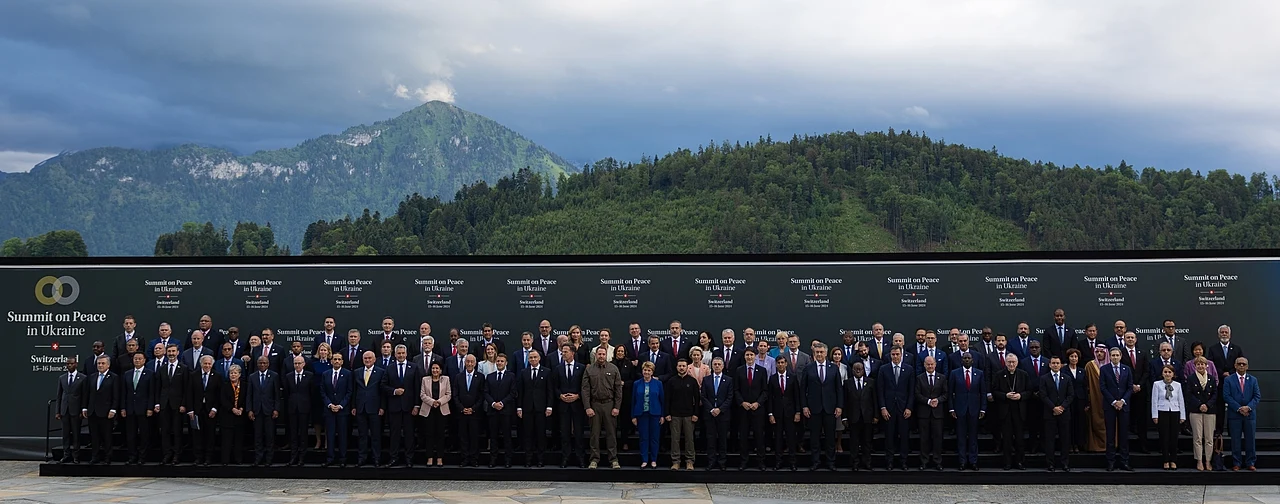
Invitations were extended to more than 160 delegations at the level of heads of state or government. The G7, G20, and many other countries are involved, including the EU, three international organisations (UN, OSCE and Council of Europe) and two religious representatives (Vatican and Ecumenical Patriarchate of Constantinople).
The two-day Summit included plenary sessions involving all heads of delegation and discussions on numerous topics focused on addressing pressing global issues, including nuclear security, food security and humanitarian issues such as the plight of prisoners of war and civilian prisoners. The discussions covered, among other things, the prevention of nuclear accidents and excess food. Humanitarian issues are also addressed, including treating prisoners of war and civilian prisoners. Many invited countries have relevant experience in these fields and could contribute to the discussions.
The final communique, signed by 82 delegates, emphasised the following: –
- Safety of nuclear installations in the war zone.
- The free flow of Ukrainian agricultural products to interested third countries to ensure “Global food security.”
- Exchange of prisoners of war and Ukrainian civilians in custody of the combatants. Special mention was made of 20,000 children that Ukraine alleges have been forcibly taken to Russia.
All prisoners must be exchanged, and all Ukrainian civilians who have been unlawfully displaced should be returned to Ukraine. In particular, the communique said, “All deported and unlawfully displaced Ukrainian children, and all other Ukrainian civilians who were unlawfully detained, must be returned to Ukraine”. According to Ukraine, 20,000 children have been taken by Russian authorities during the war.
Analysis
The crisis exposes a broader, more systemic crisis in European security. One of the most significant impacts has been the realisation of Europe’s heavy dependence on Russian energy, particularly natural gas. This dependence has limited the European Union’s ability to respond to Russia’s actions with a unified and forceful strategy. The conflict has tested the unity and strategic direction of NATO. While NATO has supported Ukraine, there has been significant debate among member states about the extent and nature of that support.
While the Summit failed to find a way to resolve the complex geopolitical tangle that the war in Ukraine has created, certain fallouts of the conflict in the region and the world could be discussed.
This first Summit on Peace in Ukraine is not to be understood as a negotiating forum but as a high-level conference that creates a jointly supported foundation for future negotiations. The Summit aims to initiate a peace process. The host and the invitees had no illusion that a solution was inconceivable without Russia’s participation. This situation is akin to building a bridge across a wide river. The initial Summit lays down the first stone, but for the bridge to be completed and serve its purpose, all pillars, including Russia, must be firmly in place.
The Summit could at least mark the beginning of this process. Several nations and organisations pledged continued support for Ukraine, encompassing economic aid, humanitarian relief, and reconstruction efforts. A significant outcome was establishing a structured dialogue process involving Ukraine and the international community. This roadmap aims to guide future negotiations and peace efforts.
The conflict has raised serious legal and humanitarian issues, including allegations of war crimes and the displacement of millions of Ukrainians. These issues challenge Europe’s human rights framework and its capacity to handle mass migration and refugee crises.
China’s absence from the Summit was not surprising. Behind a façade of neutrality, Beijing has been propping up Russia economically, if not militarily. China understands that its current economic crisis is partially related to deteriorating relations with the United States. Since the unification of Taiwan, peacefully or through the force of arms, is, in Beijing’s way of thinking, a foregone conclusion, it would expect Moscow to support it when the time comes. It is instructive to remember that the People’s Liberation Army (the largest in the world) is about to enter the fifth and final year of its major modernisation plan.
The Western media expressed disappointment that India did not sign the final statement, just like Saudi Arabia, Brazil, South Africa, Thailand, Indonesia, Mexico and the United Arab Emirates. India has maintained a notably neutral stance in the ongoing Ukraine-Russia conflict, which, in some quarters, is being dubbed “non-alignment 2.0” or multi-alignment. It acknowledges the necessity of engaging with multiple major powers to protect and promote India’s interests in a multipolar world, reflecting a pragmatic understanding of today’s global dynamics. The Indian Foreign Ministry stated that peace in Ukraine can become a reality if all stakeholders agree to a sincere and practical engagement.
Assessment
- The Peace in Ukraine Summit in Switzerland aimed to provide a platform for dialogue on ways towards a comprehensive, just and lasting peace for Ukraine based on international law and the UN Charter; promote a common understanding of a possible framework to reach this goal and jointly define a roadmap on how to involve both parties in a future peace process.
- Switzerland’s initiative highlights the dire need for balance and compassion beyond geopolitics. EU’s interest in the global south voice is received with a grain of salt because of its history of negligent attitudes towards the latter.
- While Gaza has triggered a host of conferences, mostly by Islamic countries, the Ukrainian war has failed to invoke a similar global response despite the prodding of the Global North. The international community must generate enough traction to speedily end both conflicts without making any distinction- both are equally futile and bad for humanity.