
UAVS: MILITARY BEASTS OF BURDEN
Militaries are seeking a solution to their logistic nightmares in the rapidly evolving domain of UAVs.
By Ansar H. Lone, Co-founder and CEO, COMRADO Aerospace, Program Director- UAV, ARTPARK, IISc
India has a coastline of 7500 kilometres and shares a land border of 15200 kilometres with its neighbours. The terrestrial border is unique in that it spans diverse and harsh environments– from the salt flats of Kutch to the lofty and freezing Himalayan glaciers and tops and the hot and dry Thar desert to the dense and moist forests of the Northeast.
Maintaining vigilant border surveillance under these circumstances is a challenging task that can be achieved only by putting boots on the ground, irrespective of the harsh terrain and climatic conditions. While the Indian Armed Forces can stoically face these physical hardships, they need to be logistically supported in far-flung remote locations connected by mostly poor or near-absent communication means. Continuous and uninterrupted transport of supplies is of immense importance.
Since independence, and even before that, the Indian Army has fought and lived over terrain that few can bear. For their sustenance, various logistics have been tried and tested, some successfully and others not that effectively. From human porters to camels to mules, to jeeps/ trucks/ all-terrain vehicles and snow scooters in glaciated terrain, no modern or ancient means of transportation has been ignored in seeking the most optimum means of keeping our soldiers supplied with the essentials. Helicopters and parachute drops from aircraft were perfected during World War II and continue to be used regularly by the Indian armed forces despite the prohibitive cost of the mode.
Helicopters have been found most suitable; in fact, in the Siachen Glacier, the bulk of the supplies are moved on helicopters as the terrain inhibits ground movement, but by small parties carrying very meagre loads. However, it is not economical to use helicopters for small supplies. A helicopter may be utilized for multiple small deliveries, but this translates to a higher waiting time for later deliveries.
Logistic UAVs are the Way Ahead
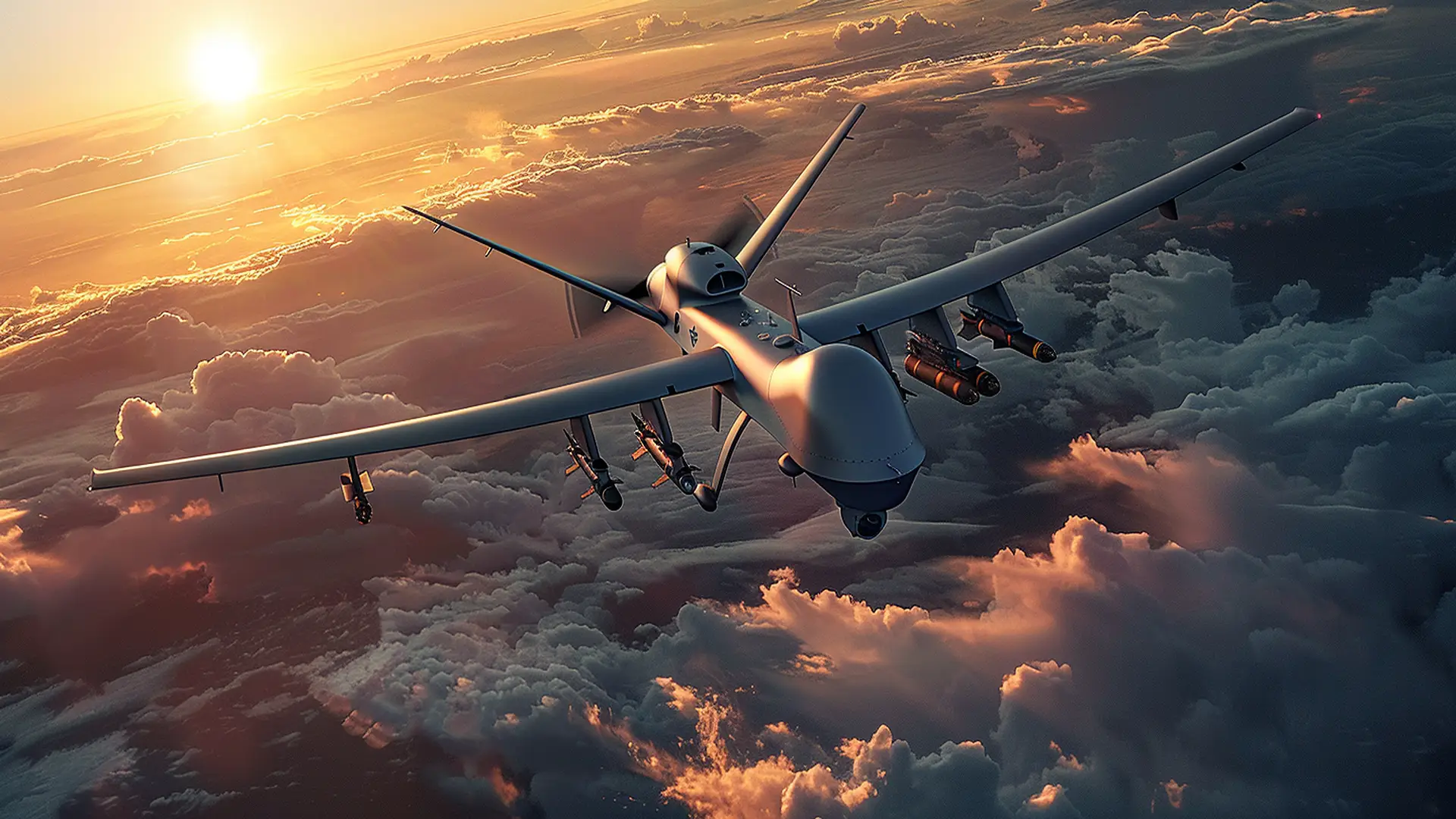
Today, militaries are seeking a solution to their logistic nightmares in technology, especially in the rapidly evolving domain of drones or UAVs.
Many advantages are associated with a military logistic supply line based on UAVs. First and foremost is the cost, which would be substantially lower than rotary/fixed-wing aircraft drops.
In harsh areas like Siachen and the Northeast, the rugged terrain restricts the number of helicopters that can be based forward for quick resupply with shorter turnaround. While forward detachments of helicopters are based for a few days in rough helipads with minimal maintenance support, the number of aircraft remains limited. The detachment must be turned over once the flying hours are quickly consumed. More UAVs can be easily based on forward jump-off points, allowing for a much faster turnaround. The platforms need no major second-line maintenance and no air crew that must return for a few weeks to their family located at a major air base in the hinterland. In situations where a UAV is lost in service due to a technical fault or enemy action, a backup UAV can always be made airborne almost immediately. A UAV, being equipment, is an expendable resource, unlike a pilot’s life and can be launched even under the most marginal and life-threatening weather conditions. The recent successful search for the crashed helicopter of the Iranian President Riasi illustrates this capability. The search was undertaken immediately by Turkish drones flying at night with thermal imaging sensors under the most severe conditions, which grounded all aircraft types and made even ground-based search parties slow in their search. Within a few hours, the drone could detect the crashed aircraft's heat signature even as the sky was thickly covered with impenetrable cloud cover.
In a heavily contested air defence environment, as existing over the Ukrainian battlespace, movement of aerial platforms has been virtually ruled out unless they fly very high above the reach of most surface-to-air missile systems. However, the skies are constantly buzzing with drones crisscrossing the battlefield carrying surveillance payloads, small bombs, and, when needed, some critical supplies. In situations like these, UAVs, which are comparatively smaller in size, can maintain the supply chain by their reduced detectability on RADAR and satellite imagery. Although heavy attrition can be expected as UAVs are slow-moving targets, taking them down is relatively easy if detected, but their lower cost enables larger numbers to be fielded. However, shooting a UAV with a guided missile itself creates an asymmetry in warfare, with UAVs costing way less than a manned aircraft and, most of the time, less than a missile itself. If used in swarms, their chances of getting through even the densest air defences become much better.
Challenges of Terrain
Although all geographies have their own logistics challenges, cargo transport through UAVs is most complicatedin high-altitude areas due to the terrain, low temperature, low air density, and dynamic winds.
In hilly and mountainous regions, the wind sometimes blows across the ridgeline. This creates an updraft on the windward side and a downdraft on the leeward side. When a UAV travels from an updraft to a downdraft region, it may become vulnerable to crash due to the terrain, resulting in high-cost equipment loss.
The low temperatures in such areas adversely affect the battery-operated UAVs, reducing the usable battery energy and sometimes losing power altogether. Also, the low density means that the UAV consumes more power to lift. This can be taken care of by increasing the size of propellers when it comes to multi-copters and increasing the wing area in fixed-wing UAVs. But doing so makes such UAVs very vulnerable to wind. Large propellers mean air is pushed at lower speeds, and large wings mean low forward velocity. A small wind disturbance can cause such UAVs to lose lift very fast. Low air density also means less oxygen, which causes an airbreathing engine to suffocate and produce low power.
The terrain also complicates maintaining communication links with the UAV. However, the use of intermediate relay UAVs and SATCOM is promising.Thus, it becomes very important to design a UAV considering all these factors.
Multi-copter versus Fixed Wing
Multi-copter UAVs do not require an established infrastructure to operate, e.g., a runway. Fixed-wing UAVs offer better efficiency, yielding to long range, endurance, and high speed, but are infrastructure-dependent. Also, when it comes to resilience towards wind, fixed-wing UAVs are more capable than multi-copters. Another category is fixed-wing VTOL UAVs; these have the vertical take–off and landing capability of multi-copters and the efficiency of fixed-wing UAVs.
Multi-copters and fixed-wing UAVs have benefits. For example, multi-copters, mainly electric, can be deployed faster and are practical for transporting light cargo to very short distances (last-mile logistics), say up to 5 to 10 Kilograms. Fixed-wing UAVs can be used to transport larger cargo (middle-mile logistics) with very little energy required, whether engine-driven or battery-operated.
As mentioned in the earlier paragraph, batteries' usable energy is reduced at low temperatures. Also, batteries as a technology have very low energy content for the same weight (low energy density) compared to IC engines. In battery-driven UAVs, the battery itself is significantly heavy, eating up the payload capacity yet yielding less range and endurance.
Fixed-wing VTOL hybrid UAVs are the most practical solution for long-range and heavy payload delivery in the last mile. The most common configuration is VTOL powered through the battery, and an IC engine/s supports the cruise. Such vehicles have the potential to transport cargo for hundreds of kilometres.Apart from practicality and performance, such UAVs can be designed to have inbuilt redundancies. For example, if the control surfaces fail, the VTOL rotors can assist in maintaining the attitude; if VTOL rotors or the batteries fail, the engine can still bring the UAV to a place where it can be landed conventionally; if the engine fails, the VTOL system can land it safely, if the entire powerplant fails; there could still be a chance to glide to a place where it can be landed conventionally. These are just a few examples; the potential is immense; these UAVs are complicated to design and perfect; however, the science is there to engineer such systems. All it takes is to relentlessly work on bringing in RELIABILITY, RESILIENCE, SAFETY, SECURITY, and PERFORMANCE.
The Future
The future of logistics in high-altitude areas is the use of UAVs. They will ensure timely delivery of food, ammunition, medical and other supplies near and beyond the enemy lines. They will also be used to transport wounded soldiers. An autonomous swarm of such UAVs will be used to transport large cargo in a highly coordinated manner. Moreover, in the future, to avoid detectability, narrower paths such as caves, tunnels, and gorges will be navigated by autonomous UAVs. The UAVs will have fully autonomous advanced capabilities, with better obstacle detection and avoidance features that are unheard of.