
TWO ENDS OF THE SPECTRUM
The challenges of high tech versus low tech.
|
This is a conversation conducted in Synergia Foundation between Lt Gen Amit Sharma, former Commander in Chief of Indian Strategic Forces Command and Mr Doron Avital, former commander of Sayeret Matkal, the elite Israeli reconnaissance unit. The Moderator was Mr John Reed, Financial Times's South Asia bureau chief, |
Qs John Reed
The extent to which the two ends of the spectrum are now converging was vividly seen in the two biggest ongoing wars-the Russia-Ukraine war and the Gaza conflict.
On October 7th, we saw an armed guerrilla force overpower and temporarily incapacitate one of the world's most competent and high-tech-reliant armies. This is the first time since 1948 that Israeli territory was temporarily occupied for several days, where hundreds of thousands of people were displaced from southern and northern Israel. At least 1,400 Israelis were killed, and about 250 more Israelis kidnapped into Gaza.
What lessons are Israelis drawing from this calamity about Israel's preparedness for low-tech and asymmetrical warfare? Israel has been very good at high-tech, but what needs to change now?
Doron Avital
This is a setback unmatched in our history. There are many lessons, of course, and once we look back, necessity is written on the wall, and everything is clear, but how come we ended in this way? And I want to start with a story from my soldiers' times. RPG, the rocket launcher, is a symbol of every terrorist, along with the Kalashnikov assault rifle. But it was also a weapon in the Israeli paratroopers' brigade. The RPG is aimed through a telescope, which helps compute the range and lead of the target, etc.- it was the most sophisticated part of the RPG. But before we went into battle, a seasoned sergeant would tell us to remember the good old iron aiming sight because once in the field, after the first tumble, the telescope would be hopelessly misaligned and of little use. This is exactly what happened in the digital revolution when we outsourced so many of our capabilities to the digital machinery and sensors that we lost the iron aiming sights!
General Yossi Pellet, an old veteran, once told me, "When in service, every day in the morning, I would wake up at five, call my officers and check what happened during the night and what they saw with their eyes?" I think we were taken astray, in some kind of frame, by outsourcing our capabilities to modern technology, and we felt that our passive defence mechanisms like the Iron Dome and the sensors tightly protected us. We were so arrogant in our feeling that we had an airtight control on Gaza. So, we lost sight of what was obvious, emerging underneath our eyes, and this is a failure unmatched. The sensors all failed, shot out in the first hours of the attack.
Last year, we were engaged in the West Bank, and we were obsessed with Iran and its nuclear programme.
Qs John Reed
Is it not also true that Israelis were telling themselves that they would solve the Gaza issue and the Hamas issue through technology, that they had this high-tech barrier that no one could penetrate into Israel?
Doron Avital
After the Cold War, there was a sentiment of risk aversion in the West, so passive defensive measures like the Iron Dome were adopted, and fences were put up to protect the civilian population. Gradually, the propensity to take risks declines. In 2018, there was a botched-up intelligence operation in Gaza, which further increased the aversion to risk-taking. This resulted in a regressive move to replace dynamic risk-taking, the hallmark of Israeli intelligence-gathering operations, with airtight defence mechanisms, outsourcing our confidence to this method and failing miserably in the bargain.
Qs: John Reed
Does the military would have to reassess how it does intelligence now? Is there too much reliance on technology and too little on human intelligence?
Lt Gen Amit Sharma
Yes, in general, technology should be a decision-making aid. And if you bank totally on technology, you can go wrong. I think the human must have the last word, and the final analysis has to be the human's responsibility and job.
Doron Avital
The digital revolution is also a translation revolution. We have to translate old habits, values, sentiments, and principles to the new technology. And in this translation process, sometimes things are lost.
I always like to give a good example from Napoleon in the Battle of Waterloo. Napoleon had to delay the attack because of night rain and wanted to separate Wellington and Field Marshal Gebhard von Blücher so that he could defeat each in detail. He sent one of his finest generals, Emmanuel de Grouchy, to block Blucher, but Blucher could successfully bypass him. On 17 June, Grouchy was unable to close with the Prussians. Despite hearing the cannon sound from the nearby Battle of Waterloo, he decided to follow the Prussians along the route literally specified in his orders, issued by Napoleon via Marshal Soult. At the same time, the Prussian and British-Dutch armies united to crush Napoleon. Grouchy did not rush towards the sound of the guns, a common principle every military man knows. So, when you translate it to the digital world, you might lose those common principles, those iron aiming sights like in the RPG.
Qs:John Reed
Was there too much high tech, too much electronic noise that your intelligence people were getting out of Gaza and out of Palestinian society, and you missed the more basic information that would have warned you? There should have been so many warning signs.
Doron Avital
Warning signshave to be interpreted in the right fashion and with the correct frame of mind. The earlier experiences of Gaza were mostly ‘shoot and scoot' operations by Hamas. They would fire some missiles; we did some incursions, and it was over. The whole Israeli mindset for the last ten years and more was that Gaza was locked in.
Qs John Reed
There was no scenario where they would invade Israel. There was no scenario where they would come in en masse.
Doron Avital
There was a scenario concerning the northern border with Hezbollah. We were thinking Hezbollah was capable of doing it. We didn't think Hamas was capable of doing it. It was purely overconfidence. You don't interpret the signals right when the frame of mind is wrong.
Qs John Reed
How does it look from an Indian perspective? When you reflect on this, do you think India has the right balance between tech-based intelligence and human beings?
Lt Gen Sharma
In this case, possibly it was overconfidence. Everybody, the entire world, thought the electronic fence that Israel has was impenetrable. The Iron Dome, they said, was the best system that we had. The Israeli army was the ultimate as far as conventional war went. And the Mossad was again the best in the world. But you cannot bank purely on machines and AI and things like this.
Humans have to make the final decision. I think humans have to take responsibility. It's finally the man behind the gun.
Doron Avital
The man behind the gun, exactly. And the basic principles of warfare that you should never lose sight ofregarding how you go about intelligence gathering. But it also has to do, I think, with the weight you give to intel signals.
I would like to refer to another famous example from Operation Market Garden during the closing stages of World War II. Gen Montgomery was planning to land two airborne divisions in Arnhem where, unknown to the allies, a German panzer division was training. The Dutch resistance could smuggle a few pictures of German panzers concealed under trees to the Allied intelligence. The head of allied intelligence disregarded this input, saying, "So you want me to discount the thousands of pictures I have for my surveillance aircraft against these 2-3 stupid pictures!” Rest is history.
Qs John Reed
Israel is good with big data, and I thought that big data was good at picking out signals from a million, especially ominous things. Shouldn't the big data have found this?
Doron Avital
You go to data with some frame of mind and paradigm; then, you fit the data inside. Once you don't have the right frame of mind, it's like slipping on a banana peel in the park. You essentially don't know what you're looking for and don't interpret the signal right.
There is also some political background. There has been an ongoing political upheaval in Israel for the last year or more. The strategic direction that the country took in the end blinded us to see what was before our eyes. In Hebrew, you say, the enemy in your eye.And you lost the enemy that was in front of you because your mind was set on some remote nuclear Iran deal, whatever, and then the upheaval in Israel.
Qs John Reed
Is this shock going to change the narrative Israelis have about themselves and their military?
Doron Avital
I think it must. You must recheckyourself, your self-image, who you are, your capabilities, who your enemy is, and who your allies are. I think we forgot who are our allies-the U.S., Europe, Egypt, Jordan and the Palestinian Authority? Bibi Netanyahu is undermining the PA all the time and promoting, in some sense, Hamas as an enemy that he uses as an excuse for not making any progress with the Palestinians.
Qs John Reed
Netanyahu has promised to conduct a commission of enquiry when it's all over. He's expressed no remorse; he's accepted no responsibility for anything that happened. But do you think Israel can do it, or he can lead an effective commission of inquiry where you get to the bottom of everything that went wrong and pinpoint responsibility?
Doron Avital
The commission of inquiry would be independent.The question is whether the scope would allow the Commission of Inquiry to go into the responsibility of the political echelon. But I think an event of this magnitude cannot stop at the height of the generals. This is a turning point in the life of Israel, and it would have far-reaching political consequences.
Qs John Reed
In the Indian context, Galwan is an example of very low-tech warfare, a much smaller-scale conflict, with unarmed border forces attacking each other with clubs and improvised machetes. What did you learn from this conflict? And was India good at fighting in this low-tech theatre?
Lt Gen Sharma
This needs to be viewed in the correct perspective.
India and China have had border problems since the time of our independence. In 1996, it was decided that both armies would not use weapons or military force against each other on the Line of Actual Control. The clash occurred not between border guards but between regular forces, the Indian army and the Chinese army. Since the treaty prohibited firearms, improvised weapons were only used by both sides.
This was the first time two modern armies fought using this medieval method. It happened at night on a slope, and there were a lot of casualties. Some were killed in the scuffle. Some fell down the steep hillside into an extremely cold river. The Indians suffered about 20 killed, including the commanding officer.The Chinese figures are not known, but an American news outletput the figure first around 100 and later 38 (as reported by the Australian website the Klaxon in 2022. Official Chinese sources, after a long silence, claimed four fatalities, including one commanding officer)
This is a one-in-a-million chance that such a thing has happened. And I don't think such a thing can happen again because even China has realized that you can't get to fisticuff as armies at this level. As per the information on the Internet, the orders for not using weapons have stayed the same because we want the situation to stay manageable beyond a point. Non-lethal weapons like electric tasers, etc., are being procured by both sides.
India and China have had problems, and the problems continue. For us, we are fighting on our borders for the territorial integrity of our own country. And in our case, victory is measured in how much you lose and how much you gain of territory.
China, we accept as far ahead in technology, in terms of numbers of the armed forces and possibly a much stronger army. But India is confident that we are strong on our borders because we are fighting in the mountains, which favour the defenders. India is not an expansionist power; we only fight for our defence. We are very confident that with what we have today and what we are getting shortly, we can defend our own frontiers.
Qs John Reed
Why do you think this, something like Galwan, couldn’t happen again or probably won’t happen again?
Lt Gen Sharma
Border transgressions cannot be stopped. It's been happening for a long time. Talks have been on. I think 20 rounds have been held. Both sides are very careful, because it's happened once, and it doesn't behove of two modern armies to get into a fight like the Stone Age.
Qs John Reed
How does the theme of 'Two Ends of a Spectrum' fit in the context of Ukraine? I covered the first two months of the war in Ukraine last year. On the one hand, it was quite high-tech, involving heavy barrages of missiles from Russia, deployment of air defence by Ukraine, and a threat of use of nuclear arms by Russia, but also a lot of much lower tech stuff, especially on the Ukrainian side and very improvised, use of drones, use of naval commandos to go into Crimea more recently. Is this a high-tech war or a low-tech war?
Doron Avital
It's a landscape with an aerial dimension, cyber dimension, and so many dimensions that calculating them would be a real challenge. I try to translate the old principles of war into the new dynamics of the new landscape. In the army, whatever technology is, the basic thing is the map, the topography, the field, and the need to command the field. If you don't have this basic instinct, you won't succeed in war; no new landscape of war will change this reality. High tech is fast becoming a double-edged sword because modern weapons like drones and ATGM have become so cheap anyone can purchase them.
Lt Gen Sharma
There are two sides to the entire thing. One is the conventional side, which is ongoing, and the other is the nuclear flexing of muscles. Before the actual fighting started, a lot of high-tech stuff happened- AI, cyber warfare, EW and Information warfare. When the offensive started, we saw vast columns of tanks and armoured vehicles converging on Kyiv, ignoring the basic principles of mobile warfare. This was when the high-tech element was introduced, mainly by Ukraine in terms of drones, ATGMs, etc., which broke the momentum of the Russian onslaught.
Qs John Reed
Have these cheap drones become game changers?
LtGen Sharma
A$400 drone was destroying a million-dollar tank; some would call it the death knell of tanks. No, it's not the death knell of tanks. The tanks must be used as a weapons system as they have been designed to be used, with Infantry support as all arms integrated battle groups. Even when the Ukrainians switched to the counter-offensive, they also displayed the same shortcomings in handling advanced Western armoured fighting vehicles. It was now the turn of the Russians to pick them up like sitting ducks.
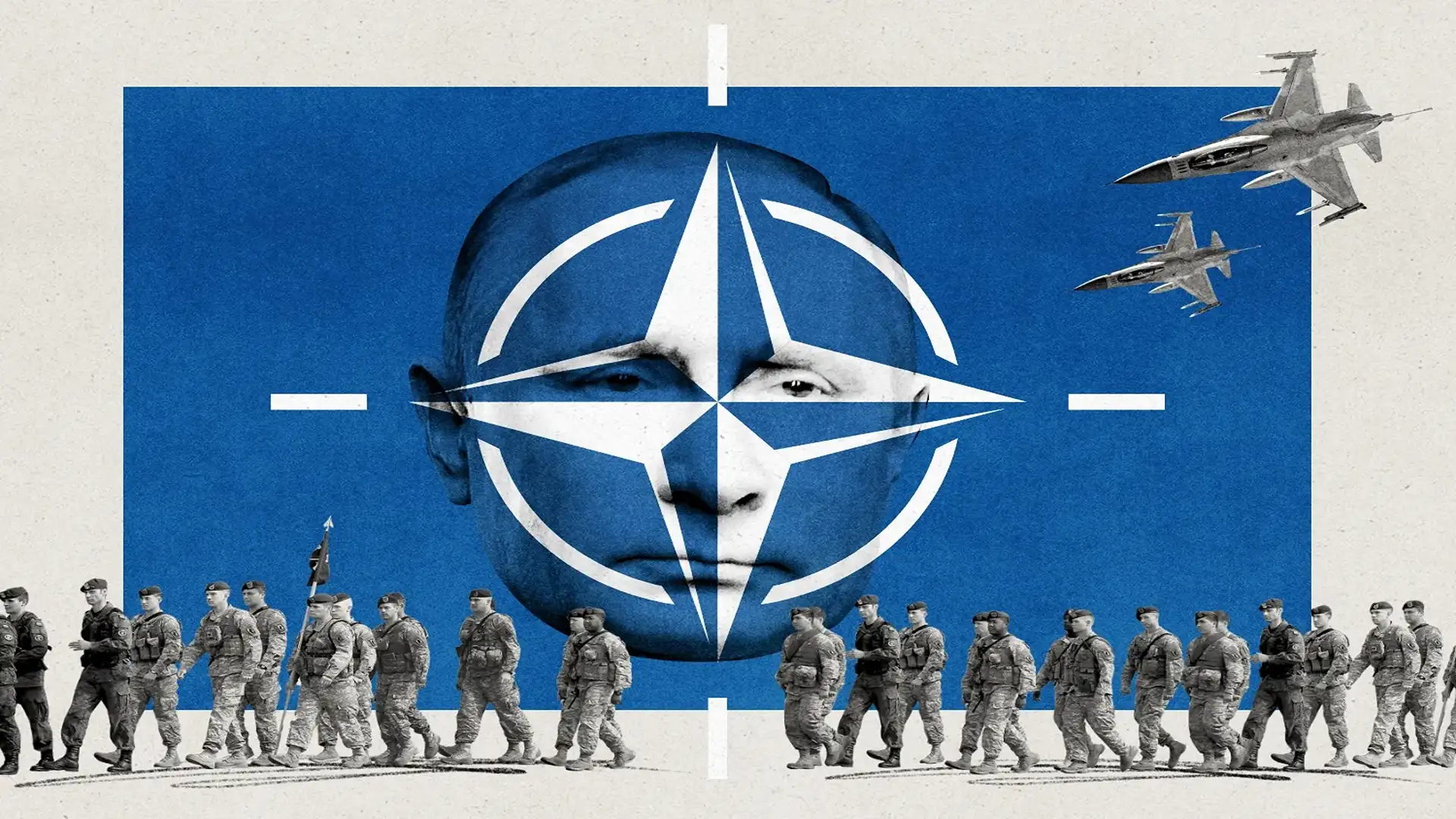
The nuclear dimension of the Ukraine war presents an interesting study of this theme of two ends of a spectrum. Early in the conflict, they flexed their nuclear muscles about three or four times. Firstly, they started flexing their muscles just before the war started as a signal to NATO to keep their boots off the ground in Ukraine. Later, as tensions rose, Russia moved tactical nuclear weapons into Belarus.
The bigger question that arises is that if Ukraine had nuclear weapons, which they had till 1994, would Russia have invaded at all? The answer is possibly no. We have countries like Japan and South Korea who are facing nuclear adversaries; what do they do? There has been talk in Japan of getting the Americans back with nuclear weapons on the soil. 73 per cent of South Koreans voted in favour of nuclear weapons in a poll, either their own or American ones.