
TURNING A BLIND EYE OCEAN WARDS?
The United Nations needs to shed its sea blindness.
By Rear Admiral Monty Khanna (Retd), former Assistant Military Adviser at the NSCS
Crime at sea mirrors what happens on land in most of its manifestations. It, however, differs in one fundamental way –it takes place in the global commons, thereby making the issue of jurisdiction complex. To make matters worse, ships today are a microcosm of a truly interconnected world, with them being registered in one nation, flagged in second, insured in a third, underwritten in a fourth, and with crew and cargo from multiple countries. Criminals have historically exploited theselacunae, carefully calibrating their activities to a level that has been below the threshold ofcompelling nations to evolve a comprehensive response.
However, with the rapidly expanding overlay of terrorism and the ability of activities such as gun running, human trafficking, drug smuggling and robbery at sea to fund it, there is a growing consensus to curb crime at sea.
Rising above Geopolitics
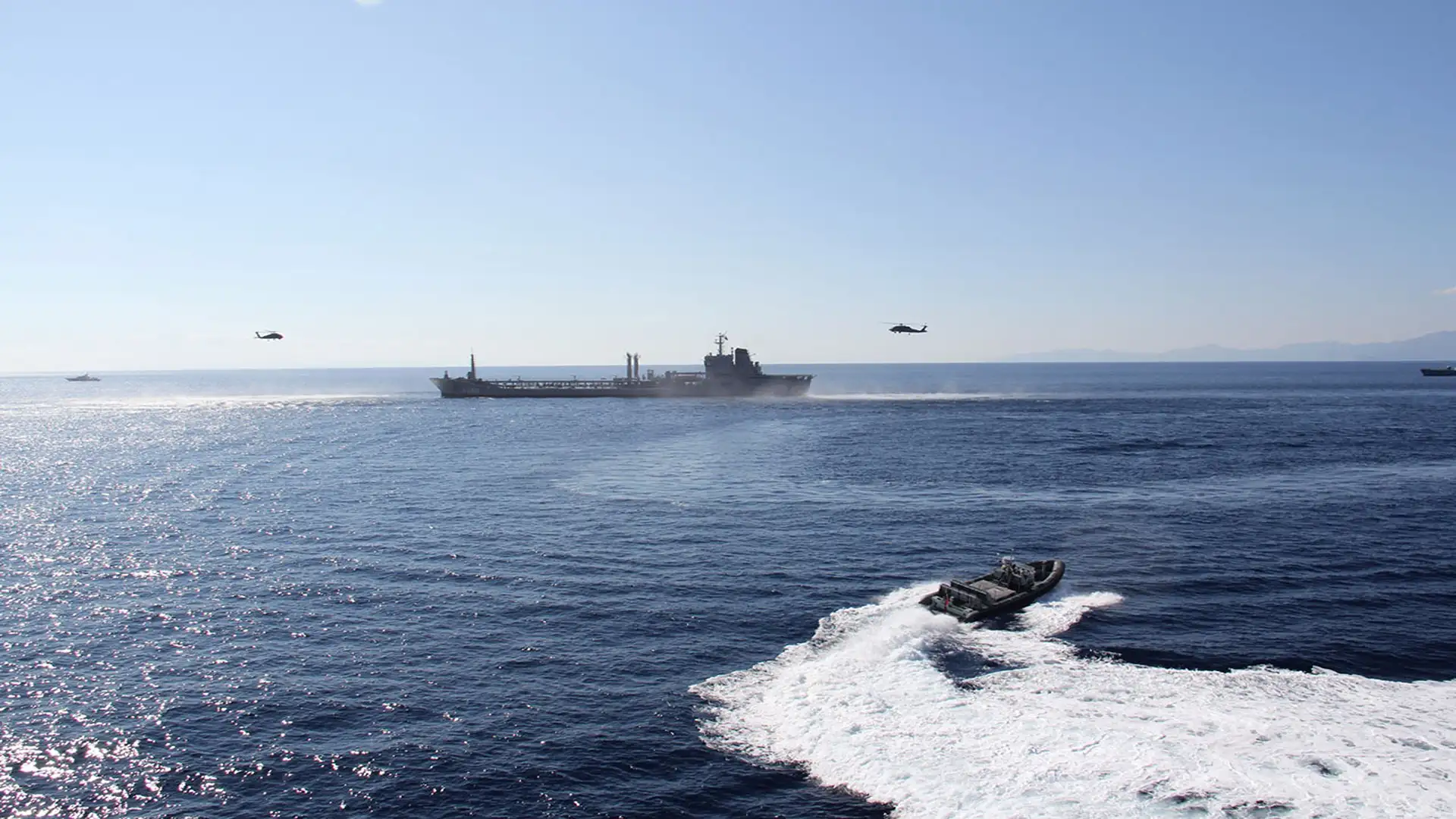
The fundamental issue in devising an effective response mechanism is the challenge of decoupling security at sea from geopolitics. A telling example is how the world responded to the piracy situation off the Horn of Africa. In its infancy, it was viewed as a merchant mariner's problem with no requirement for naval intervention. However, given that the business was highly lucrative, it soon escalated, forcing a response from flagship operators. Grey hulls, therefore, arrived on the scene, escorting ships that flew their nation’s flag. Soon, three groupings of effort emerged: the Combined Maritime Forces (CMF) run ‘Task Force 151’, the European Union Naval Forces (EUNAVFOR) administered ‘Op Atlanta’ and agrouping under NATO Standing Forces. In addition, several nations, including India and China, continued to function as independent operators.
Realising that a coordinating mechanism was essential to optimise the deployment of the large number of assets in the area, the Bahrain–based SHared Awareness and DEconfliction (SHADE) mechanism came into being. While this dealt primarily with operational issues, on the policy side, a United Nations-sponsored organisation called the Contact Group on Piracy off the Coast of Somalia (CGPCS)was created.
Though a robust response emerged, it was slow to take shape. This slackness allowed private operators to fill the gap by providing a bouquet of services pertaining to vessel protection. While solving some problems, the presence of armed guards and the consequential ‘floating armouries’ created fresh ones. Insurance companies indemnified the increased risk by drawing out a hugely expensive High-Risk Area (HRA) where exorbitant premiums were charged, the cost of which was largely borne by the littoral nations in the region. The profitability of doing so wasmade apparent by the fact that even though the security situation dramatically improved a few years later, the HRA was scaled back much later, that too after a concerted effort by impacted nations.
With the re-emergence of piracy in recent times coupled with a much more dangerous threat posed to merchant shipping due to indiscriminate attacks by Houthis operating from Yemen, we are looking at a replay of events that occurred a decade ago. While standing mechanisms such as the CMF may have shortened the response time, the coordinated deployment and sustenance of assets and their rules of engagement remain a challenge.
Policing Global Commons
A primary reason for the inefficiency of coordinated responses to maritime security issues at sea is that while we operate in the global commons, we do not have a global police force. The force that responds to identified crises invariably emerges in the form of grey hulls, flying national flagsunder national command with national rules of engagement.Asnational considerations ride high, the geopolitical baggage carried by the assets deployed raises suspicion amongst the regional actors. Thus, while on the one hand, such forces do contribute towards maritime security stability, often, on the other, they create geopolitical instability.
Where, then, lies the solution? We need to depoliticise maritime security tasking and decouple it from geopolitics. The best way to do so is by creating an apolitical neutral force that could rapidly restore good order at sea should there be a disruption. As the only institution with the capacity and capability to undertake such a role is the United Nations, consideration must be given to tasking it with such responsibilities.
What would be the contours of a UN-led initiative for maritime security? It would essentially require the setting up of a standing Maritime Security Headquarters with a lean multi-national staff whose task would be to garner and analyse information about maritime security in the global commons with the purpose of early identification of emergent issues. Once a potential issue has been identified as one that merits addressing, the planning process for intervention could commence. A protocol for approval of such an activity, either from the Security Council or a subordinate U.N. body, will need to be established.
Insofar as assets for intervention are concerned, while a standing U.N. Maritime Task Force may have some advantages, given the tyranny of distance associated with the movement of ships, a better approach would be to seek attachment of ships from regional actors. Ships seconded to the U.N.-mandated intervention force would be required to fly the blue ensign and be under the Command and Control of the United Nations, akin to how peacekeeping forces are tasked and administered. An element from the maritime security HQ could best execute the on-site command. Nations will need to be compensated for contributing assets and personnel as per established norms. With time, a comprehensive Standard Operating Procedure could be drawn up, allowing assets to seamlessly transition from 'national' to 'U.N.' tasking.
In all fairness, the U.N. is not new to this role. We already have a model in the United Nations Interim Forces in Lebanon (UNIFIL) mission, the Maritime Task Force, which was set up in 2006 and has been functioning efficiently ever since. The task force is ably led by a UN-appointed Task Force Commander, with ships being provided by various nations, all of which fly the U.N. flag. This model will need to be tweaked per the earlier recommendations to facilitate agile plug-and-play operations in diverse areas.
India’s Role
India and the Indian Navy are already strong contributors in this field. Our commitment towards capacity building and capability enhancement in the region is robust. Our efforts cover a wide swath of activities that include providing material assistance in terms of assets, support for their sustenance, meeting training requirements, providing consultancy where sought, hydrographic support, assistance in the generation of MDA, undertaking coordinated patrols and assistance in the execution of policing functions at sea, amongst others. In addition, we have been strong supporters of collective security, as demonstrated by our contribution to relevant initiatives under the frameworks of IONS, IORA, BIMSTEC, and the Colombo Security Conclave. We would, therefore, be well placed to take the lead in advocating for the global community of seafaring nations to adopt a U.N.-led approach to seek innovative solutions to collective maritime security challenges.
Conclusion
Creating strong maritime security structures inside the United Nations would reverse the trend of growing geopolitical instability at sea. It would allow maritime forces to work together, thereby building upon interoperability under a broad framework of universal trust and collective good.
Key Takeaways
Adopting a collective security approach of the type mentioned above would accrue the undermentioned advantages: –
Firstly
, it would facilitate e
ffective and equitable policing of the
high seas (global
commons
)
.
Secondly
,
when asked for,
the
policing of waters
under national jurisdiction (
C
ontiguous zone
/EEZ
)
would become far
less contentious
if it were to be conducted by
ships
operating under the
blue ensign.
Thirdly
, it would promote e
ffective plug-and-play operations as detailed SOPs would promulgate guidelines for communication and data transfer procedures, underway replenishment, visit and board operations, cross-deck landings by helicopters
,
etc.
Fourthly
, responses will be calibrated with far more economy of effort as
they will be devoid of
geopolitical considerations
that, more often than not, tend to become competitive
.
Fifthly
, as the response would largely emerge from regional nations,
cultural nuances and other
underlying
factors would be better understood.
Lastly, it would promote optimal solutions to
emergent challenges such as sea
water rise, ocean acidification and overfishing as
willingness
to acquire and share data
and implement mitigation measures
would be much greater if the agency involved in doing so were to be one
devoid of national biases.