
THE YEAR THAT WAS
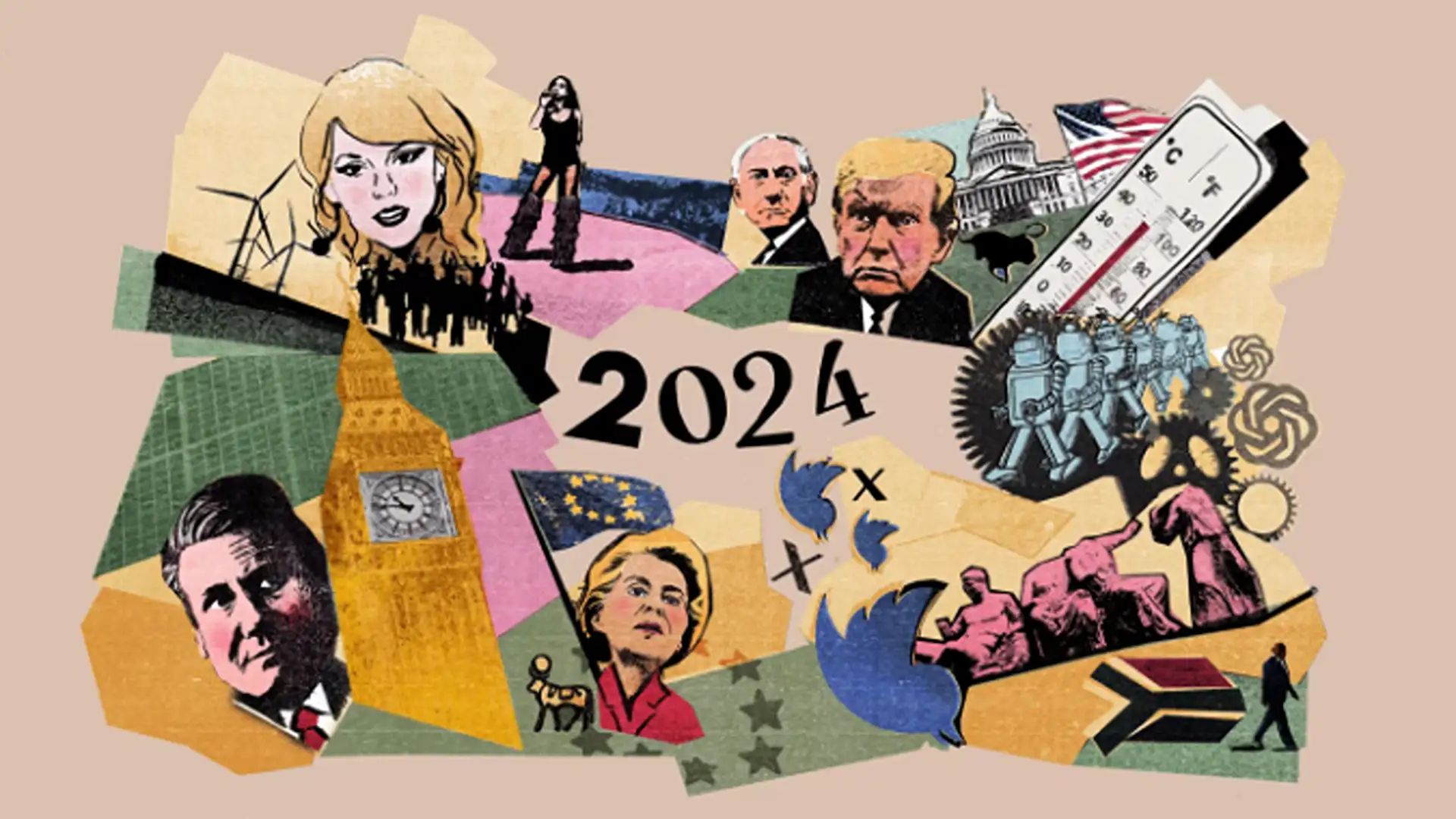
Undoubtedly, 2024 has been a page-turner: a Year of Elections marking the triumphant return of Trump and unendingconflicts pushing humanity closer to the nuclear midnight.
When history is being written, and read, what will 2024 be remembered for: definitely for the Trump 2.0, Israeli intelligence feats in Lebanon and Iran, and the sheer scale of destruction in Gaza. Or will we bemoan the paltry global contribution to halt global warming or the rising number of unemployed all over the world despite rising GDP growth rates?
As years go, 2024, too has been one with its share of ups and downs, hits and misses and moments of absolute joy interjected by sheer horror and despondency.
Let’s take a quick ride through the last twelve months.
Inching towards Global War?
The fighting in Ukraine and Gaza continued unabated and, in fact, increased in scope and intensity; Lebanon became the new front.
After the humility of October 7th, the much vaunted tactical and intelligence brilliance of Israel's secret forces received some burnishing with their remarkable scorings against their arch-enemies Iran and Hezbollah, surgically removing top echelon commanders 'safely' ensconced in their strongholds. No better feat of military excellence could have been achieved by any other state. However, it put the whole world teetering on the edge of a dark and dangerous precipice as a wider regional/ global war loomed. Even now, the fears have not totally vanished.
Gaza continued to occupy centre space, whether live broadcasting mini drone footage capturing the dying moments of Hamas leader Yahya Sinwar, the architect of the October 7th massacre, slumped in a dust-covered chair in a destroyed Gaza City apartment or drone shots of a city landscape that represents Berlin in 1945.
Having destroyed the bulk of Hamas and Hezbollah's military capacity and infrastructure, the IDF changed gears to go after its enemies' finances and support infrastructure. The kinetic attacks on banks in Beirut, known to be channels for money laundry for terrorist organisations, were shocked to find themselves being targeted by smart munitions.
The world held its breath when Iran sent hundreds of ballistic missiles screaming into Israel, crossing a redline that had never been breached before. There could be no greater provocation for a wider Middle East conflagration than this. But surprisingly, the tension quickly declined like a deflated balloon as both sides made perfunctory symbolic offensive moves, more to save face than to inflict any real pain. So far, so good!
|
Why Israel and Iran did not Go to War? “Basically, it is an aerial war we are talking about. Right now, as the war is emerging, it seems clear that Israel has the upper hand, but its strategy seems to be changing. Till now, the basic element of Israeli strategy, the way I see it and some other analysts have seen it, is the concept of what is called escalation dominance: however much the war begins to escalate, you remain the dominant force in either choosing to escalate the level to which you escalate, or you choose not to. It has shifted away from this to some extent to classical deterrence. By deterrence in this context, I mean it still has, of course, the sheer technological and military advantage. Still, it is interpreting deterrence right now as the lack of response from Iran, which can be shown as an Israeli victory and many analysts would say probably it is given the state of Iran and its inability to respond or failure to respond so far." Ambassador Ranjan Mathai, former Indian foreign secretary and India's Ambassador to France, the UK, Israel, and Qatar. |
A Year of Elections
As the year 2024 dawned, a UNDP article postulated that it was the biggest election year in human history. Half of the world’s population – some 3.7 billion people – would have the opportunity to go to the polls in 72 countries. Many will be voting for the first time. This phenomenon would be experienced, for good or bad, from South Africa to the South Pacific, Europe and the Americas, and the stakes were immense. Voters would have their say in local and national elections, determining the world's political, social and economic landscape for years to come. Yet, UNDP cautioned that the billions of people voting live in a vastly unequal world, and trust in government falls when inequality rises.One in two people feel they are not in control of their lives, and two out of three don't think their voices are heard in the political system. Not only are governments and institutions failing to meet people's expectations for a better life – but distrust is also fuelled by disinformation, extreme polarisation and shrinking civic spaces. These are truly prophetic words because this is mostly what was experienced.
Of course, the focus the whole year remained sharply on the U.S. as a blundering and senile incumbent president stubbornly clutched his nomination till unseated by his debate performance that shocked the world. The Indian-African-American Vice President was thrown into the ring at the last moment. She fought bravely but in vain; the Trump juggernaut was too overwhelming to be stopped.This brings the spotlight on issues like abortion rights, the economy, democracy and immigration. The world can expect a more aggressive “America First” policy with reduced overseas spending, possible aid cuts, and a more protectionist approach. NATO nations are concerned that US defence spending could fall, weakening the defence alliance. A Trump presidency is also likely to mean less US support for Ukraine. We have interesting days ahead!
India also saw critical states coming up for legislative council elections, producing mixed results for both sides, the only winner being the Indian voter. The good news is that, even if the right-wing rose in Europe and Trump is all set to return to the White House, democracy prevailed, all its pimples notwithstanding.
Global Contestations
Meanwhile, multipolarity seems to be in style as “swing states” like India, Turkey and Saudi Arabia gain more weightage as middle powers determined to not align with any particular side in polarised situations like the US-China rivalry.Regional blocs like BRICS stand to gain more influence.
Trump threatens to upend the global security equilibria if he seriously pursues his long-stated intention of making European nations stand up and pay for their security. When asked if he would support a country attacked by Russia if it didn't meet NATO spending targets, Trump replied, "No, I would not protect you. In fact, I would encourage them [Russia] to do whatever the hell they want.” The message could not have been more starker. Will Russia, and China, take a cue from this? Unlikely in the short term, occupied as both are with their own problems and headaches- a mix of war, internal dissensions and, most importantly, falling economic growth.
Taiwan Straits maintained an uneasy calm, with the PLA occasionally rattling the sabre to keep its estranged cousin on its toes. However, neither side risked going up the escalatory ladder, even though China ended the year with a massive three-dimension military exercise that rehearsed the blockade of the Island nation. Was it a trailer for an impending, much bigger and dangerous act?
It’s the Money, Stupid
A phrase made famous by James Carville in 1992, when he was advising Bill Clinton in his successful run for the White House, reflects a universal truth with applicability in perpetuity.
The Red Sea crisis impacted economies across the globe as the critical shipping lane was held hostage by the Houthis, claiming solidarity with Palestine. Shipping companies rerouted their vessels and faced longer transits and higher transport costs.
Meanwhile, China continued to drive the global green transition, and the EU imposed higher tariffs on Chinese electronic vehicles (EVs). The move marked the bloc's determination to safeguard its domestic EV market, even if it meant making low-cost green goods more expensive. Having witnessed its solar panel industry being decimated by Chinese exports, the EU was keen to get it right this time.
India’s rising self-employment raised questions about the availability of formal jobs as individuals were compelled to take to self-employment.
Japan’s central bank raised interest rates for the first time in 17 years, raising hopes that the economy would pivot towards normal growth. However, rising inflation meant that real wages did not rise in tandem with nominal wages.
A Worsening Climate Situation
2024 surpassed 2023's record scorching temperatures and depicted the potentially disastrous effects of climate change. Not only was it the hottest year on record, but it also witnessed the hottest recorded ocean temperatures and a barrage of heat waves, droughts, floods, wildfires, and storms. Global warming exceeded the 1.5-degree Celsius benchmark over a continuous year, bringing the Paris Agreement into the spotlight. The El Nino phenomenon exacerbated the hot temperatures. CO2 levels in the atmosphere reached record levels.
The United Kingdom (UK) Supreme Court delivered a milestone verdict for climate change. The decision laid down that local councils and planning authorities should consider the full environmental impact of new fossil fuel projects when approving them. This means they must account for emissions produced at different points in the value chain. The ruling made it clear that a project's Environmental Impact Assessment (EIA) should include downstream emissions, such as when oil is subsequently burnt or refined, and not just emissions from the oil mining.
The 29th Conference of the Parties (COP 29) concluded with overall disappointment. Developing countries criticised the agreement reached as inadequate in addressing the escalating security threats posed by climate change. The disappointment of the Global South was well articulated by the statement of India’s Representative Chandni Raina: "We are disappointed in the outcome, which brings out the unwillingness of the developed country parties to fulfil their responsibilities. This document is just an optical illusion… [and] will not address the enormity of the challenge we all face."In the end, the world agreed to US $300 billion a year with US $1.3 trillion to be mobilised by 2035, but that is completely inadequate to what is needed – at least US $1.3 trillion per year (1% of global GDP).
Technology Leaps
On the technology front, different levels of warfare – tactical, operational, and strategic – have been affected by disruptive technology like AI. A new development in this area uses nano drones and miniaturised unmanned aerial vehicles (UAVs) designed for tactical reconnaissance and intelligence gathering. Nano drones are being used for offensive, defensive, and reconnaissance advantages, allowing soldiers to out-manoeuvre the enemy in last-mile warfare.
We saw this being put to great effect in Ukraine, Gaza and Lebanon.
“Integrating AI into the military is not just a technological challenge but a deeply human one. It involves harmonising the economic investments with the cultural readiness of the force and addressing societal concerns about the nature of warfare and ethical use of AI.”
• Paul Scharre, Executive Vice President and Director of Studies at CNAS, the award-winning author of Four Battlegrounds.
Health
In all things health, the integration of generative AI into healthcare has demonstrated promising outcomes. Generative models are increasingly being used for drug discovery, such as designing new small molecules and proteins with specific structures or functions, as well as medical diagnosis, personalised medicine, and medical education and training.
Meanwhile, two US scientists bagged the Nobel Prize in Physiology / Medicine for discovering micro RNA, revealinghow genes give rise to different types of cells within the body. The discovery elucidated how gene regulation works regarding how the micro RNA regulates which genes are expressed and which are blocked in a particular cell.
The Indian Picture
India’s neighbours, from Maldives to Sri Lanka, kept our Foreign Ministry busy.
Sri Lanka’s first presidential election since its 2022 economic crisis delivered an unexpected victory to Marxist leader Anura Kumara Dissanayake. The public expressed disillusionment with the ruling elites and the incumbent interim president, linked to the ruling elites. The left-leaning Dissanayake is considered close to China and has already handed over the strategic Hambantota Port to Beijing on a 99-year lease, posing a major security worry for India.
Using an anti-Indian plank, the current political dispensation in the Maldives won a convincing electoral victory and then proceeded rather undiplomatically to put the manifesto into action. Predictably, there was an angry retaliation from Big Brother, which had economic and geopolitical costs. Chastened, the new dispensation veered away from diplomatic bating to more conciliatory measures, resulting in much-mended relations as the year ended.
Our western neighbour remains in political turmoil as Imran Khan continues to generate enough roadblocks even when incarcerated under dubious charges. For the first time in its existence, the military is facing resistance and anger from the public but is determined to retain its primacy. Despite its preoccupation at home, the Pakistani establishment indulged in raising the terror threat South of Pir Panjal ranges in Jammu and Kashmir substantially after almost a decade of relative tranquillity. It was a clear message from the Deep State- we may be down, but not out!
However, the biggest loss of face to India occurred most unexpectedly in a country that, for almost 15 years, has been its biggest foreign policy success story- Bangladesh. The ouster of Shiekh Hasina has turned Indian foreign policy towards Bangladesh on its head. As we head into the new year, the relations seem to be only heading southwards.
Tag
#Insights #Geopolitics #Economy #Security #War #Gazawar #India’sNeighbourhood #India #USelections #climatechange #energy #health