
STIRRING UP OF BLOOD TIES!
The Indian diaspora in South Africa is undeniable, but do they have the bandwidth to act as a bridge with their mother country?
The roots of the Indian diaspora in South Africa go back to the 19th century. In the 1860s, Indians from Tamil Nadu, West Bengal, Andhra Pradesh, Bihar and Uttar Pradesh were brought to South Africa as indentured labourers for a five-year term to work in farms and mills. At the end of the contract, Indian immigrants were offered either to return to India or a piece of land. Only a small percentage chose to return, while others set up small businesses in cities like Durban, KweaZulu-Natal and Cape Town, becoming “free Indians” and marking the beginning of a blooming Indian population in South Africa.
The second wave of Indian immigrants in the 1880s were called ‘Passenger Indians’, who paid for their tickets to South Africa. Among them was Mahatma Gandhi, who failed to further his legal career in India and went in 1893 to assist with a legal matter. He found that Indians were treated only marginally better than Black Africans, and Gandhi’s experiences were enough to drive him to unite and educate the Indian population. The well-known Satyagraha movement in 1906 symbolised his drive to represent Indians on the foreign land and stand up to racial subjugation. The movement challenged the then-South African coloniser government in its blatantly racist governance, like denying trading licenses to Indians and imposing a three-pound tax on all “free Indians” to force them to re-indenture or leave South Africa.
The Indian population became the foundation of a middle-class community and helped development in Natal. However, the struggle to be accepted became harsher over time. Indians felt more outlier and estranged because of how deeply racial discrimination was ingrained into the entire population. At a civilian level, native South Africans could not relate to them entirely because of the concept of Indians being "free" at some point. But at a political level, the Gandhian philosophy of mutual respect, tolerance, unity and non-violence brought about a peaceful transformation in South Africa. It impacted the struggles against poverty, homelessness, sustainable development, and inequalities of apartheid and colonialism.
India was always at the forefront of anti-apartheid movements in South Africa. It was the first country to sever ties and impose economic sanctions and trade embargos on South Africa's coloniser government in 1946. South Africa may have gotten its independence on 31 May 1910, but the first democratic election in the country took place between 26-29 April 1994. South Africans celebrate their Freedom Day on 27 April to commemorate the radical change that occurred nearly 85 years after independence.
Diplomatic Relations
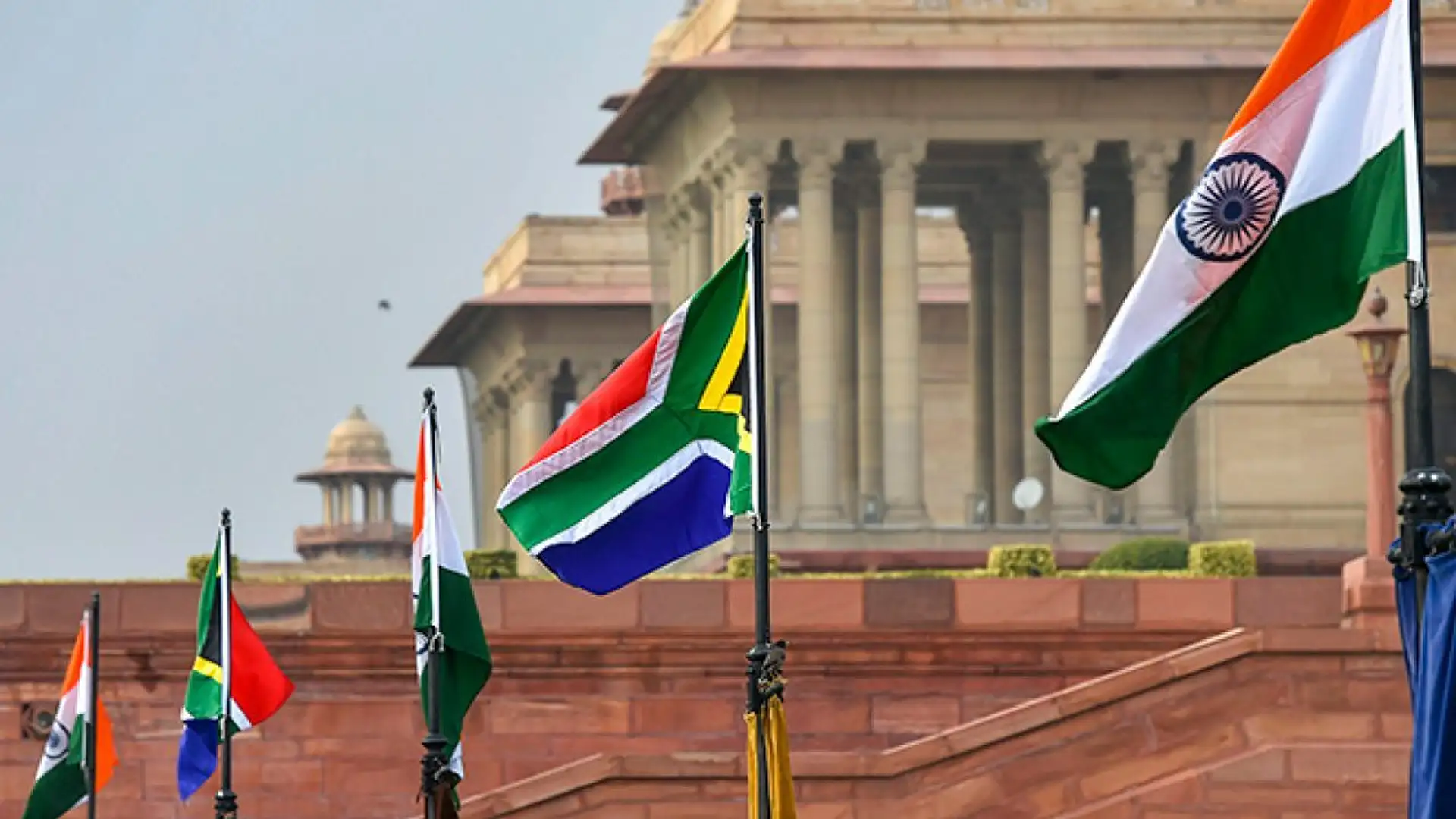
During the apartheid era that ended in 1994, all Indian passports were stamped with the dire message, "Not valid for South Africa." This diplomatic boycott, observed by the bulk of the global community, ended with the demise of the apartheid system in South Africa. India and South Africa resowed the seeds of diplomatic relations with The Red Fort Declaration in 1997 between then-Indian PM Shri Deve Gowda and then-South African President Nelson Mandela. Then, the Tshwane Declaration in 2006 fertilised the soil for their strategic partnership.
Both countries are closely associated with multilateral organisations like IBSA and BRICS.
Trade and Investments
India and South Africa’s bilateral agreements encompass economic and commercial cooperation, defence and public administration, health and education, culture and human settlements, and science and technology. After the formation of the India, Brazil and South Africa (IBSA) forum, trade between the two countries increased substantially. According to a study on India-South Africa Bilateral Trade, total trade between India and South Africa increased by 16.5 per cent per year between 2000-01 and 2018-19. India exports commodities like railways, tramways, machinery, nuclear reactors, mineral fuels, oils, distillation products, pharmaceuticals, food, grains, etc. South Africa exports materials ranging from mineral fuels, oils and distillation products, ores slag and ash, iron and steel, coal, nickel, copper, etc, to electrical machinery and parts, precious stones, food and leather, the pulp of wood, fibrous cellulosic material, and waste.
Trade and investments run deep between the two as India is the second largest trading partner of South Africa from the Asian subcontinent. In 2022, India’s exports to South Africa were US$ 8.47 billion. South Africa's exports to India were US$5.23 Billion, a 4.29 per cent share of South Africa’s total exports. Concurrently, India’s imports from South Africa were US$ 10.39 billion, and South Africa’s imports from India were US$8.33 Billion or a 7.44 per cent share in total imports.
Social System
The present President of South Africa, Thabo Mbeki, states that Gandhi’s legacy is rooted in the heartbeats of his people. But despite the common trend of attributing Indian ties with South Africa to Mahatma Gandhi, fourth-generation and beyond South Africans of Indian origin do not associate with the Indian hero much. Access to their ancestral ties recently opened up to the South African population, and it is only now that they ask about where they came from.
Both countries share similarities and sentimental bonds through their cultures, experiences and freedom struggles. Both countries link on both ends of the spectrum of experiences like intense coloniser experiences, racial segregation, rapid and sporadic industrialisation, apartheid, and exploitation of regional resources to diverse cultures of art and music, tradition and community closeness.
Literacy rates in South Africa since the 2000s have risen from one-fifth to four-fifths of the population. Since the early 1900s, South African native and coloured migrant populations have progressively begun occupying higher positions across various fields, while more white populations occupy mid-tier positions. According to Statistic’s 2017 mid-year population estimates, the Indian population in South Africa is around 2.5per centof the total population. In 2023, Reineth Mgiba, Director of the Department of Higher Education and Training in Pretoria, stated that being a part of BRICS meant that South Africa and India help each other with overall development. The Indian-South African community is known to be highly urbanised, contributing as the 2.8 per cent economically active community and holding 9 per cent of the top-management positions. The South African Indian origin population is well represented in government, media, businesses, legal and other professionals.
Geopolitics
India and South Africa are significant players in the Global South. In a discussion document on South Africa’s foreign policy, the Department of Foreign Policy placed South Africa as the bridge between the North and South of the African subcontinent. Mr Alfred Nzo, South African Minister of Foreign Affairs, expressed that South Africa finds itself in a position that points to an intersection between the developed and developing world. He adds that it is an industrialised southern state that can communicate the developing world's needs, concerns and fears. This is a remarkable similarity to where India finds itself on the global stage. As an emerging global power with undeniable economic strength and technological achievements, India has been acknowledged as the informal representative of the Global South, especially at the 2023 G-20 Summit in Delhi, where India took the opportunity to solidify its longstanding relationship with Africa on a global level. At the recent Summit, India made a bold suggestion favouring all countries of the African Union to become permanent members of the Group of Twenty, which is now official.
The confidence that South Africa has displayed in filing a petition in the International Court of Justice (ICJ) against Israel for violating clauses of the Genocide Convention is an indication of its growing confidence in the international arena. On the other hand, India has played a much more muted role, considering its strong ties with Israel and the Arab nations. This move by South Africa, which is contrary to the views of the Western governments, could backfire in the long run, but for the present, it has been admired around the global South.
Security and Technology
Both India and South Africa come within the somewhat safe yet dangerous range on the Countries Safety Index. Security challenges in South Africa include high crime rates, armed insurgencies and social cleavages that directly relate to political corruption, and widespread unemployment and poverty. Governance deficits, political conflict and electoral violence also affect the consolidated democracy of South Africa. In addition, South Africa has witnessed a surge in cybersecurity challenges with increased threats of phishing and ransomware, data breaches and identity theft. The U.S. generates the highest revenue from the South African security market in response to the growing demand for advanced surveillance systems to counter high crime rates. India and South Africa have faced common security challenges such as piracy, drug and opium trafficking, and illegal fishing, which have implications for maritime security. India also has uneven development, income and education opportunities that hinder the country’s national security interests. Indian imports from the U.S. for the Security industry are estimated to be around US$159 million.
The higher levels of internet connectivity and the use of digital technologies in South Africa, coupled with widespread income inequalities, make it hard for less-informed individuals to access protective mechanisms. South Africa's digital literacy is the highest in Africa. Still, the digital literacy divide has caused hospitals, banks, businesses, electricity units and other government facilities to take the hit, especially during the COVID-19 pandemic. India's million-dollar Safety and Security Industry categorises its sectors into cybersecurity, electronic security, road safety, private and industrial security (homeland security), fire safety, detection and prevention, and personal protective apparel and equipment. Most recently, the Indian cybersecurity domain has gone full throttle on its protection mechanisms. With the digitisation of government activity, e-banking systems like UPI, and high technological advancements in space, the government has to manoeuvre around a brittle digital ecosystem.
Opportunities
Trade and Investment. In addition to existing trade and investment deals, India can engage in trade agreements exchanging Information Technology expertise for rare earth metals. This can help South Africa gain the technical knowledge to operate newer equipment, and India receives resources to produce clean technologies. India and South Africa's opportunities in trade depend on the rate at which both are willing to uplift each other. India can offer to invest in South Africa to set up IT Companies where Indian experts can train South African locals, consult local businesses and widen the Indian perspective. South Africa can invest in energy sectors to help tap into more advanced infrastructure that poses significantly less harm to their environment. South Africa can also make the most of research and development achievements by trading intelligence through discussions with policy institutions, think tanks, academia, the military and NGOs. Both countries have a lot to offer and a lot to take, but what is exchanged depends on whether both decide to take up a Westernised style of trade and investment or seek out unique and mutually beneficial opportunities.
Social Systems. South Africa is facing failing energy systems, sky-rocketing crime rates and the worst economic disparity between black and white South Africans seen in all of Africa. Despite the decline in racially discriminatory activities in South Africa, it has taken a lot for the most oppressed communities to break free from the victim mindset and push for their rights and liberties. No matter what anyone says about freedom, the idea of being free begins with the mind. After centuries of being convinced that they are less deserving or valued than the fairer population, it will take a lot of generational healing, empathy building and narrative reframing for the worst victims to take up space in society and feel comfortable doing it. One major opportunity India and South Africa can work on is a cultural exchange programme. The difference is that the setting in which Indians and South Africans interact will help appreciate their cultures' similarities and differences without pitting them against each other. This can be through think tanks, schools and universities, NGOs, music, theatre and arts industries, large businesses and government-funded projects. With India interwoven into the population of South Africa, it is a great way to engage and get real perspectives and stories to deepen the relationship between people beyond the politicised and volatile context in this era.
Geopolitics. South Africa is Africa's economic giant, with one-fifth of the continent's GDP. However, holistic development depends on a country's self-reliance; Russia's negotiation to offer security in exchange for mining access for diamonds or China buying up major parts of Africa with negligible charges does not necessarily uplift the country's individuality. It makes sense between Russia, China and the West why South Africa wants to look both ways and make the best out of what they all have to offer. India could become a friendly guide for South Africa to navigate its geopolitical routes in an increasingly unsettling and polarised world. It is a similar route that India has taken and it could mean playing safe as long as possible to avoid getting caught in the crossfire. One of the many things South Africa and India have in common, now more than ever, is challenging the Western world. South Africa's case against Israel is the beginning of an uphill battle against Western dominance over international law and order. India contesting on the global stage as an economic superpower is another win for the Global South. Combining strengths, enhancing conversations on education, infrastructure and needs, and recalling common beliefs would be a commendable move for the Global South to assert its opinions on Western double standards and strengthen its recognition as a force to be reckoned with.
Security and Technology. India can aid South Africa in navigating through the recent technological boom and the possible threats and vulnerabilities. India has had many trials and errors on the digital spectrum and can guide its partner. With the 2024 South African elections set in mid-May, technological awareness and security structures should be at an all-time high. Think tanks and non-profit organisations from India can help share insights and recognise new online threats like deepfakes, mass-malware attacks and scammers that could jeopardise diplomatic fairness and freedom in elections. Terrorism is a major security threat prevalent in both countries. By forming agreements and sharing security intelligence and technology to the extent that they abide by national interests, they can implement each other's strengths to generate countermeasures before a problem arises.
Key Takeaways:
South Africa represents Northern and Southern Africa, while India is seen as an
informal
representative of the Global South. Both countries are critical players in the Global South, and coming together would be an invaluable strategic power move.
Beyond geopolitics, trade and investment, and technology, there is an underlying social struggle that threatens their relationship on a civilian level. India's choosing to help South Africa begins with South Africans accepting help from Indians because apartheid made it seem like Indians took things away from them, too.
There have been many instances where South African natives see the Indian diaspora as an unwanted community that holds significant power
/influence
in the country even today.
At a political level,
shared
Gandhian values of non-violence, mutual respect and unity helped South African leaders, like former president Nelson
Mandela
and even the current President Thabo Mbeki, lead the country through a peaceful transition.
But how relevant these values are in the modern world is a mute question.
The real opportunities like in tangible results in trade, investment and technologies.