
SMALL BUT RESILIENT
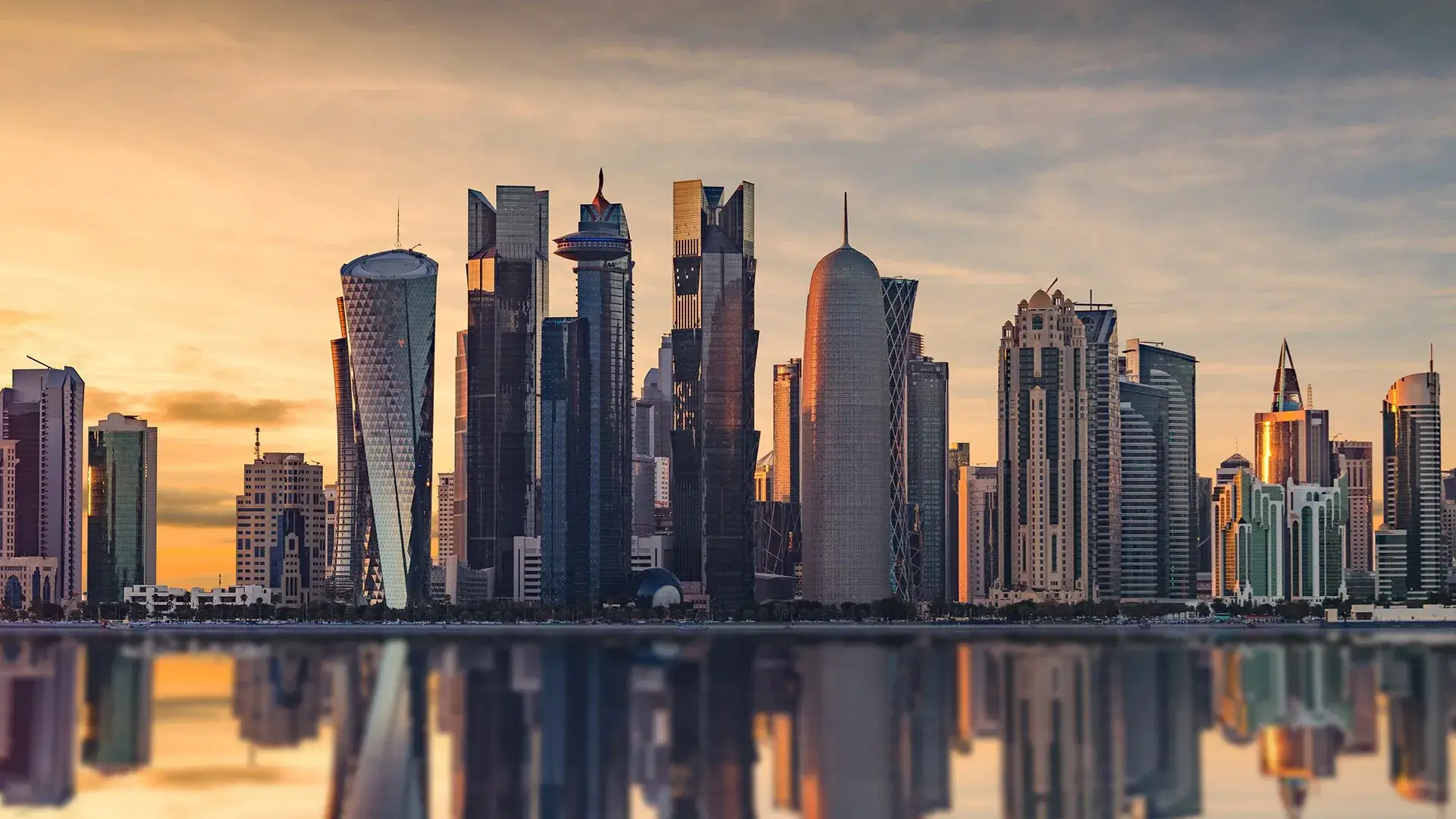
Despite its unconventional approach, tiny Qatar has carved out a unique regional and international geopolitics position.

(https://static01.nyt.com/images/2017/06/06/world/06QATAR-01/06Qatar-superJumbo.jpg)
Qatar is a small country wedged between bigger states in a tough neighbourhood. It has adroitly capitalized on its resource strengths to become financially independent and developed a network that helps it stay resilient.
From being an outlier amongst its Gulf neighbours, it has become a regional mediator and a world-leading natural gas exporter.
Resources and Strengths
Qatar's small population, desert climate, and limited ground and surface water make it less conducive for agriculture or industry. It is geographically sandwiched between two regional heavyweights, the Kingdom of Saudi Arabia and Iran, both vying for control of the region.
However, Qatar does have physical assets that can contribute to its strength and make it geopolitically important. Its leading natural resource is abundant natural gas: with vast swathes of gas fields, the Emirate has the third largest natural gas reserves after Russia and Iran. It is a leading liquified natural gas (LNG) exporter. In this way, it differs from other Gulf states, whose main source of income is oil and which do not have as much export capacity for natural gas.
Qatar's strategic location at the convergence between East and West, between Asia, Africa, and Europe, enables it to participate in international markets, expand the scope of its exports, and develop trade connections with other countries.
It has made the most of its geography through robust transportation infrastructure. Its range of ports, airports, and logistical centres has enabled it to enhance its trade links. It has a marine transport line through Hamad Port, a strategic window in maritime navigation and Qatar’s portal to global trade. Additionally, its modern shipping fleet and LNG carriers have contributed to boosting the spread of its exports to markets across the world. Its ports, like Hamad Port and Ras Lafan Port, boast global quality infrastructure. This, combined with its proximity to channels of global communication, has made it a focal point in trade, particularly energy and gas trade. Its national flag carrier, Qatar Airways, was rated the second-best airline in 2023 by Skytrax. Qatar Airways serves more than 150 key business and leisure destinations worldwide, with a fleet of over 200 aircraft.
Its infrastructure facilities have also helped it attract leading economies as strategic partners like China, the United States, and Europe, as well as foreign direct investment. Qatar Airways, in particular, has helped bring in more tourists and allowed the private sector to reach foreign markets through its extensive network that covers places like Africa, Central Asia, Europe, South Asia, the Middle East, North America, and South America.
With the Ukraine war having hiked energy prices and Europe turning away from Russia for its natural gas supplies, Qatar stands to become a major energy supplier for Europe.
It is worth pointing out that Qatar’s assets have enabled it to become financially independent as a small state and helped it maintain political autonomy vis a vis its larger neighbours. Financial independence was an important factor that enabled Qatar’s new ruling elite to adopt an independent foreign policy.
Regional Challenges
Qatar has faced its fair share of challenges with its regional brethren. In the most severe diplomatic crisis in the Gulf Cooperation Council (GCC) block, Saudi Arabia, Bahrain, the United Arab Emirates (UAE), and Egypt imposed a blockade on Qatar from 2017 to 2021. The GCC is a political and economic alliance of six Middle Eastern countries – Saudi Arabia, Kuwait, the UAE, Qatar, Bahrain, and Oman.
The embargo and severing of ties were the culmination of years of tensions building as Qatar's neighbours were convinced that it was too independent and non-conforming in its foreign affairs. The 2011 Arab Spring uprisings had set several governments on edge, with GCC states alarmed by threats to dynastic rulers. Most GCC nations backed rulers like Egypt's Hosni Mubarak, but Qatar tried to build ties with some opposition members, particularly groups connected to the Muslim Brotherhood, a controversial political Islamist group in the Arab world. Qatar's neighbours were also irked by the positive depiction of the Arab Spring protests by Qatar-linked media, notably Al-Jazeera.
However, the three-and-a-half-year blockade did not have the desired effect, and Qatar seemed to emerge stronger. According to a Brookings article (January 19, 2021), it pushed Qatar to grow more self-reliant and boosted its economy. Qatar also strengthened ties with countries like Turkey, another supporter of the Muslim Brotherhood. It developed closer commercial ties with Iran, Saudi Arabia's rival since Iran's airspace became an essential channel for Qatar to access the rest of the world. Qatar was compelled to forge alternate supply routes, boost domestic production, and expand the capacity of its Hamad Sea Port as it grew new trade links. The boycott failed to accomplish its key aims, like pressuring the tiny nation into conformity or driving it away from Iran and Turkey. It came to an end with a GCC agreement, bringing about a Gulf reconciliation.
Since then, GCC rapprochement has proceeded steadily, through diplomatic and economic channels, including efforts to jointly enter into Free Trade Agreements (as a regional bloc) with other countries and groups.
Qatar’s Regional Role
Qatar’s foreign policy from 1995 has looked to overcome structural limits such as its geographical position between two major regional powers with an ongoing fierce rivalry.
However, this had met resistance from the Saudi kingdom, which backed two coups to overthrow the government in 1996 and 2002 and opposed gas pipelines carrying Qatari gas to Kuwait and Bahrain. Such security challenges pushed Qatar's government, led by Sheikh Hamad, to build alliances and soft-power tools such as conflict resolution, media and culture. For instance, Qatar launched Al Jazeera, the first Arab satellite news channel.
Qatar has played mediator and intervened in several regional crises, such as in Lebanon after Hezbollah invaded Beirut and between the Houthis and the Yemen government. More recently, it has played an active role in Ukraine, Sudan, Iran, Gaza, and Afghanistan between the U.S. and Taliban, most notably in 2020 towards the U.S. withdrawal of troops from Afghanistan.
While other Middle Eastern countries aspire to don the mediator's hat, like Egypt and Oman, Qatar's image as the regional conflict resolver seems most widely accepted. Its ties with controversial outfits like the Taliban and Hamas enable it to broker tense situations involving such actors.
This role helps it maintain ties with the international community and protect itself from unwanted interventions from neighbours like Saudi Arabia, Egypt, and the United Arab Emirates.
Doha's efforts to minimize its risk in the tumultuous region seem to have paid off. For instance, when Iran retaliated against the U.S. for killing its general Qasem Soleimani, it targeted U.S. bases in Saudi Arabia, Iraq and Jordan, but not Qatar. This is despite Qatar's two major U.S. bases and the fact that they would be easy to hit.
Qatar’s negotiator role in the Gaza crisis has made headlines and released hostages as well as aid to Gaza. This is enabled by its contrasting connections with Western powers like the U.S. on the one hand and Islamist groups on the other hand. Qatar’s ties with Hamas and Iran have helped it gain a prominent position with global powers that is often described as indispensable. However, Qatar is also aware of the bad press it’s getting in the West for its ties with Hamas, which has led it to tread more carefully.
Qatar has deftly managed its relations with the U.S. and China, taking advantage of both big powers. It created waves when it opened a Chinese Renminbi clearing facility in 2015, and in 2022, amidst the Ukraine war, it sealed a lucrative contract with China for the supply of LNG.
Qatar and India
India and Qatar established formal diplomatic ties in 1973, and since then, their bilateral relationship has expanded to cover a range of aspects, including defence, counterterrorism, and energy trade. A significant diplomatic visit in 2015 featured the signing of five MoUs during the Emir's visit to India.
Qatar’s exports to India have been mainly in the hydrocarbon sector, including LNG, LPG, petrochemicals, chemicals, plastics, and aluminium articles. Qatar is India’s largest LNG supplier, accounting for 50% of India’s LNG imports in 2023. QatarEnergy and India's largest LNG importer, Petronet LNG, recently signed a long-term mega deal as India increases its use of the fuel to reduce its emissions.
The balance of trade remains significantly in Qatar’s favour, although India’s exports to Qatar have sizably grown in the last few years. India is among the top three export destinations for Qatari goods and is also one of the leading exporters to Qatar. Its exports to Qatar cover a range of products like copper, iron and steel articles, cereals, vegetables, machinery, electronics, and textiles.
The Indian diaspora in Qatar makes up one of its largest expatriate communities. This makes India-Qatar ties all the more important and adds a sociocultural element to their relationship. For Delhi, the condition of Indian expatriate workers in Qatar continues to be a priority, with labour mistreatment being a prevalent issue. The amicable settlement of the case of seven ex-Indian Navy officers sentenced to death for alleged espionage in Qatar has done a great deal in strengthening relations between the two countries.
Going forward, the two nations are likely to strengthen LNG trade as India looks to increase the natural gas component of its energy mix in a bid to turn to cleaner fuels. They would also do well to expand renewable energy cooperation, as Qatar looks to diversify its exports to keep up with the green energy transition, and both countries are looking to diversify their energy sources.
The two nations could also cooperate in the area of education. Western universities in Qatar are an attractive option for Indian students looking to access quality education abroad without the high costs associated with the West. Indian students could also offer a potential talent pool for employers in Qatar. The two nations could engage in human resources cooperation through training programs and skill-building. On the other hand, perceived anti-Muslim sentiment in India could prove to be an obstacle to ties between India and Qatar.
Assessment
Qatar emerged from the Gulf crisis as a significant player that navigated regional pressure without compromising its sovereignty and independent foreign policy. By maintaining and expanding ties with diverse states and non-state actors, it has created a niche for itself as a legitimate regional and global mediator.
In the context of the Gaza war, the Red Sea crisis and heightened regional tensions, Qatar stands to play a useful role in offering a communications channel with actors like
Iran and its proxies
Hamas,
Hizballah
and
the Houthis
to broker
a potential peace agreement.
India and Qatar stand to benefit from energy cooperation
through trade, investment, technology exchange, possible joint endeavours, and cooperation in areas like education and human resources.