Afghan talks in Doha resumed but failed to offer anything to millions of Afghans left in limbo.
The third round of UN-led talks on international engagement with Taliban-ruled Afghanistan concluded in Doha, Qatar, once again, inconclusively. As is their wont, the Taliban stuck to their guns in not relenting to any concessions on key issues like women’s rights-education and freedom to work.
The positive side is that at least the global community has been able to wrest itself away from Gaza and Ukraine and turned a gaze at distant Afghanistan, a festering nest of suffering humanity and violent armed groups.
Background
The “Doha process” was initiated by UN Secretary-General Antonio Guterres in 2023 as a forum for the international community to engage with Afghanistan’s de facto Taliban rulers. The first round of talks was held in May 2023, but the Taliban refused to participate, citing unmet demands. The second meeting occurred in February 2024, again without the Taliban; they claimed their invitation arrived too late for them to attend, perhaps deliberately, as some hinted. UN chief Guterres had noted with concern the unacceptable conditions set by Taliban interlocutors for their attendance, including demanding the exclusion of members of the Afghan civil society.
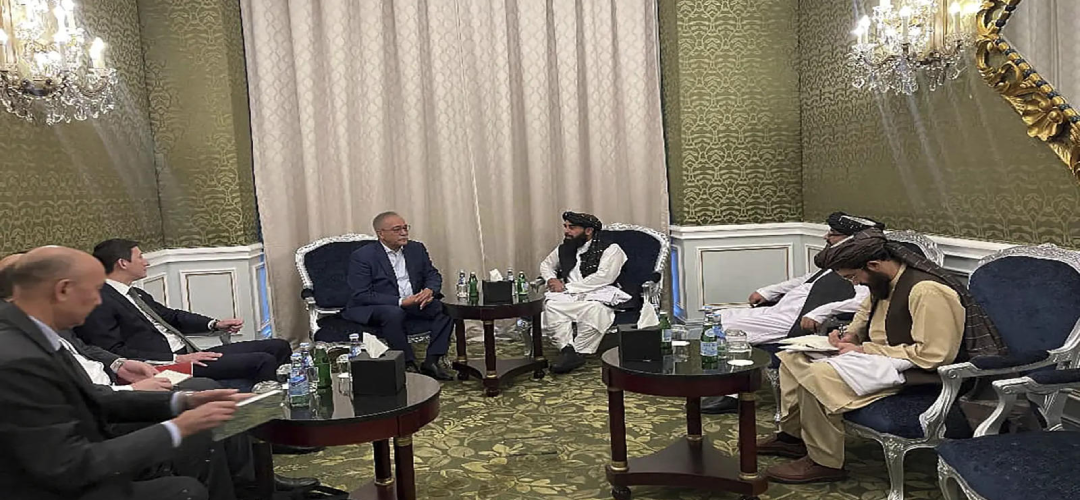
This time around, the Taliban made it to the Doha talks, which was, by itself, an achievement. Led by the familiar Zabihullah Mujahid, the delegation had the opportunity to exchange ideas with representatives from about two dozen countries, the UN, the World Bank, and the Asian Development Bank also attended.
Expectedly, the cash-starved Taliban is keen to get its hands on the substantial funds (over $ 7 billion) lying frozen in Western banks. Half the amount has been placed in a trust account for humanitarian relief. A portion was sent from this trust account to buy food grains in the past when the country was facing an acute food scarcity. With a moribund economy and a victim of banking and other sanctions, Kabul is hard-pressed to get some concessions from the West. Clearly, the pressure is mounting with its ties to Pakistan, an erstwhile mentor and supporter, having taken a nose dive and the flourishing informal border trade coming to a crashing halt.
Characterising the restrictions on women’s rights as ‘cultural and religious mores’ and not a violation of basic human rights (as they clearly are), the Afghan delegation stubbornly stood its ground. That left no scope for the UN and other attendees to deny Taliban-ruled Afghanistan a return to the fold of the international community, even if, in the bargain, the sufferers would be the women and the poor, not the ruling clergy and the elites.
While the political talks made little headway, the humanitarian situation in Afghanistan remains dire. A recent UN survey found “widespread shocks” in the country, with 60 per cent of households affected by much higher food prices and 58 per cent by drought. More than two-thirds of Afghan households reported a decrease in their primary source of income, while another 10 per cent were living on savings and debt. Shortfalls in international aid, Taliban mismanagement, and natural disasters have exacerbated the crisis, which the UN has called the world’s largest.
Analysis
There is still a huge divide between the Taliban and the international community, even after nearly three years of Taliban rule. The Taliban did not make reform pledges or win concessions from the participants. No new policies were introduced by any country either. Mujahid claimed the Taliban did not expect a breakthrough, saying the talks were about “understanding each other’s views”. The Doha talks highlighted the challenges in bridging the gap between the Taliban and the international community.
While the Taliban seeks greater engagement to address Afghanistan’s economic woes, the world remains reluctant to fully embrace a regime that denies women their basic rights. The exclusion of women activists from the talks drew sharp criticism, underscoring the difficult choices UN officials face in balancing engagement with principles. Without progress on human rights, the Taliban’s path to international recognition and support remains blocked.
The Taliban’s plea for unfreezing the $7 billion in assets and lifting banking sanctions is crucial for stabilising the country’s economy. However, the international community remains cautious and wary of empowering a regime that does not adhere to basic human rights norms.
The Taliban’s ban on opium cultivation, while aimed at curbing the drug trade, has also impacted the livelihoods of thousands of farmers. The international community’s support for alternative livelihood programs is essential but requires a stable and cooperative government.
The exclusion of women from education and employment is not only a human rights issue but also an economic one, as it deprives the country of half its potential workforce. UN Undersecretary-General Rosemary DiCarlo’s assertion that Afghanistan cannot fully develop economically and socially if it deprives itself of the contributions of half its population highlights the broader implications of the Taliban’s policies.
A Western diplomat’s observation of the competence and technical know-how of the Afghan delegation is noteworthy. It indicates that the Taliban can engage in sophisticated discussions, but their unwillingness to compromise on key issues remains a barrier.
Assessment
- The lack of concrete outcomes from the Doha talks underscores the deep political and diplomatic stalemate. While the Taliban’s participation in the talks is a positive step, their refusal to make concessions indicates a long road ahead. The international community’s unified stance on not recognising the Taliban regime without significant reforms remains firm.
- The Doha talks have opened a channel for dialogue between the Taliban and the international community, but much work remains to turn that into meaningful change for Afghanistan. The exclusion of women activists from the talks, while ensuring Taliban participation, highlights the difficult compromises that lie ahead.
- As the humanitarian crisis deepens, urgent action is needed to alleviate the suffering of the Afghan people. This will require difficult compromises and concessions from both sides. The international community must find a balance between engaging with the Taliban to address