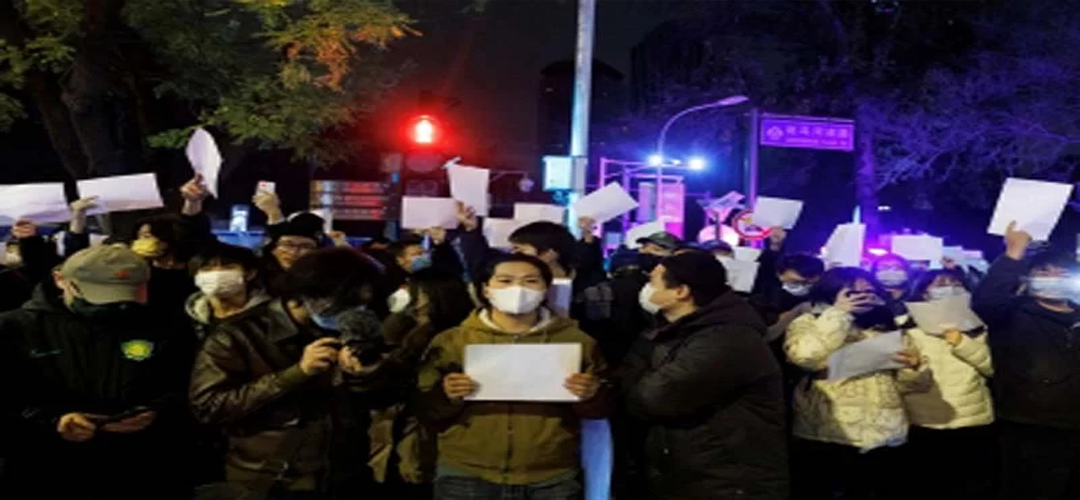

Chinese citizens have adopted a unique style to register their protests against China’s draconian Zero Covid policy.
A single spark is known to have started revolutions, like the one that started the Arab Spring in Tunisia. In a recent incident in Urumchi, the capital of Xinjiang province (notoriously famous for its ‘education camps’ reforming the Uyghurs), it took more than just one spark to trigger the ‘white paper’ protests- in fact, it was a deadly apartment fire that incinerated ten of its inmates.
Apparently, as part of the stringent lockdown imposed in this restive province, the residents (mostly Uyghur Muslims) died with their escape route barred by allegedly externally bolted doors! Residents of Xinjiang province claim that in some badly affected communities, people have remained confined to their tiny flats for more than four months. The whole of Xinjiang province had been under continuous lockdown for about 100 days.
Within hours of the news hitting the media channels, spontaneous protests in the form of candle-lit vigils and rallies surfaced all over China in support of the Urumchi victims. In an innovative move, the protestors held high blank sheets of white A4-sized paper, a silent plea to the rulers to relent.
Apparently, the ploy worked because, as per BBC reports, the government seems to be relenting; COVID cases will be permitted home isolation rather than state facilities if suffering from mild symptoms, and tests are no longer mandatory for most venues and domestic travel.
Background
People in most parts of China are weary after three long years of restrictions on movement and frequent coronavirus testing. The White Paper is the epitome of their frustration against a callously brutal state and the absence of free speech. Moreover, white is a common funeral colour in China, and demonstrators are perhaps mourning the deaths of not only the Urumchi Ten but thousands of others who fell victim to the mismanagement of the pandemic.
White papers as a sign of protest were previously used in authoritarian setups; in Hong Kong in 2020 to avoid slogans banned by China under the city’s new national security law and in Moscow to protest Russia’s war with Ukraine. Similarly, ‘The Indian Express’ under Ramnath Goenka had published a framed blank editorial column to criticise the press censorship during the 1975 Emergency period.

Analysis
The # “A4Revolution” began trending on Twitter after the protests spread across China, with Instagram and Facebook users changing their profile photos to blank sheets of paper. The movement has proliferated to an extent where the hashtag “white paper exercise” was banned on Weibo and WeChat, China’s state-controlled social media.
The uprisings also suggest that President Xi may be losing the political gamble of forcefully implementing his “dynamic zero” (qingling) policy against the Covid pandemic. The CPC had resolved to switch from Zero-Covid to “living with Covid” soon after its 20th Party Congress, but an unexpected new Omicron surge made the plan go awry. In fact, the Chinese National Health Commission’s “20 Measures” announcement to curtail every aspect of Zero-Covid at a time when daily new cases were touching all-time highs in mid-November 2020 was an unprecedented case of failure in planning, wrong timing and epidemic management.
The situation worsened fast because the state had not bothered for months to expedite vaccination programmes, especially boosters for over 50 million elderly between the ages of 60 and 80. Perforce the reinstatement of strict zero Covid policies, restrictions on movement and lengthy lockdowns became the only way to keep death counts low.
There are allegations that the ongoing lockdown in Xinjiang province has been especially harsh, in line with the overall policy of Beijing to keep the majority Muslim Uyghur population in check.
Whatever the initial purpose of the lockdown, with the Urumqi fire incident, people from 18 cities in China, including Shanghai, Beijing, and Wuhan, besides the majority Han Chinese who otherwise have little in common with the Uyghur people, have joined the anti-government protests.
The anti-Zero-Covid unrest was preceded by protests such as the one by thousands of workers turning out premium iPhone handsets at the Foxconn sweatshop in Zhengzhou against their horrific living conditions and the denial of over two months’ pay. The insensitivity and indifference of the Party towards millions in the marginalised sections — rural migrant workers, the poor in the countryside, low- or no-wage urban labour — have also been amplified by the suffering caused by the economic impacts of Zero-Covid policy and regulations on movement.
China has been in the throes of a serious socio-political churning for decades. However, accessible debates on Chinese social media do not present these as being either ‘popular’ or ‘lasting’. The heavy deployment of the Chinese Peoples’ Armed Police, the use of artificial intelligence and cyber vigilance, and arrests in Hangzhou and Shanghai have resulted in the White Paper protests petering out.
Assessment
- It is difficult to understand Beijing’s ongoing stance towards COVID more than two years after its surfacing in China. Now that the virus is a well-understood pathogen and vaccinations have proved their efficacy, the delay in shifting from unsustainable lockdown strategies to implementing primary and secondary mass vaccination seems hard to comprehend. Unless, of course, the much-touted Chinese Sinovac has proved a dismal failure!
- Cracking down on protestors instead of addressing the issue at heart is inimical to the full and free expression of civil and political liberties of people anywhere. China would benefit its development and human rights trajectory by including its citizens in its policies by acknowledging them as primary stakeholders.