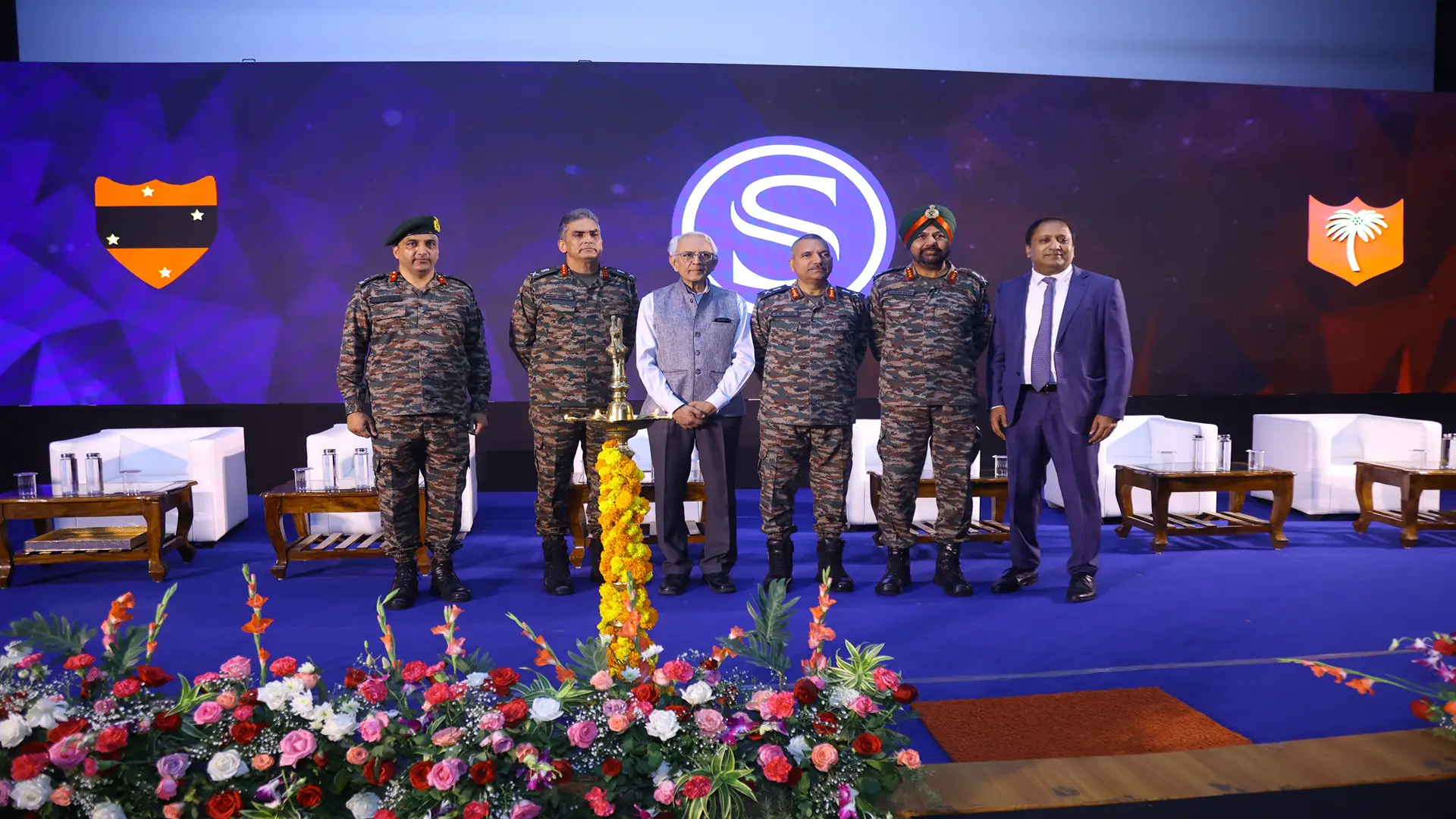

LEVERAGING STARTUPS FOR FUTURE BATTLE
A lot of Indian companies not only make for India but also the rest of the world; their strength must be leveraged for national security.
The military has always been the early adopter of technology. The birth of the internet, the computing environment, and even Silicon Valley, to a large extent, is thanks to the immense power of the defence needs of big powers like the U.S.
The Russia-Ukraine conflict and even the preceding Armenia–Azerbaijan conflicts have shown the asymmetric advantages of what drones could offer to the defence forces. It’s a paradigm shift in which drone technology or aerial systems have become more affordable and nimbler and have produced different capabilities than what the traditional defence forces and systems that are present have acquired over the last several decades.
Four main pillars are crucial for defence capabilities for those nations that aspire for great power status, a world in which India also wants to be one. First is the increasing range at which combat engagements will take place. Second, there is a need to grant greater autonomy at all levels of command- tactical, operational, and strategic. Third, real-time information will be crucial to making quick and correct decisions. Lastly, high precision will be needed to make every strike count with little or no collateral damage.
A Collaborative Strategy
As per Professor Murthy HSN, Professor and Head of Aerospace Engineering, IIT Madras, the pace of technological change is asymmetric. However, it is very difficult for rigid organisations like the armed forces to change within your own organisation. To meet the demands of a modern battlefield, militaries must take technology and apply it to the existing doctrines of war. They must evaluate the risks, threats and opportunities they face and demand technologies that can achieve the military objectives. There are many pillars of technology development. First is academia, which brings in scientific knowledge. Then, there are national labs that use existing scientific knowledge developed by academia and probably partly by national labs to develop technology. This technology is then picked up by industry, which does some engineering to increase efficiency. And then there are marketing experts and suppliers. At the bottom of the pyramid are the end users who have experiential knowledge. In all this, the flourishing startup ecosystem in India can play a vital role.
Mr Parithi Govindaraju, Founder and CEO of Okulo Aerospace and producers of tactical drones, claims that in such a disruptive battlespace, there is a paradigm shift in which drone technology or aerial systems have become nimbler and affordable with different capabilities than what the traditional defence forces and systems that are present have acquired over the last several decades. “As a company, we develop solutions that enable decision-makers in the defence forces to get the right information at the right time,” Govindaraju claims. His company is developing long-endurance drone systems that can persistently obtain information about areas of interest and relate them to the appropriate decision maker for any sort of decision-making. “We have raised the bar in terms of what current drone solutions can do. We develop solutions that fly for extended periods, often 3 to 4 times better than existing drone solutions. Because of that, we are enabling what's called persistent monitoring. With drones, you get situational awareness, maybe for a short period. Maybe for a particular small area of interest, but with these new capabilities, decision-makers in the defence forces can have eyes and ears on the ground always at all points in time,” he says.
Satellites can also perform this task, provided there is a constellation or satellitesin a geospatial orbit. However, space-based systems are expensive. Homegrown technology is, therefore, required to bridge this gap and develop solutions that offer high-resolution data capture, be it imagery or sensor data.
Challenges
Startups taking up financially risky ventures in the defence sector face many challenges. A major plea is that when startups develop niche technology products, the end user should have a better understanding of his own requirements, including some trade-offs so that the startups can progress forward to build the right product. In most cases, due to confused signals from the user and changing demands, the product's development cycle goes awry and drifts into costly time delays. In this process, less robust startups wither away, and their innovations are lost and picked up by bigger companies at a pittance.
The user requirements or GSQR (General Staff Qualitative Requirement), termed in military parlance, tend to drift with every new technology the user reads about in Western tech glossy magazines or Jane's Weekly. The innovator is expected to replicate these solutions in his product, leading to conflicting technical requirements. Neither side is willing to agree to a trade-off, and in the ensuing standoff, the operational efficacy is the only victim. Says Govindaraju, “I would request a faster feedback cycle. A startup life cycle is a very short–1 or 2 years. Often with the defence, the feedback for product development is several months, and the procurement cycle is even longer.”
On its part, the Defence Forces have initiated many corrective actions, including the Defence India Startup Challenges aimed at supporting Startups/MSMEs/Innovators to create prototypes and/or commercialise products/solutions in the area of National Defence and Security.Documents like the Technology Capability Roadmap, released every few years, will also help guide startups on the projects that need to be developed.
Capital is another major roadblock. While the IDEX grants may partly assist in developing technology demonstrators, serial production is quite another thing. Defence orders must cater for adequate funds to see through the technology demonstration phase and the limited series production with some confirmed orders to keep the flow of capital ongoing as the startup accelerates the development/ production phase. This would see the startup through only the next few years. The real challenge lies in the series production, which would require substantial financial capital raised through sources other than the military, including healthy export orders.
Aabhay Aradhya, CEO of Vaydyn Technologies that, designs and manufactures all the electronic components that go into autonomous systems, all the way from drones to all kinds of autonomy, says, "The Regional Technology Nodes established by the Army have been critical to give us the time and feedback that has been necessary to mature our products. But although it's been a very warm handshake, as startups, we want more of a bear hug from the armed forces, where we require more caressing, more time, and more honest feedback to mature our products faster. "
Startups have access to certain limited spaces, but their technologies need to be implemented in the frontiers of war. Testing and validating their technology in the relevant spaces not only assures the startups that the technology is being matured in the right direction but also gives the armed forces the confidence that certain technologies can be helpful in the given environment.
The armed forces, used as they are to public financing and the maze of bureaucracy, need to re-learn the financial side of the startup ecosystem. Mr Naganand Doraswamy, Founder IdeaSpring Capital, a venture capitalist, says, "A startup ecosystemhas three Cs- competence, capital and the customer. There is a symbiotic relationship between all three of these. You know one cannot get ahead of the others. All these three Cs must be in lockstep with each other for anything to succeed." The military must try to understand the mechanics and dynamics that drive startups' profitability and, hence its existence. In its life cycle, a startup goes through the incubation, proceeds to the seed capital stage, and then only starts the growth stage. Interaction at the seed stage is most crucial because the VCs will bring on the capital. The VC always looks closely at the venture, and if a startup is selling to a large customer like a nation's armed forces, the response of VCs will be much more positive. Conversely, VCs will tend to give it a pass if the startup is catering only to the defence sector and that too in a niche product with limited volumes.
Key Takeaways
Technology will disrupt warfare, as we are witnessing in near real-time in Ukraine and the Gaza Strip. The
winning factor will lie with the one with a technical edge on these disruptive technologies.
Defence startups are aligning their products with the tactical and operational requirements, providing the solution as a force multiplier to the armed forces.
These are the disruptive solutions that the armed forces are looking for. These startups are agile and can develop products in the manner or the way the forces require them.
They have their weaknesses, like shortage of capital and inexperience. The way ahead is handholding and collaboration. A proper road map is required, jointly crafted to create homegrown innovations in the defence sector.
|
Cyber Diplomacy Ms Sanjana Rathi – CEO & Founder, Cyber Diplomat Cyber diplomacy is a new term. In today’s world, cyberspace knows no borders. Much technology transfer is taking place, with coding being outsourced internationally. How much cyber risk and threats do we consider when doing such kinds of projects?Around 80 per cent of cybercrime today has an international component to it. When a cybercrime is reported, law enforcement agencies step in. If the crime committed is within the nation's sovereign territory, law enforcement agencies could use technology for forensics and hunt out cybercriminals in the territory within the Indian jurisdiction. But when it comes to international crime, like, for example, by a cyber-criminal sitting in Nigeria, Interpol would come into play. Interpol is nothing more than a liaisoning body. They, in turn, would seek the collaboration of the Nigerian police and their National Central Bureau (NCB) to solve this particular case. However, Interpol usually would not like to take it up for small sums lost by individuals since international investigations cost a lot. So, how can such small individual cases be helped? This is an area in which the Cyber Diplomat is working through international collaboration with certain agencies. Since these crimes have a national security angle, we want to work with the armed forces to find solutions. The U.S. government recognises around 16 critical infrastructure sectors, and there are around seven that the National Critical Information Infrastructure Protection Centre (NCIIPC) recognises. These critical infrastructure sectors include the health, finance, defence, and government sectors, directly connected to the Indian economy. These sectors are getting highly digitised today. There are a lot of technology transfers happening. The cyber diplomacy part of it is something that is overlooked. For example, if you go to a company to do a product threat assessment, the company will just take into consideration the technical controls and will give you a report on what are the gap areas and where they need to be bridged; they will not take into consideration the national security aspect of it. They will not consider where the company is based and how the flows are happening in terms of policies as well. The international relations aspect or the locational advantage aspect is not taken into consideration when such threat assessments are done. It's not taken into consideration whether there are some Chinese links or certain malicious links as well to a company. Therefore, it is important to bridge this particular gap by bringing in the aspect of cyber diplomacy. |