
GEOECONOMIC FUTURES 2035
“Hope might seem elusive, but it exists!”
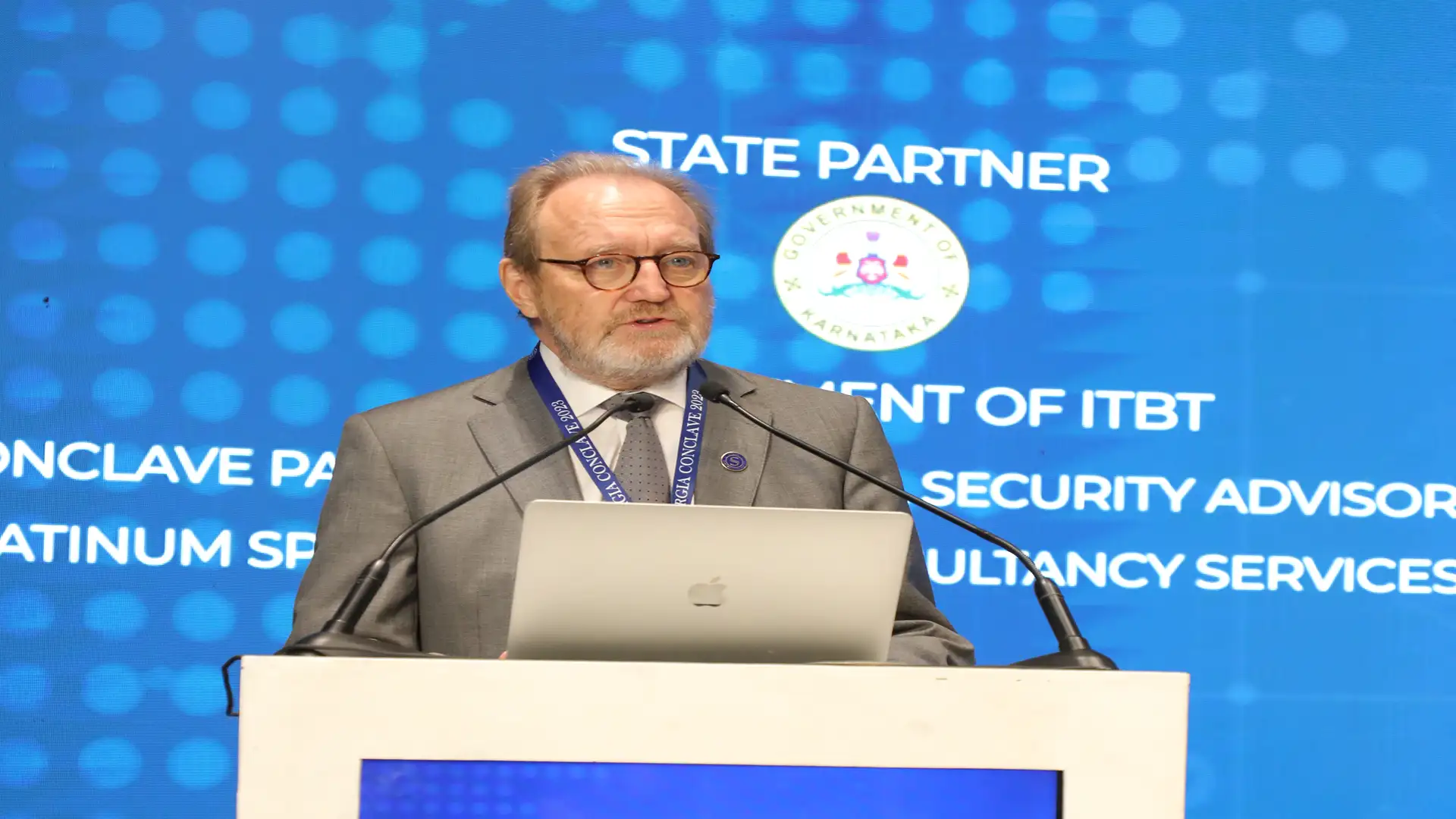
Prof Mats Karlsson
In Dante's Inferno of 1472, the inscription over the entrance to hell runs: 'Abandon all hope ye who enter here'.Confronted with the question of what the future will be like in a dozen years, 2035, well, one can be forgiven for fearing what awaits us. Even if hell is not quite the only possibility, whoever tries to forecast surely faces a hellish task already.
The Domino Effect
A dozen years ago, the world was just about able to manage the seismic financial crisis of 2008. Still, it did not see the consequences of the austerity programmes nor the ensuing underinvestment in public services and infrastructure for which we will have to pay for years to come.We had also not foreseen the full consequences of the Iraq invasion in 2003; it was a breach of the global security order. The surging migration fuelled the disruptive rise of far-right populism in Europe and the U.S. We had not yet seen (the now evident) economic consequences of climate change, although predicted in the 1950s and now making reinsurers and financial regulators nervous.
We had not had COVID, although pandemics would have been on any government's top ten list of serious, unexpected risks. And we had to recommit to basic science, public health and institutions. AI was still only in its laboratory infancy, drones were toys, and fake news had not yet torn our communication asunder.
Globalisation was still a strong locomotive with rising income that would follow stronger institutions and democracy, many of us thought. We can no longer see a solid relationship. Instead, populists and autocrats of different views are gaining ground, supporting each other, whether they have common interests or not. There was a serious dialogue between the global powers with the assumption that international law and multilateralism were useful. Today, it is increasingly replaced by a sense of power rivalry, fragmentation and hyper-dangerous conflicts.
And once this genie was out of the bottle, it is now taking on a life of its own in unexpected places. Those signs were visible a dozen years ago. We did not prepare for the consequences, either geopolitical or geoeconomic. The implications of not having had foresight on each of these issues and more are dire.
What is the point of scenario writing if the willingness of strategic policy planners to seize the possible is not acted upon? Over the years, with every iteration, the set of scenarios has shifted in the direction of fear, even despair. Such is our planetary predicament and the nature of today's politics in many nations and in international relations.
So how do we avoid the same mistake? How do we bring the set of narratives about the future in the direction of hope while still being a hard-headed analyst instead of only adding more weight to the accelerating deterioration? We need to focus on what we should hold on to and be aware of how to build the case for hope in this time of uncertainty. It is close to a moral duty to try to see elements, be theygeopolitical or geoeconomic or indeed technological, that could make strategic policy planning for the better.
Five perspectives will determine likely scenarios on the spectrum as far ahead as 2035.
Scenario One -China
China's economic challenges may not be solvable within their current model. In every economic way – macro, micro, demography, green transition – China's challenges will not go away easily or rapidly. The party-state will have to focus on these issues for a very long time and seriously. Is this societal model really adapted to the world?
China gives cause to worry about their macroeconomic situation, its housing market, and what it can trigger domestically.China's population will start to decline. They have an age profile that is going to be difficult to maintain socially. I think that's important. China needs to face what all ageing societies and modern societies have had to face, namely the social-based health system; China needs a welfare state.
As societies mature, certain structures have to be created that protect people. China may have exhausted what migration can give with the first stage of urbanisation. They have to create more stable perspectives for the demographic profile they have for the profile of knowledge that the Chinese will have.And it would be frightful if China returned to the old ways of changing the social model. But maybe the positive would be if they find ways of reforming, while they still have time.
In 2035, profound changes can and may come to China, too, however remote the possibility might seemnow. This is good news as far as it goes, but China is far from a sustainable path and what is sustainable won’t be sustained and that something must give to something else. The question is how.
Scenario Two: Political Stability of the U.S.
The U.S. is today in its deepest political crisis since its civil war; outsiders are complacent at their peril.The dangers that Trump unleashed are deeply unsettling. They are existential for the U.S. as we know it. Trump's party shows no sign of halting the self-harm it is inflicting on the country's social fabric.
The good news is that the institutions remain intact. And importantly, the economy is hugely resilient. On all counts – inflation, growth, employment, green investment, innovation, health, the rational policy side is winning ground.If that political path can heal the societal rifts and rebuild social cohesion internally, then and only then can the U.S. uphold its role as a leader and adapt its role as a partner in the world. No country can be stronger externally than it is strong internally, and the current internal weakness simply is why the U.S. keeps missing the opportunities to be bolder on more open and wider trade and economic relations.
Scenario Three-The Rise of the Global South
The global South has emerged. What will its diverse nations make of it? Its emergence is hugely welcome for the countries themselves, of course, but also for the world. The global South now stands to overtake the rise of China as the most important current economic phenomenon of our time. Country after country,self-identifying with the Global South that keeps its eye on the ball and builds institutions, opens freedom for its people, respects rights and laws, is moving down the path of rising productivity and prosperity. It starts at home. There will be many models. Developmental paths will differ. India will choose its way. The Indo-Pacific has huge potential.
Africa's rise is underway. Complex as it is, the world's population growth will come to a halt at 14 billion this century, when Africa reaches 4 billion larger than India and China.The young in Africa must be brought into the mainstream. Given a chance, they will take it.
If the world is to be a secure place and all parts sustainable, we must, therefore, care about each other, look out for each other and be honest with each other. Each country's choices impact others. In the European Union, by way of a treaty, each country's economic policy is the business of others. The rise of the global South will transform international cooperation and global economic governance. The question is whether the multitude of institutions we have and those being formed can work coherently and provide real added value through norms building, finance, and shared public goods.
A case in point is the current discussion on international tax. It is certainly a 2035 issue. It should not be an issue of which institution leads. It should be an issue of effectiveness so that global economic governance can be built credibly. Predictability and law are in the highest interests of institutions and corporations of the global South. Global and regional economic governance should support each other.
Keeping the national flag waving to a minimum might seem like a wish and a dream. Still, stronger institutions in different geographic constellations and groupings can emerge to deal with climate, trade, finance and many specific sectors. The field is huge, and there is no one model. Fragmentation is a threat. But I put my money on that effectiveness and coherence will weed out what is empty politics and strengthen what is useful if rational minds prevail.
Scenario Four-A Stronger EU
Europe, as in the European Union, will become larger and stronger for reasons inherent to itself. Europe is usually said to punch below its weight. There is a lack of joint-focused political developments in different member states, its belated focus on defence and defence industry and obviously how Europe is going to handle its multitude of socio-economic challenges are some concerns.
But one should recognise Europe's lasting strength. The EU has not backslid. The war in Ukraine has transformed the resolve for strategic integration. It took Germany less than a year to overcome its dependency on Russian energy. Some governments, such as Hungary, are spoilers but carry no clout in the EU.
On the contrary, countries in the East and the Balkans who want to become members are now on an accelerated track to accession. Expect the coherent agenda contained in Ursula von Der Leyen’s recent State of the Union address to strengthen over time. Expect Britain to work more closely with the EU again and watch the elections to the European Parliament in June next year.
From a 2035 perspective, much could happen. No one could imagine Brexit a dozen years ago, and Britain regrets it today. But my money is on a stronger Europe. When you look at the international tables and graphs, beware of not seeing the whole category of the EU, not only its major members.
Scenario Five- Russia in Decline
A word in this context about Russia is neededwith 2035 in mind. Russia has a lot of work to do domestically. It has a decreasing aging population of 145 million and an economy just larger than Spain or Scandinavia. And unlike every major country of the global South, it produces next to nothing of value in terms of innovation for the global market.
Its chosen war will leave an investment gap at home to be paid for over decades. Russia's current international influence stems from its military projection, including its command over false news and is, therefore, highly overrated in economic terms. President Putin is likely to suffer a strategic defeat sooner or later in this war on Ukraine and on international law. Russia's European neighbours all choose the EU and democracy any day.This will not change.
In time for 2035, change in Russia is also possible, and though scars will last, new perspectives might become conceivable. Russia's choice at that point may not be as important for Europe or the world as it is for its own people.
A Spectrum Between Fear & Hope
We now have more to fear, and more is demanded to achieve what we could hope for. The span between realistic, good, bad and evil scenarios has widened. Faced with uncertainty and downside risks as never before, if our 2035 hope goal is prosperity, security and sustainability, these objectives can only be achieved if our sense of justice informs the social contracts underpinning economic life.
Low-level equilibria exist among social contracts. Countries carry different histories, but rights, including human and economic rights, are fundamental to sustainability, which in turn can only be found through deliberate, deliberative processes in good faith. That mostly goes under the name of democracy, and the objectives can only be achieved if a willingness to comply with the law permeates economic life.
Corruption is the opposite driver. No scenario writing can be done without assumptions of degrees of corruption. We know that corruption is fiendishly adaptable also to democracies. But the way in which economic and political elites have pursued interests at the expense of justice, law, rights and truth is perhaps the single most important obstacle to what could be possible.
The objectives are only achievable if our understanding of economic change puts productivity at the centre. Productivity, because better than many other measures, thinking productivity will lead you to the binding constraint facing economic improvement and competitiveness.
And it is also far more likely to lead to shared growth scenarios. And if we let the potential of female empowerment continue its breakthrough and inexorable rise – improving productivity, community building, early childhood development and rational societal choice to boot. And if we dare to test our best choices against false choices.
What are our blind spots? When are we fooling ourselves? When are we just repeating or, being self-servicing or denying our weaknesses? Future scenarios can indeed be analysed by likelihood, but they grow in science as what drives choice is essential, rational or irrational.
And lastly, will we stand a chance if we have the courage to put well-being at the core of our understanding of prosperity rather than the usual economic measurements?Well-being, too, can be measured scientifically and operationalised to strategy, but only if it is articulated and agreed upon. Given our track record, hope might seem elusive, but it exists.