
ELECTIONEERING IN THE CYBERSPACE
Politicians are learning the hard way how social media can queer their electoral pitch.
Historically, new media has always influenced politics, from Franklin D. Roosevelt's use of radio to John F. Kennedy's mastery of television. Today, political candidates invest heavily in social media campaigns.
A Digital Electoral Blitz
The mostly youthful (and social media savvy) supporters of jailed former prime minister of Pakistan, Mr Imran Khan, sent a resounding message to the military establishment of Pakistan on February 8, giving an unexpected largesse of seats to Imran Khan’s PTI. This was remarkable considering the host of curbs imposed-jailing all prominent leaders commonly considered 'electable', banning public gatherings and, worst, taking away the familiar election symbol of a cricket bat from the party. Imagine if the Congress Party in India was denied its familiar hand symbol or the BJP its lotus! Beating all odds, PTI emerged as the largest block in the parliament, winning 93 seats out of 264. Of course, their supporters claim that the win would have been a landslide one if the establishment had not coerced the Election Commission of Pakistan (ECP) to change the results in a midnight swoop where Form 47 were changed to catapult clearly losing candidates from the PML and PPP to victory.
Amidst this dramatic turnaround, there is an undivided opinion that the strong performance of PTI-affiliated candidates could not have been possible without PTI's pervasive use of technology, much of it not cutting-edge, to overcome the obstructionist role of the military-dominated interim government and the compliant ECP.
An analysis of this surprising result carried out by the Atlantic Council (February 14) gives credit firstly to the cultivation of a culture of bottom-up innovation, “in which volunteers and supporters feel empowered to take initiative and contribute ideas. This grassroots movement was fuelled by digital platforms that allowed for the dissemination of information at an unprecedented scale. When the party's leaders could not find space on mainstream television, they used Twitter Spaces; when physical rallies were not permitted, they organised virtual ‘jalsas’; and when experts with a leaning toward PTI found no space on mainstream talk shows, they took to YouTube.”
Since the jailed Imran Khan had no opportunity to address the millions of his supporters personally, AI was used strategically to generate his voice and image to present a visual image to the people.
Even more innovative was harnessing the nearly 130 million mobile broadband subscriber base to create a web of interconnected supporters. This network was cleverly used to ensure voters in every constituency were educated about the electoral symbol of the PTI candidate. It must be noted that every PTI candidate was forced to fight on an individual symbol, which illiterate voters would find very hard to remember. This personal-to-personal network bypassed traditional media gatekeepers and engaged with the voters directly.
A key enabler was WhatsApp, which was used extensively to disseminate campaign materials, voting instructions, and key messages from Imran Khan. "By mastering the art of social media, PTI consistently generated newsworthy content, ensuring that the party and its leaders remained at the forefront of the news cycle, even when the party and its leaders could not get direct coverage. In addition, PTI got stories into international media, including a piece Khan wrote for the Economist ahead of the elections. In doing so, PTI forced the governing status quo to respond to what the party and its leaders were claiming internationally,” claims the Atlantic Council piece.
Displacing Mainstream Media
Social media has transformed how politicians, parties, and interest groups interact with the public. These figures and organisations now frequently use social media platforms to share their messages, engage with supporters, and debate opponents. This direct communication creates a more immediate and personalised connection between politicians and their constituents, bypassing traditional media gatekeepers.
During the 2016 U.S. presidential election, the British political consulting firm Cambridge Analytica collected and sold social media user data to influence voters with targeted ads. The firm gathered extensive demographic information from social media platforms. Then, it used large-scale modelling to analyse election trends and predict which advertisements would most effectively appeal to different groups.
The rapid dissemination of information and opinions has made social media a potent tool for political mobilisation and activism. Grassroots movements like the Arab Spring, Occupy Wall Street, and Black Lives Matter have harnessed social media to organise protests, share information, and raise awareness about their causes. Often, social media has been crucial in highlighting issues that might have otherwise remained unnoticed.
As per the New York Times (February 11 24), increasingly, technology has been replacing print and electronic media to connect with the voters. In the 2022 South Korean presidential elections, the People Power Party created an AI avatar of its candidate, Mr Yoon Suk Yeol, to interact virtually with voters, using slang and quips to appeal to the younger demography. This trend has also been witnessed in U.S., Canada and New Zealand elections. The Indian Bhojpuri film star turned politician, Manoj Tiwari, used AI deepfake to show himself speaking the Haryanvi language (spoken by a significant segment of his constituency) in the 2020 Delhi assembly elections, which he won. The NYT article quotes Saifuddin Ahmed, a professor at the Nanyang Tech University, Singapore, "The integration of AI, particularly deepfakes, into political campaigning is not a passing trend but a trend that will continue to evolve over time.”
The Dark Side
The influence of social media on public opinion and political discourse is complex and multifaceted, presenting both opportunities and challenges for democratic societies.
While social media has opened new avenues for political engagement and expression, it also brings significant challenges and risks. One of the most pressing issues is the spread of misinformation and fake news. The rapid dissemination and vast reach of social media make it an ideal platform for false information, which can severely impact public opinion and political decision-making.
Social media platforms often use algorithms that prioritise content based on user preferences and engagement, creating echo chambers reinforcing existing beliefs and biases. This can lead to the polarisation of political views and hinder constructive dialogue and debate.
Additionally, social media can foster online harassment and hate speech, negatively affecting political discourse. Politicians, activists, and regular users may face threats, intimidation, and abuse, discouraging them from participating in political discussions and debates.
Social media platforms have also become hotbeds for disinformation and the weaponisation of information against political opponents. These platforms' broad reach makes them perfect for those seeking to manipulate public opinion through false or misleading information.
Disinformation campaigns can take various forms, including fabricated news articles, doctored images, conspiracy theories, and deepfake videos. These tactics can be used by individuals, political parties, or foreign governments aiming to influence another country's political landscape. The ease with which disinformation spreads on social media has eroded trust in traditional news sources, making it increasingly difficult for the public to distinguish fact from fiction. When Jordan Peele, an American actor and comedian, made global headlines by transferring his own facial movements to former president Obama's facial characteristics using deep fake technology, he drove home a powerful message.
The weaponisation of information involves using personal or private details against political opponents to discredit or undermine their positions. This can include leaking private conversations, sharing embarrassing photos, or orchestrating targeted harassment campaigns. Social media facilitates these tactics, as the rapid spread of information and online anonymity can lead to swift and devastating consequences for the targeted individual.
Misinformation, Echo Chambers, and the Bandwagon Effect
An echo chamber is an environment that reinforces existing beliefs rather than challenging them. Research published in the Proceedings of the National Academy of Sciences in 2021 indicates that social media's content curation fosters political echo chambers.Political echo chambers result from social media’s impersonal algorithms, which analyse user engagement and recommend similar content. For example, a platform will likely show a left-leaning user more left-leaning content.
These echo chambers contribute to the bandwagon effect. Social media amplifies and reinforces mass media messages without context or fact-checking, influencing public perceptions of candidates and their platforms.This environment allows misinformation to spread rapidly and easily. When all the messages on a person’s social media align with their existing beliefs, and no one in their social circle challenges those messages, misinformation proliferates unchecked.
Unfortunately, antagonistic state actors have exploited social media to influence public opinion in U.S. presidential elections. During the 2016 election, Russia employed tactics such as propaganda, troll farms, and bots to spread false news stories and create disorder.
Sabotaging Democracy?
Despite the critical role social media played in Obama's election, he has since labelled it the biggest threat to U.S. democracy. These comments were made a month before the January 6 Capitol attacks, which were fuelled by disinformation claiming the 2020 election was stolen from Donald Trump. This falsehood spread widely on social media platforms, deceiving voters and undermining their ability to make informed decisions, thus compromising election outcomes. Researchers have accused Facebook and Twitter of exacerbating political sectarianism and extreme polarisation among the U.S. electorate due to their inadequate response to disinformation.
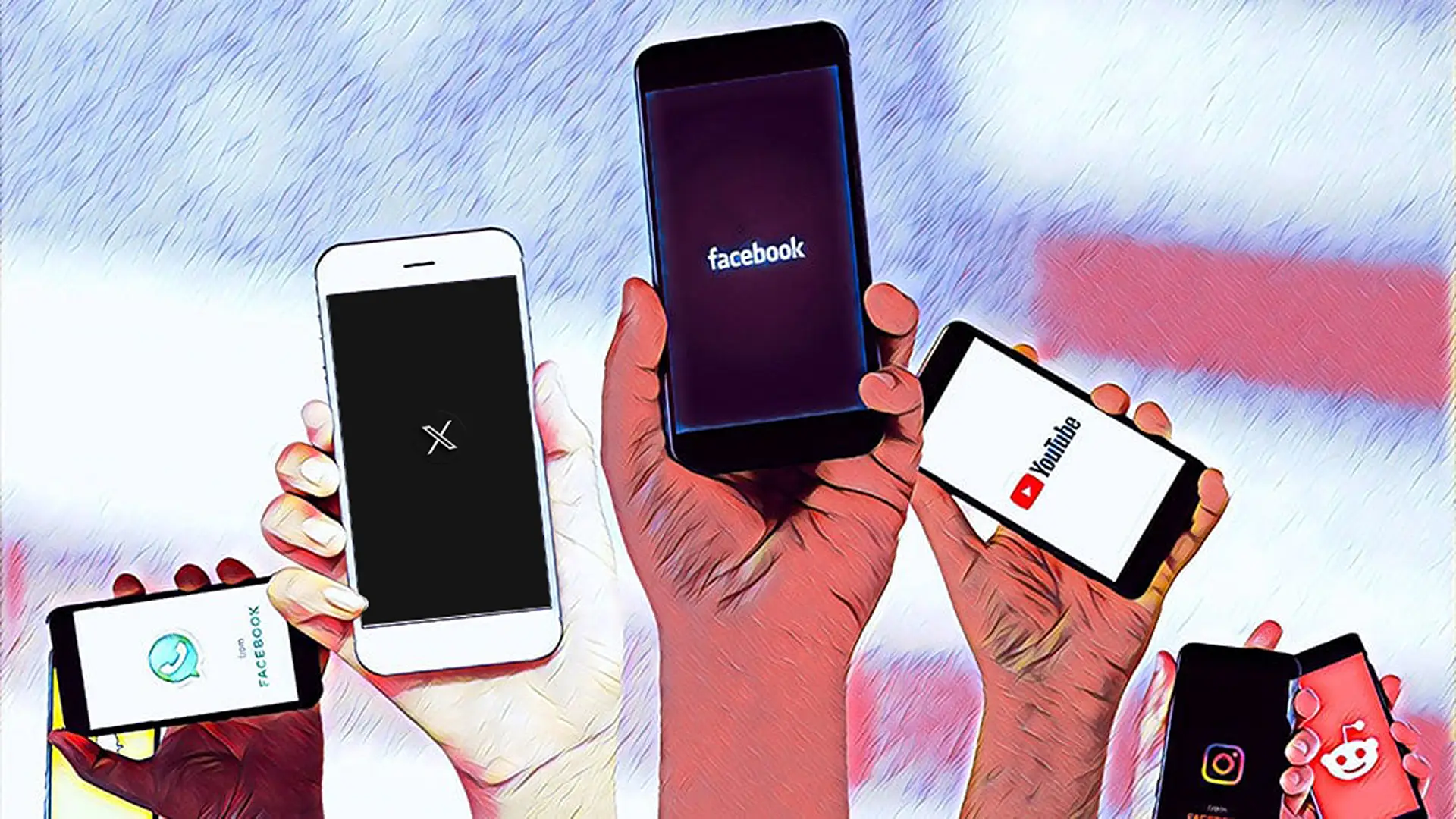
As more people turn to Facebook, Twitter, WhatsApp, and other platforms for news and opinions, social media has become a new public arena for discussing—and often bitterly arguing about—political and social issues. Many analysts believe social media is a major factor in the declining health of democracy worldwide.
This perception has substantial cross-national differences, and the United States is a clear outlie. As per the Pew Research Centre (06 Dec 2022), only 34% of U.S. adults think social media has been good for democracy, while 64% believe it has had a negative impact. Even in countries where social media's impact is viewed positively, most people acknowledge its pernicious effects, particularly in terms of manipulation and division.In addition to being the most negative about social media's influence on democracy, Americans are consistently among the most critical in their assessments of specific ways social media has affected politics and society. For instance, 79% in the U.S. believe Internet and social media access has divided people more politically.
The Indian Political Scene
Existing scholarship on the potential impact of the Internet on party campaign strategy in India is divided into two main schools of thought. The first, the innovation hypothesis, adopts an optimistic view, suggesting that the Internet can potentially reform politics. This theory posits that as internet usage becomes more widespread, party campaigns on social media will eventually replace traditional, in-person campaigning. Proponents of this hypothesis anticipate that digital technologies will fundamentally transform campaign politics, rendering physical campaigning obsolete. Based on the logic of technological determinism, this prediction implies that a party could run a successful campaign entirely online with minimal ground presence.
On the other hand, the normalisation hypothesis argues that, despite increasing Internet use, a party's online campaigns will complement rather than replace traditional, in-person campaign activities. According to this logic, in-person campaigning will remain central to party strategy, resulting in "politics as usual" even in the digital age. This theory suggests that in the future, parties may simply live-stream their in-person campaign events on social media platforms.
However, evidence from recent election campaigns in India does not neatly align with either of these hypotheses. Online party campaigns have not replaced in-person party campaigns; traditional, in-person party campaigns are not merely replicated on social media platforms.
In modern Indian political campaigns, parties strategically leverage content complementarity—a two-way relationship between online and in-person campaigning.Social media creates a perpetual demand for parties to produce online content. In-person campaign activities, especially campaign rallies, are valuable content sources. Scholars have found that rallies serve various purposes, such as resolving asymmetric information within a party and facilitating clientelistic exchanges between parties and voters. Additionally, rallies provide parties with material for online content. This dual purpose enhances the significance of rallies today. Moreover, the demand for online content also influences how parties conduct mass campaign rallies.
With India's smartphone-based internet penetration estimated at a whopping 74.97 per cent (Statista 2024) of the entire population base, it is of little surprise that social media and messaging have gained significant influence in Indian electoral politics. Yet, they do not overshadow the importance of in-person campaigning. Despite the cost savings involved, major Indian political parties still organise mass in-person campaign rallies during election seasons.
The continued prevalence of mass campaign rallies in the digital age raises a broader question about modern campaigning in India. Why do in-person mass campaign rallies—expensive, labour-intensive, and time-consuming—persist when cheaper methods for conducting more targeted outreach online are available? Specifically, how do internet-based communication technologies, including social media, shape party campaigns in India today?
An analysis of parties' self-reported campaign expenditures during the 2014 and 2019 parliamentary elections reveals that both the BJP and the Congress Party allocated between one-quarter and one-third of their total campaign expenditure to in-person campaigning, with a significant portion devoted to rallies.
Several powerful social media influencers have risen whose role in the recent Indian elections has been hotly contested. One such player is Dhruv Rathee, who is active in the entire repertoire of the social media landscape. As per Al Jazeera (May 24 24), WhatsApp has over 400 million Indian subscribers and 460 million on YouTube, making India YouTube's biggest market. Al Jazeera further claims, "Studies show that more Indians trust news they get on YouTube and WhatsApp than what they source from mainstream news channels, Rathee has emerged as a formidable digital force. Polls suggest that Modi’s popularity remains high. But they also reveal that inflation and joblessness, issues of the kind that Rathee hammers on about in his shows, worry Indians the most[..].On YouTube, Rathee has more than 20 million subscribers, nearly four times the BJP channel’s count. The Congress, the principal opposition party, has a little more than 5 million YouTube subscribers, while its biggest leader, Rahul Gandhi, has 6 million.” Mr Modi has over 23 million YouTube subscribers.
Elvish Yadav, another popular YouTuber and social media influencer, challenges the credibility of Dhruv Rathee, calling him "a political party member (AAP) waging anti-India propaganda" at the behest of "anti-India NGOs and foreign entities."
Assessment
I
ndividuals, governments, and platform providers must confront potential risks and strive for a more wholesome and inclusive online space for political dialogue. Initiatives promoting digital literacy, fostering civil discourse, and combating misinformation can leverage social media to enrich democratic participation and cultivate a more knowledgeable and dynamic public sphere.
Both disinformation and the weaponisation of information present substantial threats to the democratic process, undermining public trust in institutions and fostering a toxic atmosphere for political discourse. To address these risks, social media platforms must assume accountability for the content they host, while users must maintain vigilance and
scepticism
towards the information they encounter online
.
Policymakers must account for social media's impact and implement measures to counter influencers' dissemination of misinformation. Potential strategies could involve collaborating with social media platforms and employing artificial intelligence tools to authenticate content and flag misleading posts.
But all stakeholders must somehow ensure that this does not impinge upon a citizen's most basic right
to freedom of expression.