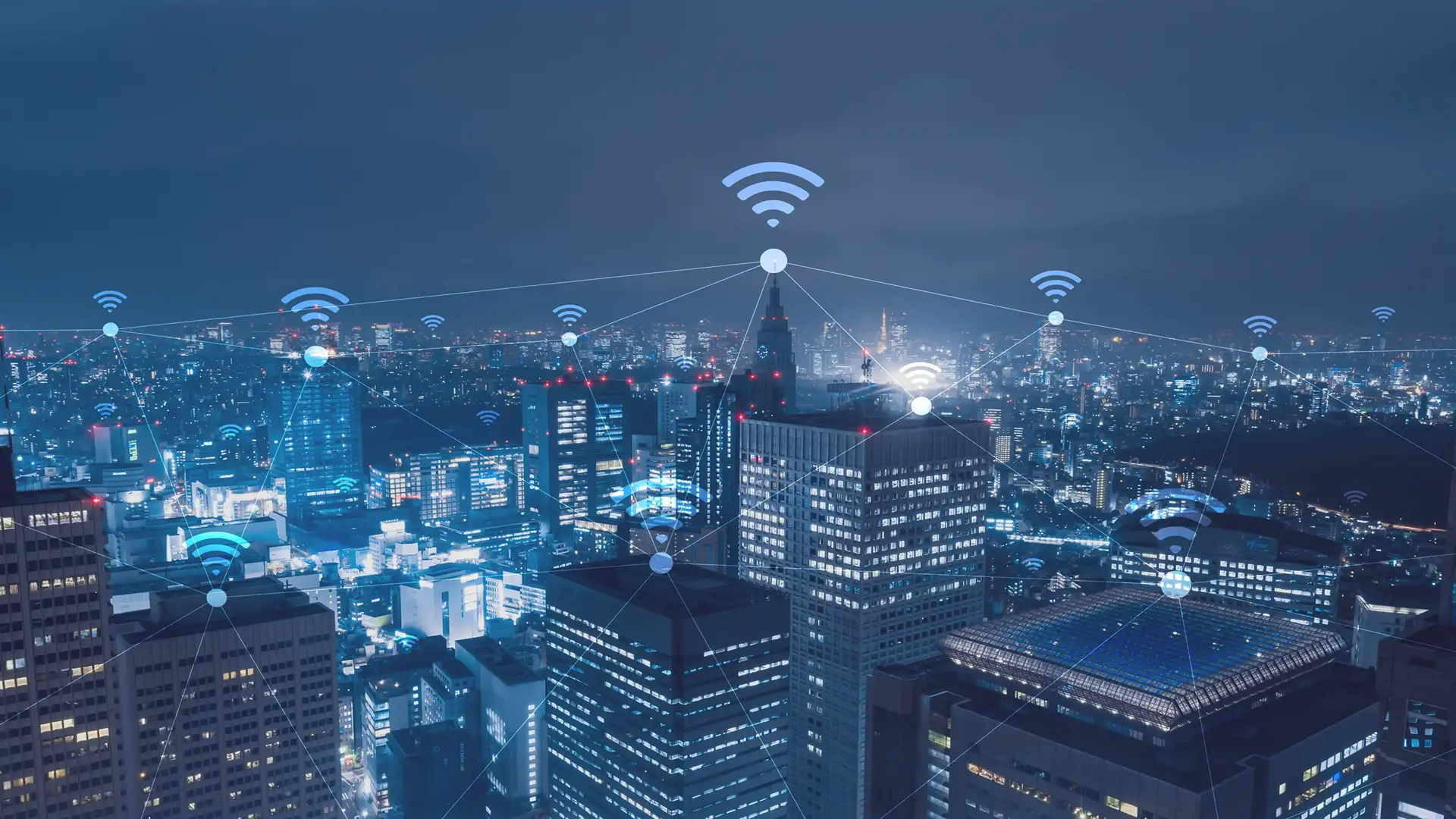

CONNECTIVITY IN FUTURE CITIES
FSO Networks can play a critical part in implementing India’s ambitious Smart Cities Mission
By Ritika Simon
The Indian government initiated the Smart Cities Mission on 25th June 2015. Its goal is to foster sustainable and inclusive cities that offer core infrastructure, a clean and sustainable environment, and the application of smart solutions, thereby enhancing the quality of life for its citizens. The mission emphasizes implementing novel and innovative approaches at a small scale, which can be scaled up and replicated nationwide. This approach, known as the "lighthouse" strategy, aims to expedite the development and successful operation of such zones, promoting sustainable and inclusive growth in urban areas.
The goal of converting Indian cities into smart ones can only be achieved by leveraging the latest technologies, which reduce the time and resources needed to create the infrastructure. In pursuit of this vision, free-space optical (FSO) communications have emerged as a promising technology for delivering high-speed, secure, and reliable connectivity between future cities and their surrounding infrastructure.
Smart City Priorities
The concept of future cities is rapidly gaining momentum as urban areas worldwide aspire to become more interconnected, sustainable, and technologically advanced.A smart city's fundamental infrastructure encompasses various essential components to enhance urban living standards. These include efficient water management with smart reservoirs and distribution systems to ensure access to clean water, reliable electricity supply, and comprehensive sanitation solutions covering solid waste management. Additionally, the infrastructure extends to facilitating efficient urban mobility and transport systems, robust IT connectivity, and digital ecosystems.
Moreover, a smart city infrastructure incorporates provisions for affordable housing, promotes good governance practices such as e-government and citizen participation, ensures a sustainable environment, and fosters education and public health initiatives. It also emphasizes the safety and security of citizens, with particular attention to vulnerable groups like women, children, and the elderly.
In implementing these initiatives, the program sets achievable benchmarks and selects suitable systems and structures to modernize planned cities. Employing a blend of retrofitting, redevelopment, and greenfield development approaches, the initiative identifies approximately 6 to 10 cities across various densely populated states.
FSO Networks a Gamechanger
The concept of Free Space Optical (FSO) networks was first introduced in the 1960s, utilizing high-powered lasers to transmit large volumes of data through the air as a medium. However, being a Line of Sight (LOS) technology, it had many challenges to overcome.
The biggest advantage of using the optical spectrum in FSO networks is that no licenses are required, unlike other wireless Radio Frequency (RF)- based technologies. This results in significant cost savings on spectrum licensing fees.
FSO networks are also immune to interference from electromagnetic fields, making them highly suitable for co-existence with existing wireless deployments. The current hardware used in FSO networks can mitigate interference between multiple light sources with the same specifications. Additionally, FSO networks offer advantages over RF-based technologies, such as higher data transmission rates, lower cost, and increased security.
In addition to their rapid deployment and cost efficiency, FSO communications offer various other benefits for future cities. They boast high security, as the light beams used for data transmission are challenging to intercept or disrupt. Furthermore, they are environmentally friendly, as they eschew the necessity for cables or other physical infrastructure.
High-Speed Internet: A Modern Basic Necessity
The World Bank's assessment reveals a stark contrast in broadband high-speed internet accessibility, with 80 per cent of the population in advanced economies having access compared to only 35 per cent in developing nations. In this context, "broadband" denotes internet speeds faster than dial-up connections.
FSO communication holds promise for enhancing wireless communication for both those already equipped with broadband access and those lacking it. Optical communication offers bandwidth enhancements ranging from 10 to 100 times that of radio frequency (RF) wireless communication while demanding lower input power. Additionally, the costs associated with establishing ground-based radio stations to receive FSO signals are notably lower than those of laying new optical fibre connections due to reduced labour and excavation expenses. In certain scenarios, utilizing FSO communication between ground locations proves more cost-effective than deploying optical fibre cables.

Figure: General process for free-space optical communication
Why FSO?
Topography. The distinctive geographical layout of Indian cities presents a challenge for network planners and engineers, often leading to concerns about network dead zones. These dead zones, areas with poor or no network coverage, are common in such environments. FSO lasers offer a solution to overcome the challenges posed by the unique topography of Indian cities. FSO technology can bridge network dead zones and enhance connectivity in areas where traditional network infrastructure may struggle to reach by providing a long-range, high-speed connection without needing physical cables.
Network Resilience. Smart cities, inherently reliant on data, necessitate strong digital connectivity. Free Space Optics (FSOs) offer a level of redundancy and primary access that align well with the demands of a smart city infrastructure. Recent assessments of FSO technology have demonstrated high-speed capabilities per link exceeding 100 Mbps, even in challenging atmospheric conditions where FSO technology historically faced limitations. These findings highlight the significant potential of FSO technology in enhancing the efficiency and reliability of smart city networks.
Security.Smart cities rely on sensors and interconnected devices to generate substantial amounts of data, which cybercriminals can target, potentially disrupting access to essential resources and even illegally accessing security cameras. For instance, in February 2021 in Florida, hackers manipulated the water supply by increasing the level of sodium hydroxide, which could have resulted in a significant public health crisis if not promptly detected and rectified.Free Space Optical (FSO) technology provides inherent security features by design, preventing unauthorized interception and control of signals, thereby enhancing the security of smart city networks and safeguarding against potential cyber threats.
Challenges
Free Space Optical (FSO) networks offer high-speed wireless communication with built-in security features but face challenges during implementation and operation. Atmospheric conditions like fog, rain, and snow can cause signal attenuation, reducing data rates or causing communication failures. Redundancy systems and optimized network design can improve reliability.
Additionally, FSO networks require line-of-sight (LOS) connectivity, which can be limited in urban areas with tall buildings. Combining FSO with LAN or WLAN networks can overcome this limitation. Precise pointing accuracy is also essential for FSO networks due to laser-based communication, achievable through tight mechanical tolerancing and steering mechanisms.
FSO networks may experience scintillation, causing rapid signal variations due to atmospheric conditions or ground location differences. To mitigate this, highly sensitive optical systems and tailored algorithms can improve signal reception. Additionally, deploying and maintaining FSO networks, especially in rural or remote areas with limited infrastructure, can be costly.
Assessment
At its core, the Smart Cities Mission (SCM) and its related initiatives represent an ambitious urban renewal and revitalization agenda. The primary goal of retrofitting existing cities is
to align with the evolving needs of urban residents and enhance the capacity to address future challenges centred around sustainability, equity, and resilience.
FSO can play a critical part in implementing India’s ambitious Smart Cities Mission
Despite the apparent challenges, the advantages of FSO networks, including high-speed data transmission and built-in security, often justify the expenses.
Recently,
t
his technology has demonstrated its capabilities as a viable competitor to existing commercial solutions. With the capability for gigabit throughput rates, it is positioned to be a key player in linking future cities.
Recent advancements have led to the commercialization of this technology, with numerous equipment manufacturers and service providers developing products and services that leverage the advantages provided by free space optics (FSOs)
, including a few in Bangalore.