
AI AND ADVANCED OPS FOR MILITARY COMMUNICATIONS
|
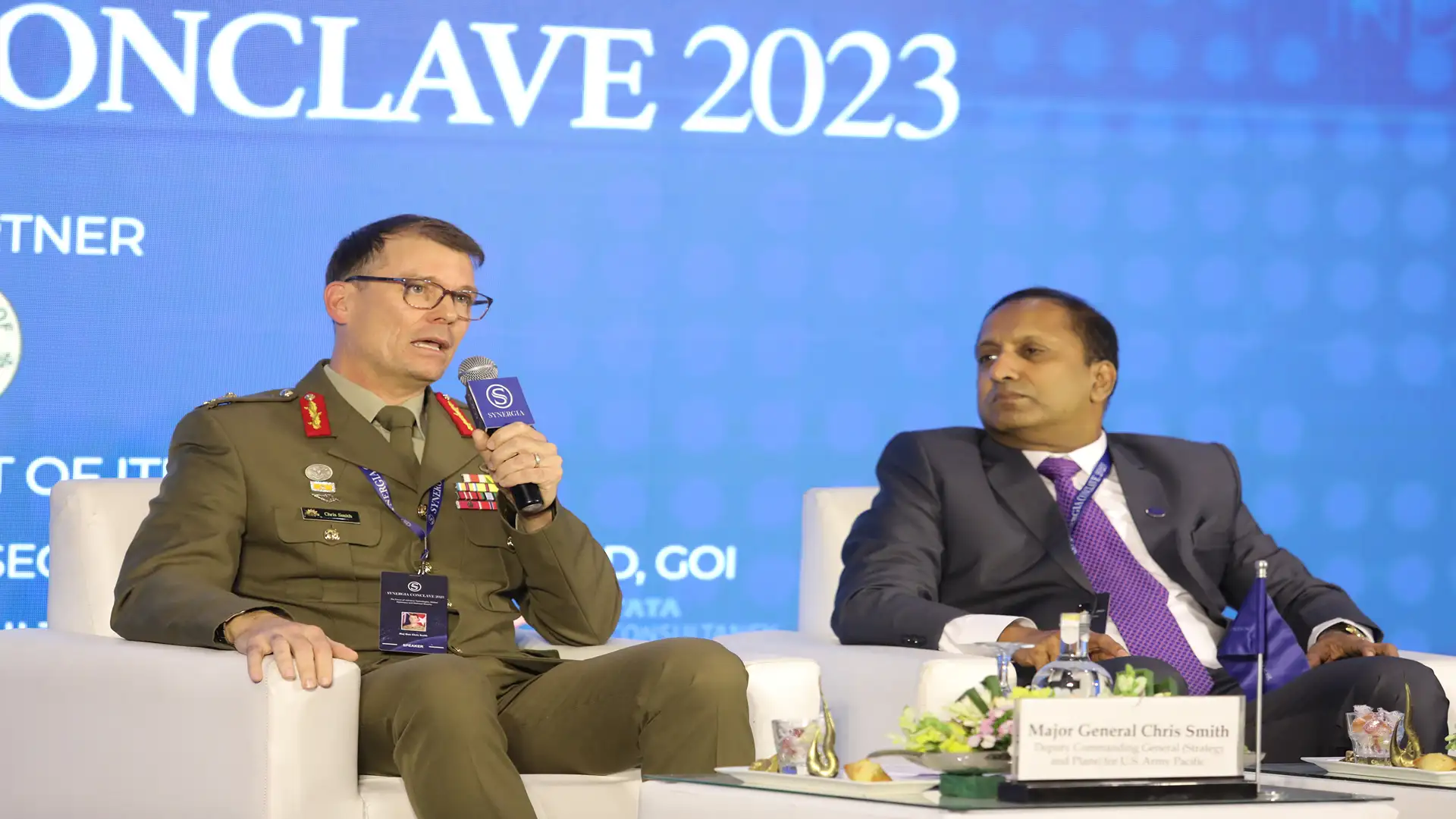
This article is based on the talk delivered by Major General Chris Smith, Deputy Commanding General (Strategy and Plans, US Army Pacific Command, at the 9th Synergia Conclave. |
The future is irreducibly unknowable, and war is a practical phenomenon. Cognitive actions like knowing, thinking and deciding that could be more impacted by the application of advanced computing are likely to have a more substantive influence on warfare than applications that enable better command and control. This may run somewhat counter to the prevailing thinking. A word of caution is advised for those who think that the potential of advanced computing in warfare is greatest in the area of command and control, particularly its support to decision making on the battlefield.
Advanced computing refers to a range of technology like artificial intelligence, machine learning, quantum computing, etc. This analysis does not touch upon cyber warfare because there are essentially only three security-related things that one can do in cyberspace– espionage, sabotage and sub-diffuse/ misinformation/disinformation. When it comes to warfighting, those things, while they have been present in the battle space from the very beginning of time, have never actually been decisive.
Information Domination& Warfighting
Returning to the 1990s, the decade of Fukuyama's End of History. At the beginning of the decade, in the process of liberating Kuwait, the American post-Vietnam rejuvenated army and air force virtually annihilated Saddam Hussein's army. And in the aftermath of that, there were some major claims made.
To some, the American success was evidence that developments in precision munitions and information technologies had changed the very nature of war, and it seemed that the side able to take full advantage of those new information systems could succeed in battle and win wars with reduced risk to their troops. And it inspired a theoryof network-centric warfare.
Network-centric warfare theorists like Vice Admiral William Owens, the Vice Chairman of the American Joint Chiefs of Staff in 1995, made some bold claims, for example, that technology could enable U.S. military forces in the future to lift the very fog of war itself. He said battlefield-dominant awareness, the ability to see and understand everything on the battlefield, might now be possible. He observed that when you look at areas such as information warfare, intelligence, surveillance and the like, you see a system of systems coming together that will allow the U.S. to dominate battlefield awareness for years to come.
And he concluded that it suggests we will dissipate the fog of war. Now, to some extent, Admiral Owen's prediction was true. He was probably fair to say that the United States dominated those particular fields for the next decade. And the reconnaissance strike systems that he anticipated in those words have certainly come to play a significant role in warfare.
In Ukraine, for example, the battlefield is so saturated with sensors, particularly drones, that almost nothing can occur unobserved. These sensors are linked to digital command and control systems and responsive long-range fires such that if any force congregates in any significant size, it is easily discovered and rapidly destroyed. Advanced sensors, autonomous explosive boats, and long-range anti-ship missiles have largely made Russia's Black Sea fleet redundant. Local air superiority in that war seems to be as much a function of ground-based air defence systems as it is of a traditional function of aeroplanes. But despite all of that, or perhaps because of all of that, as the recent comments of the Ukrainian Commander-in-Chief indicate, the Eastern Ukraine front is in a state of stalemate. Over the summer, the Ukrainian land forces advanced at most 17 kilometres and only in a few particular places.
Rather than providing a decisive advantage to one side or another, the new reconnaissance strike systems have strengthened the defence over the offence in warfare that the net result seems quite disappointing. Its features are trenches, futile attacks, stalemate indecisiveness, attrition and seemingly a long war with no clear path to victory. It is as though the net result of the information age advances is a reversion to a sort of early and mid-20th-century warfare. The scenes coming out of Eastern Ukraine resemble more than anything the Western Front of 1916 and Stalingrad of 1943 more so than we might envisage some futuristic vision of warfare.
TheUkraine War is not the only recent example of this phenomenon. The war fought to force ISIS out of Northern Iraq had very similar characteristics; even with complete air superiority and a complete overmatch in space and electromagnetic warfare capabilities, it still took months and thousands of Iraqi infantry before the Iraqis were able to force ISIS back into Syria. The recent Israeli incursion into Gaza looks very similar, too.
It may be recollected that many times, war theorists go wrong. For the air power theorists, the flawed assumptions were that the bomber would always get through and, having got through, that the bombing would have the effect of decisively demoralizing the civil population, bringing an end to war. Network-centric theorists assumed that the senses would deliver perfect knowledge and awareness of the battlefield and that having achieved perfect awareness would offer a marked advantage in decision-making, quality and speed.
The assumptions are flawed in both cases because they derive from a mechanistic sense of the battlefield and war. Clausewitz observed war is akin to a duel, a physical and dynamic thing, a function of doing rather than thinking, and something considerably more complex than an action-reaction, counter-action dynamic. When Admiral Owens made his extraordinary claims about the effect of information technologies on warfare, heassumed that only his side would have the advantage offered by the network. And like his air power counterparts, he imagined the adversary largely as a passive thing that is reactive; he had not anticipated a future in which both sides could achieve a similar level of technological advancement and, therefore, similar levels of battlefield transparency. It is for these reasons, perhaps, that despite such extraordinary technical advances in recent decades, particularly in the areas of information sciences, warfare today, at least warfare on the land, still looks much like the wars of the middle and early 20th centuries.
Expectations from Advanced Computing
A 2021 Global Trends Analysis Report from the Office of the American Director of National Intelligence states that "the future of warfare is likely to focus less on firepower and more on the power of information and the way it connects the military forces through concepts of command, control, communications, computers and the like.”
The second quote is from Dr Michael Richardson, an Australian researcher in political violence and emerging technologies at the University of New South Wales. He claims that there is “a move towards killing that is intensely predictive, and we will have the technological capacity in many instances to take human decision-making out of the killing process and to push computer predictions to the forefront.”
The People's Liberation Army is making similar claims about the effect of advanced computing on warfare, too. Chinese strategists claim that artificial intelligence's value for decision-making will cause future warfare to become a competition over which states can produce computers with the quickest computing capacity. They claim that wartime commanders will be armed with supercomputers that will come to surpass the decision-making capabilities of the humans directing them, what the Chinese call ‘Algorithmic Warfare.’ The same strategists predict that frontline combatants will be gradually phased out and replaced with intelligent swarms of drones that will give operational-level commanders complete control over the battlefield. They expect over time that the tactical level of warfare will largely become a function of competition between robots and, therefore, in some ways, largely become a game.
These recent claims are very similar to the claims of Owens and the network-centric warfare theorists of the 1990s. All the Western and Chinese claims are heavily premised on the assumption that knowledge and decision-making are critical in warfare. This assumption can be challenged.
Reconnaissance strike systems are having a profound effect on warfare. In one sense, they have given age-old battlefield features like fortifications, stalemate, nutrition, new leases on life, artillery and land mines are proving as important in the battles in Ukraine as anything else. But in another sense, they have caused us to ask some hard questions about warfare, including the whole function of domains in warfare.
For example, the range and accuracy of modern armed drones and missiles coupled with ubiquitous sensors pose profound questions about the conduct of war at sea. The challenge that the Chinese systems pose is a particular example.It is already probably possible to exercise sea denial over vast swathes of the ocean from the land with missiles and drones, a circumstance never seen before and why air power has not been as decisive as expected in Ukraine. Importantly, all these emerging changes to warfare have only a tangential relationship to the matter of knowledge and decision-making by commanders.
Flawed Assumptions
The main expectation of advanced computing for command and control and, in particular, decision-making in warfare is that it will improve both the quality and the speed of decision-making. It promises to sift through enormous amounts of battlefield data in the blink of an eye and develop plans and solutions for attack and defence in battle. It might even predict what an enemy will do, enabling some form of pre-emption.It promises to take all the tracks of the myriad targets on the battlefield, including ships and planes radars and headquarters, air defence systems and the like. Based on an awareness of one's target priorities and the state of one's systems and munitions, this computer brain will assign the best munition and the best launcher to the most appropriate target in this central grand reconnaissance strike system. And from those promises is the grander promise that these results will offer greater battlefield advantage or even a war-winning advantage to the side that takes full advantage of them.
The idea that improved decision-making, enabled by advanced commuting, will have a marked influence on warfare is basedon a common fallacy to overestimate the importance of cognitive command and control functions like thinking, knowing and deciding in warfare. Knowing your enemy's intentions and his disposition certainly has its advantages. But knowing what your enemy is doing and is about to do is not decisive. War is about doing, not about thinking or knowing.
In his seminal book titled Intelligence in War, British historian John did a case study of the Battle of Crete in World War II. Having recently cracked the German enigma codes, the Commonwealth forces knew the German plans for the invasion in their entirety, time and place and manner of landing amphibious troops and paratroopers. Despite that knowledge and a numerical superiority by the Commonwealth defenders, General Freyberg's defenders lost. Would decision-making support of advanced computing have delivered a different result in Malaya and Singapore in 1942, for example? It seems unlikely. Would it have made the hard-fought battles of the Pacific Islands atolls any easier? Unlikely. Because the factors that led to those victories and losses were myriad, and most had little to do with battlefield decision-making. The point is that knowing and deciding is less than half the battle.
It partly explains why such a decisive technological advantage over ISIS in Iraq did not translate into a quick and easy victory. And this goes for maritime warfare, too. Investing in quicker and quicker decision loops might be pointless if sea denial can be affected by the land, for example.
Potentially, the solution will probably lie in changes to how you fight. In effect, careless investment in advanced computing to get some sort of battlefield decision-making advantage also has serious risks. One risk is that risk-averse commanders start to use advanced computing as a crutch for their decision-making and responsibilities, to, in effect, contract out the responsibility for their decisions to computer algorithms. We can all recognize this feature in human nature, particularly in a certain kind of commander. Advanced computing offers an alluring but potentially illusionary kind of due diligence.We can imagine how a commander might be reluctant to make battlefield choices inconsistent with computer-generated options and recommendations.
There is already evidence of this predisposition of commanders seeking certainty or assurance from the process and third parties for their decisions. In a paper authored by Dr Leanne Rees, Colonel Grant Chambers and Chris Smith (the author of this piece) a few years ago, it was found that the Australian Army was putting too much emphasis on quantifiable, procedural and informational aspects of the function of headquarters and staffs, even if such functions produced diminishing returns. Headquarters were not improving despite greater and greater effort and investment in C2 systems.
On the flip side, it was found that effort put into broadening the battlefield experience base and the expertise of talented individuals for future command was likely to result in markedly better headquarters performance.
The commander's role in a headquarters is fundamental and profound. Many commanders tended to become approvers of staff solutions and staff plans as a function of that emphasis on procedure and information. They were keeping themselves somewhat at arm's length from the circumstances of the battlefield and the detail of planning, acting more like staff course instructors approving their students' solutions than acting as commanders deeply involved in the process.
On the other hand, talented and experienced commanders tend to rely on only a few pieces of information to make good battlefield experience decisions, and knowing what those pieces of information wereimpossible to predict. This corroborates British defence analyst Jim Storrs' assertion that decision-making in battle is not information-intensive but information-sensitive. In other words, there is little evidence to support the idea that lots and lots of data will lead to better battlefield decisions using AI; in battle, decisions only need to be near enough to be goodenough. Regardless of the quality and speed of a recommendation by some advanced algorithm, commanders still need the courage or the nerve to act on the recommendation. They must still accept associated risks.
Conclusion
Successful armed forces tend to be those that better overcome the new problems created by technological advances. Solutions to overcome the limits of new technologies normally relate to procedural, doctrinal and social adaptations rather than further technological advances.
Napoleon and Frederick the Great, universally considered two of the greatest geniuses in war, both pre-ordained their battlefield success with their focus on institutional factors such as rigorous training, selection of marshals, creation of staff schools, new social arrangements, taking advantage of nationalism for the levy en masse and many other similar factors. Applying advanced computing to the problem of ensuring a high quality of action is likely to get a greater return on the application of advanced computing than applying it to quicker and better decision-making.