
A WOBBLY AXIS
The “Axis of Resistance” amid leadership losses and geopolitical shifts.
Dishari Chakravarti and Veer Puri
14/10/2024
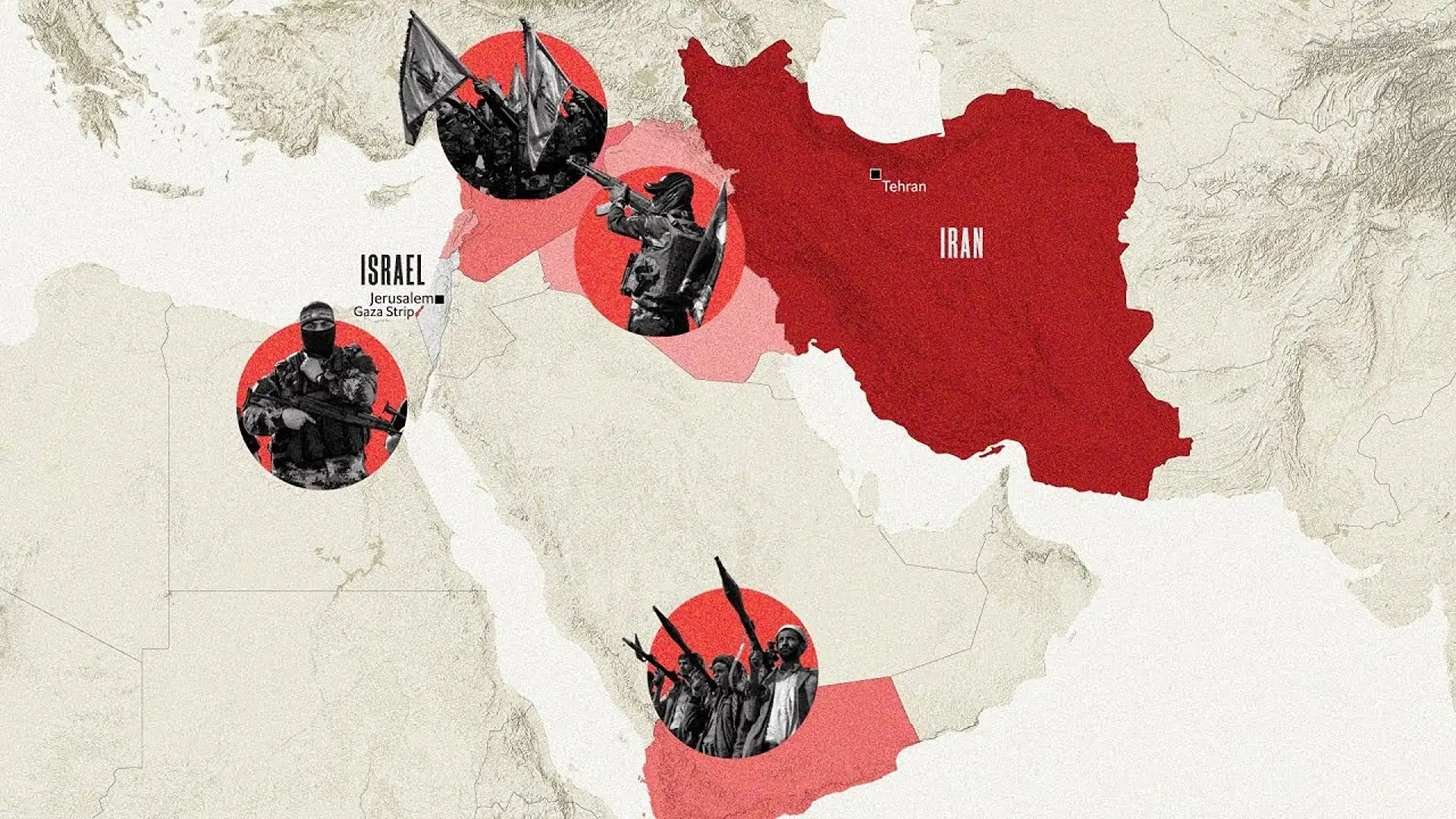
The Middle East has long been shaped by shifting alliances, religious divisions, and competing geopolitical interests. The current turbulence is largely a product of the Iran contrived "Axis of Resistance." Comprising of such disparate entities like the failed states of Syria, Yemen and Lebanon and ultra-radical militant organisations like Hamas, Hezbollah and Houthis, the coalition stands in opposition to the U.S.-led Middle East as also Israeli 'hegemony.' Less openly stated but clearly implied is as a counter to Sunni domination of the region under the tutelage of Saudi Arabia.
With the recent surge in a potential all-out Iran-Israel conflict, the geopolitical focus on this Axis has intensified. While its supporters may laud its ability to stand up to Israel, with all its massive Western backing, the damage the Axis sustained in the last one year has been considerable and questions its ability to sustain this punishment for an extended period.
Meanwhile, Saudi Arabia and other Sunni powers may see an opportunity to consolidate their own influence and reassert their dominance amid Iran's struggles.
The Axis
Undoubtedly, the Teheran is the epicentre of the so-called Axis of Resistance, with a range of strategic support for these groups across the financial, military and political spectrum. The Axis has significantly influenced Middle Eastern geopolitics, including by playing a role in the Syrian Civil War and Hamas and Hezbollah's contemporary confrontation with Israel.
The alliance emerged as Iran sought to become a regional power by exporting its revolutionary ideology whilst looking to counterbalance Israel and the USA's influence in the region. At the outset, it was centred in Iran and included Syria under Assad, along with Hezbollah in Lebanon. Iran’s primary objective was to create a forward defence perimeter against perceived threats from Israel and the U.S. It aimed at contesting an Arab status quo composed of the Sunni-centric regional order.
The establishment of Iran's proxy networks and alliances began to pick up pace in the 1980s, a trend exemplified by the creation of Hezbollah in Lebanon. Hezbollah became a template for proxy relationships, deriving funding, arms and ideology from Iran. The Iran-Iraq War (1980-88) reinforced Tehran's resolve to form a coalition of support in what was then an Iraq-dominated regional setting. Over the next several decades, Iran broadened their reach by nurturing connections to Shia communities and militia groups — including in Iraq, Yemen, Syria and Gaza.
Several key events shaped the evolution of the Axis of Resistance. The 2003 U.S. invasion of Iraq created a power vacuum that Iran exploited to increase its influence, supporting Shia militias and political parties. The Arab Spring uprisings in 2011 presented both challenges and opportunities for the Axis. In Syria, Iran intervened decisively to support the Assad regime, deploying IRGC advisors, Hezbollah fighters, and other Shia militias. This intervention not only preserved a crucial ally but also secured a land bridge connecting Iran to Lebanon. In Yemen, Iran seized the opportunity to support the Houthi movement, turning the conflict into a proxy war with Saudi Arabia and expanding the Axis's reach to the Arabian Peninsula.
Also referred to as the "Shia Crescent", this Axis serves as a strategic corridor for Iran to project power and support its proxies across the region. Following the U.S. invasion of Iraq in 2003, Iran capitalised on the ensuing chaos to strengthen its foothold in Iraq, subsequently extending its influence into Syria and Lebanon through military and financial support for groups like Hezbollah. For decades, Tehran's support of these groups has allowed it to wield considerable regional influence, challenging Sunni-led powers and countering Israeli and Western ambitions. Meanwhile, in Yemen, Iran’s backing of the Houthis has turned the conflict into a proxy war with Saudi Arabia, straining relations further and complicating efforts for peace.Iran has significantly assisted the Assad government in Syria; during the Syrian civil war, the Iranians provided the Assad regime with over $16 Billion in military and economic aid.
Lebanon-based and founded in 1982, Hezbollah is Iran's most capable and prominent proxy; it functions as the main arm of Tehran across Lebanon and Syria. Hezbollah continues to have a powerful military wing, funded by Iran at an estimated annual budget of $700 Million to $1 billion, as well as functioning as Lebanon's predominant political entity.Hamas, despite its Sunni ideology, aligns with Iran's anti-Israel stance, receiving substantial support estimated at $100 million annually. The Houthi movement in Yemen has emerged as a growing threat, particularly through its attacks on maritime traffic in the Red Sea, with over 100 incidents reported in 2023 alone.Despite having been weakened by years of civil war, Syria under Bashar al-Assad provides Iran with strategic depth and has acted as the country's overland bridge to Hezbollah.
The Axis has demonstrated increasing military sophistication, with Iran transferring advanced missile and drone technology to its partners. Politically, Iran has worked to legitimise its proxies within their respective countries, as seen with Hezbollah's role in Lebanon and the integration of Popular Mobilisation Forces in Iraq. This evolution has transformed the Axis from a loose coalition into a more cohesive network with shared strategic objectives, posing significant challenges to regional stability and Western interests.
Weakening of the Links?
Economic sanctions have taken their toll, and Israeli strikes against its proxies put pressure on an overstretched Tehran. The targeting of prominent Iranian figures, including several IRGC commanders, has shaken the command structure in Tehran and hamstrung its ability to communicate with its regional partners.
Meanwhile, in Syria, the Assad regime is still struggling with economic woes and internal discontent from a population that has endured several years of civil war. Hezbollah, portrayed as the most powerful non-state actor in the Middle East just a few months ago is now reeling from blows struck by Israel. In September 2024, its Secretary-General Hassan Nasrallah was killed, and many other senior leaders were eliminated, along with most of the known communications infrastructure. Inside Lebanon, Hezbollah also confronts a rising wave of discontent, which is a product of dire economic conditions in an impoverished and bankrupt country that still further diminishes its already tenuous grip.
Recent events have presented major obstacles to the Axis of Resistance. Israel's targeted assassination campaign has had detrimental consequences for Iran's proxies across the region. The assassination of Hezbollah Secretary General Hassan Nasrallah in September 2024 and the targeted killing of Hamas leaders Ismail Haniyeh and Yahya Sinwar have disrupted the command structures of these organisations. In the civil war in Yemen, Iran-backed Houthi rebels have made progress towards seizing control of major cities yet might face future legislative challenges with peace talks facilitated by Saudi Arabia. The Houthis have also stepped up their efforts, attacking maritime traffic in the Red Sea, elevating them within the Axis but further exposing themselves to international action.
What Lies Ahead?
The geopolitical consequences of the Axis of Resistance are broad and have ripple effects felt across the Middle East. The activities of the Axis have driven up tensions and set the stage for wider regional war —with direct missile exchanges between Iran and Israel. In 2024, the coalition is at a critical tipping point: its military forces have been sapped and internal unity fractured. The Axis' fate still depends on how well Iran might learn lessons from recent adversity and whether other regional actors can exploit or mitigate growing splits in this alliance. Whilst less devastating militarily for the Axis, the fallout from these events has further sapped trust between Iran and its proxies, which could dampen the effectiveness of their combined actions across the region.
Sanctions against Iran have grossly affected its finances to support its proxies. U.S. State Department and congressional estimates indicate that Iranian financial assistance to its allied militias fell from typical annual spending of $2 Billion since 2019 down to far less in the aftermath of COVID. This has been a product of oil revenue losses amassing to around $160 Billion and a contracted economy of around 20% since 2020. The economic situations in Syria and Lebanon are equally dire, with Syria's GDP projected to contract by 1.5% in 2024 and 69% of its population living in poverty. Lebanon's economy has been devastated by multiple crises, including currency devaluation, COVID-19, and the Beirut port explosion, pushing 80% of its population into poverty.
Nevertheless, Iran — and its proxies by extension — have managed to build the intricate financial networks needed to continue their operations. The Islamic Revolution Guards Corps (IRGC) employs Iran-based sources such as Khatam al-Anbia, a major domestic engineering firm responsible for infrastructure projects and bonyads (charitable trusts) to create income. Overseas sources of funding, such as illegitimate operation proceeds and funds from sympathetic states/non-state actors, are predominant as well. However, with the growing global backlash, funding from these sources continues to become more tenuous.
With all the recent setbacks to Iran and its key proxies, a question mark now hangs over the military capabilities of the Axis of Resistance. Although Iran retains a significant conventional military capability, with an army of about 600,000 soldiers and missiles capable of striking targets across the Middle East, its ability to project power across the region has been hampered by economic sanctions and targeted operations against its leadership and assets. In a series of recent flare-ups with Israel, Iran's missile program — the cornerstone of its deterrent strategy – had been less effective. Though the April and September 2024 missile barrages against Israel were unprecedented in their scale, they ultimately inflicted limited material harm to multiple cities across Israel while also revealing weaknesses Iran had with its long-range strike capabilities.
The Axis drone program is proving to be a resilient and developing threat. Hezbollah, in particular, has shown a high level of drone capability, having launched around 1,500 drones since October 2023 — both for surveillance purposes and to attack. And they have proved effective in getting through Israeli defences against military and civilian targets deep within Israel. The drones' potential to remain undetected and carry heavy payloads has caused Israel to reevaluate its air defence doctrine.
The Axis leans heavily into cyber warfare and intelligence operations. Iran is among the most aggressive cyber actors and has poured significant resources into building its own capabilities, often using them to disrupt infrastructure or conduct espionage against adversarial states.
Iran has sought diplomatic solutions to offset its economic isolation, as seen in the successful détente with Saudi Arabia mediated by China. But normalisation initiatives between Israel-Arab states are a challenging new prospect for the Axis of Resistance. China's increasingly powerful economic presence underscores the continuing relevance of external actors in the region; its GCC trade has soared from $10 billion in 2000 to an excess of $230 in 2021. The United States has an extensive outright security coordination with Gulf states, whilst Russia is also keen to defend its few regional allies. These dynamics have delivered a complex geopolitical reality in which regional actors are pursuing more multi-aligned strategies to hedge between the great power competition.
Key Takeaways:
Overall, while the Axis of Resistance remains active, its cohesion and effectiveness have been severely compromised, forcing Iran to reassess its regional strategy. The Axis faces severe internal strain due to leadership losses, economic pressures, and targeted military strikes.
Despite financial difficulties, Iran continues to support its proxies through alternative funding networks and strategic shifts
and its military
capabilities, especially drones and cyber warfare, remain a significant threat
in the region.
For Iran, leveraging the growing divide between Russia/ China and the West is a geopolitical gambit that could produce dramatic results. India would have to play its hands with dexterity, caught as it is between two sides that are essentially both important for its national interests.
Tags:
#AxisOfResistance #MiddleEastGeopolitics #IranProxies #Hezbollah #Hamas #IranIsraelConflict #RegionalPowerStruggles #GeopoliticalTensions #IranianInfluence #MiddleEastSecurity #ProxyWarfare #LeadershipCrisis #StrategicShifts
Works Cited:
https://www.understandingwar.org/backgrounder/iran-update-may-7-2024
https://www.ispionline.it/en/publication/the-economic-challenge-ahead-for-iran-165060
https://www.wilsoncenter.org/article/irans-islamist-proxies
https://www.brookings.edu/articles/the-path-forward-on-iran-and-its-proxy-forces/
https://www.csis.org/analysis/war-proxy-irans-growing-footprint-middle-east
https://ecfr.eu/publication/beyond-proxies-irans-deeper-strategy-in-syria-and-lebanon/
https://www.cfr.org/article/irans-regional-armed-network
https://www.cfr.org/global-conflict-tracker/conflict/war-yemen