
ALIGNING TECHNOLOGIES TO FUTURE CONFLICTS
“We should be able to see first and see the farthest, reach first and reach the farthest, and hit first and hit the hardest.”
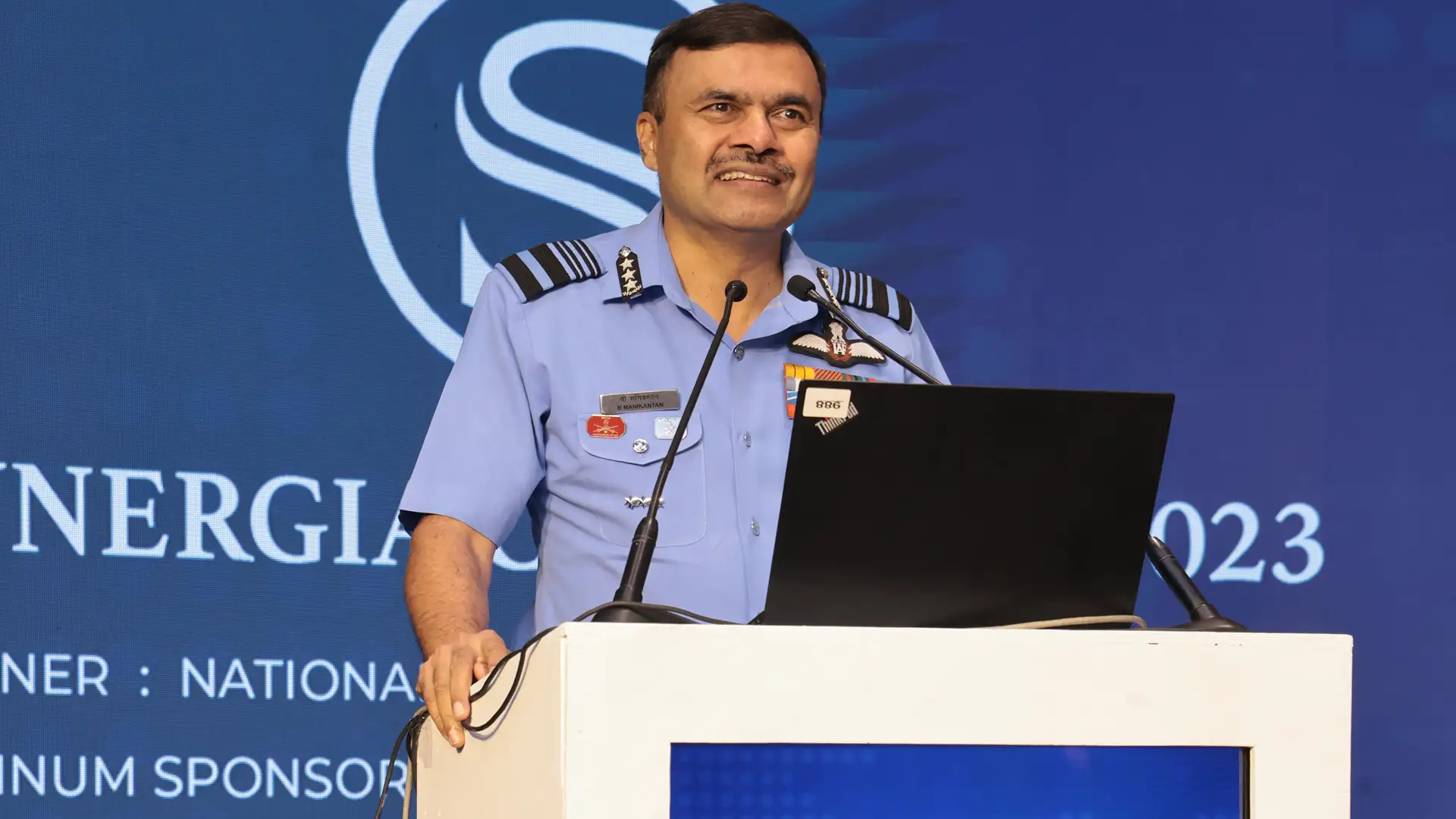
Air Marshal V. Manikantan
"'Victory smiles upon those who anticipate the changes in the character of war, not upon those who wait to adapt themselves after the change occurs.” – General Giulio Douhet.
It is necessary to examine the salient aspects of future conflicts and how they might differ; are they going to be more non-traditional, more non-linear, more non-sequential, etc? After reviewing the scenarios and salient aspects of future conflicts, we must review the technological impact, particularly of advanced technologies. We will need to align these emerging technologies to utilise these technologies as a force multiplier for conflict resolution. And finally, we should not forget that advanced technologies are also vulnerable to adversarial actions.
We are at the cusp of a new era, but the very nature of conflict is changing and transforming at an unprecedented pace and so much is in the realm of science fiction. All this has to be viewed in the context of the unprecedented and unpredictable changes that are happening across the globe in geopolitics. What will be the salient aspects of future conflicts? How would technology play an important part in these? And which technologies can be aligned in future conflicts?
Taking a Leaf from the Past
Technological transformation is already underway. Increasingly, the threats will manifest themselves at even longer ranges across all domains with much higher speed, high lethality and accuracy. For instance, at the end of World War I, who would have imagined that aircraft, aircraft carriers, submarines and tanks already being used in World War I would transform themselves so much and become powerful actors in World War II, which was just 20 years ahead? The lesson is, though it is difficult to forecast which technology might eventually prevail, we need to align our capabilities, thought processes, and organisational structures to meet these scenarios of technological transformation ahead.
The Manhattan Project ushered in the atomic era, and nothing has been the same. Operation Desert Storm in 1991 showcased the successful alignment of technologies, precision-guided munitions, and GPS, all integrated into the strategy, minimising collateral damage and a quick victory, primarily from the air.
The Stuxnet worm, used against Iranian nuclear facilities, was a sophisticated cyber weapon that augured cyber warfare's emergence.
Operation Neptune Spear in 2011, which led to the death of Osama bin Laden in Pakistan, best exemplified the interoperability of technologies. Stealth helicopters, night vision equipment, encrypted communication, and real-time satellite intelligence were all combined for a complex mission by night, far away from home.
The Armenia-Azerbaijan conflict of 2021 highlighted the lethality of autonomous UAVs. This marked the dawn of combat UAVs, and now it has been joined by the small UAVs proliferating in Ukraine.
During the COVID-19 pandemic, we saw the crucial role of biotechnology in monitoring and responding to the spread of the disease. Biotech played a crucial role in the rapid development of vaccines, the use of telemedicine, the development of contact tracing applications, and data analytics.
Crystal Gazing
In the future, wars will continue to be fought for the same reasons as the case so far. However, if possible, powerful nations may seek to bring out outcomes without resorting to overt military means. Inducing compliance would include four phases, which we are all familiar with: information warfare, cyber-attacks, and coercive deterrence, which would include the massing of hybrid forces, including private military companies, the establishment of no-fly zones, naval blockades, etc. Intervention in the battle space is the fourth phase, if inevitable, would involve kinetic operations to degrade the enemy's war-fighting potential.
The key to military strength will continue to depend on technological innovation, especially in aerospace power, and nations will invest in technology to ensure mastery. Before we look at how technology will play an important role in future conflicts, let us examine past scenarios to see how they have impacted.
Urban warfare is already a reality. By 2050, over 70 per cent of the world's population will likely be in urban centres, and militaries will have no choice but to fight in the cities. This will require responsive, agile forces to protect civilians and infrastructure and precision munitions to minimise collateral damage. All these are technology intensive.
Multi-domain operations will be the norm. Capabilities and resources of all domains will be integrated into the planning and execution of missions to beat the adversary's strengths and to present them with operational and tactical dilemmas.
Challenges And Opportunities
Aligning technologies for military superiority essentially means integrating and synchronising advanced technologies within a military framework to gain a competitive edge and ensure dominance in battle. What advantages do we expect as a military user from such an alignment?
Real-time situational awareness will allow the commander to stay inside the adversary's OODA loop (Observe, Orient, Decide and Act). This level of efficient decision-making is particularly crucial because future wars, as always, will be very complex and fast-moving. So, this will greatly help them in anticipating.
Cutting-edge communication systems will ensure command and control over dispersed units, enabling rapid response and coordination between them for interoperability for orchestrating a complex response or campaign.
Risk mitigation will be achieved through AI-powered autonomous systems, which will reduce human presence in high-risk situations. This will enhance operational effectiveness and efficiency, reduce human casualties and maybe even make military missions safer.
Space-based assets are always advantageous since they give you global surveillance, secure communication, precise navigation and great offensive capabilities.
Demonstration of technical readiness is very important for a nation because it provides strategic deterrence. A military with advanced technology is operationally much more effective. For example, open-source studies of training exercises have shown that fifth-generation aeroplanes such as the F-22 and the F-35 have significantly higher kill ratios than the previous generation and much better survivability.
The MUMT (Manned Unmanned Teaming) is another technology that, in the future, will be a real game changer. Aligned technology will provide better protection for troops and minimise casualties and collateral damage.
Adaptability is crucial because the dynamic threat landscape of the future will require us to use adaptability to meet hybrid threats and make the most of resources that will always be scarce.
Operationalisation Concepts for Technology
A military commander would be required to get a hand on the new technology- intelligence, weapon systems, maintenance and training, and link the technologies that can be aligned to achieve it.
Concerning intelligence, sensor fusion and data integration would provide the foundation as they integrate data from multiple sources and sensors like satellites, drones, ground-based sensors, etc. Advanced algorithms, AI, and machine learning can help combine these data streams for a comprehensive and real-time understanding of the battle space. This would be useful even in detecting a stealth aircraft in a heavy, dense EW scenario. The machine vision technologies will analyse imagery and video feed from different sensors, providing insight into an adversary's movements, vehicle identification, and even facial recognition of high-value assets. Predictive analytics using machine learning models can be trained to predict the adversary's actions based on historical data, weather conditions, and real-time inputs and offer valuable inputs into potential threats. For tamper-proof data storage and transmission, blockchain technology will be of great use for the integrity and authenticity of sensor data.
Weapon systems could be offensive and defensive and require things like directed energy weapons, which are high-energy laser microwave weapons that will provide precise near instantaneous engagement of targets. Hypersonic weapons are highly lethal, very fast, and manoeuvrable. We have already seen Russia using them in Ukraine. Aero engines to support them and electric propulsion are on the anvil and will provide the next level of capability. Next-generation materials like composites and metamaterials would improve survivability and be used in stealth aircraft.
Multi-domain integration by linking air, land and space forces with communication and data sharing for integrated operations across domains will increase and enhance effectiveness both for offensive and defensive actions. It is important for defensive actions because it will improve our redundancy from physical and virtual attacks.
Operational logistics and maintenance are very important. Predictive maintenance monitoring can be done by implanting sensors and IoT devices on aircraft and other platforms to continuously monitor their health. Machine learning and log algorithms can analyse and predict when maintenance will be needed, reducing downtime and extending the lifespan of equipment. Additive manufacturing, like 3D printing, will revolutionise sustainability, a major problem today. Warehousing can be automated with smart inventory management systems for efficient storage and retrieval of supplies and spares. IoT devices can track the location and condition of assets and equipment, enabling us to better manage them. Automation by using robots and autonomous vehicles for aircraft inspections, parts delivery and maintenance, thereby enhancing efficiency and reducing human labour and human errors.
For example, the G Aerospace Worm, Sensei Worm, is a small device that can crawl into interior parts of a jet engine and look for cracks, corrosion, and gas leaks, even measure the thickness of coating within, which will revolutionise maintenance of engines and avoid aero engine related accidents, incidents in future.
Concerning training, we could use LVC, which combines light training with virtual and constructive elements. You could have real aircraft, virtual simulators, and computer-generated forces all operating in tandem, making it more realistic. Distributed mission operation systems will enable collaborative training exercises across different locations so you don't have to move physically and save costs. Digital twin technology creates digital replicas of actual aircraft for testing, training, and maintenance simulations, thereby removing any risks of physical assets.
Some Red Signals
There are limitations in this drive towards technology for the armed forces. The budget for R&D is an important issue because advanced technologies require substantial investments. Regarding India, our public R&D appears good at about 0.36 per cent of the GDP. Perhaps the private sector needs to pitch in a little more.
The proliferation of technology in this digital age is a real worry. Potential leakage into the wrong hands, particularly non-state actors, would pose serious threats. Compatibility issues exist, as integrating diverse systems to achieve technology alignment is technically complex. It can result in communication breakdowns, reduced efficiency, and operational vulnerabilities. And while attempting to synchronise legacy systems with new technology, there can be further problems.
Cyber threats are real, and the interconnected nature of technologies exposes many vulnerabilities. Cyber-attacks can disrupt and cause even crippling of some of our critical capabilities.
Global supply chains are complex and susceptible, particularly for an aerospace industry. Counterfeit components, compromised software, and vulnerabilities introduced during production can all jeopardise the integrity and security of systems. Sabotage, espionage or theft in the supply chain can cause anything ranging from reduced safety to compromised national security.
It is also true that integrating emerging technologies has inherent risks. This includes a lack of maturity of the system, technology, and possible vulnerabilities that the adversaries can exploit. Its rapid development and deployment may also have outpaced certain regulatory and ethical frameworks, which could lead to unintended consequences or misuse. There is also a major worry that technology replacing humans may cause some blurring of our focus and involvement, potentially leading to a disconnect between the operator and his immediate external environment. In other words, over-reliance on technology should not lead to complacency, which the enemy can capitalise on.
It is useful to highlight that the evolving character of warfare has placed great emphasis on multi-domain operations, which is very dependent on advanced technology. Our endeavour should be to identify, nurse and leverage promising technologies to suit our operational requirements at an affordable cost and within a suitable time frame to deter our adversaries.