
THROUGH FRENCH PRISM
Navigating Flows, fostering partnerships, and embracing multilateralism lies at the heart of France's vision for the Indo-Pacific.
Veer Puri
5/12/2024
|
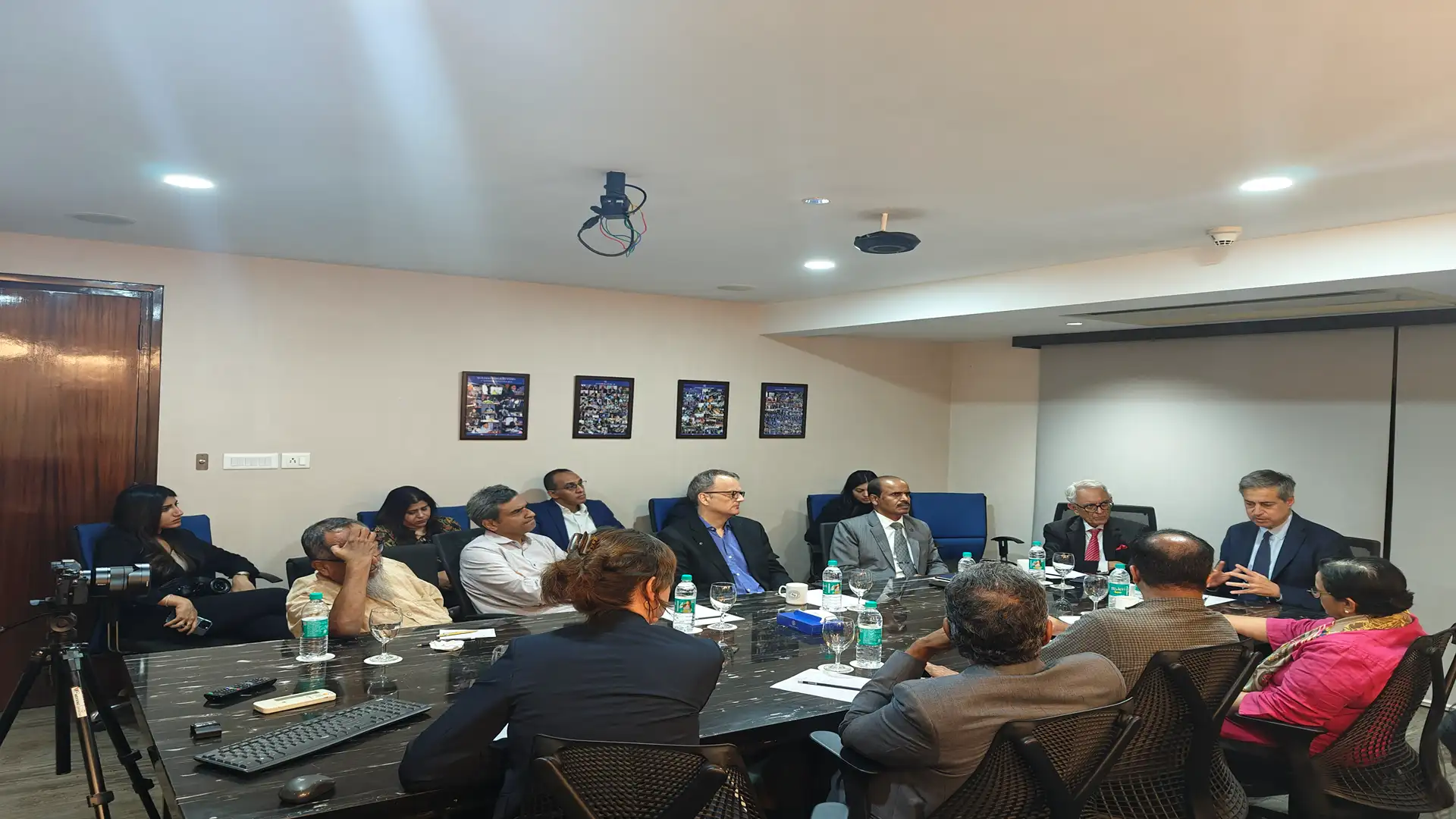
This article is based on the interaction at Synergia Foundation with the French ambassador for the Indo-Pacific, Ambassador Marc Abensour. |
While not widely acknowledged as a major Indo-Pacific power when compared to the U.S. or China, France remains an important stakeholder. As per the Centre for Strategic & International Studies (01 April 2021), France sees itself as an "island state" in the Indo-Pacific due to its numerous overseas territories across the region (e.g., Mayotte, La Réunion, New Caledonia, and French Polynesia), which are home to 1.6 million French citizens. These territories provide France the second-largest exclusive economic zone in the world, with 11 million square kilometres, second only to the United States. Along with this extensive maritime footprint, France shares borders with five countries in the Indian Ocean and 12 in the Pacific Ocean.Economic ties between France and the Indo-Pacific have grown significantly over the past years. More than one-third of French exports to non-EU countries go to the region. As far back as 2018, France under President Emmanuel Macron described itself as an “Indo-Pacific power” for the first time.
French Strategy for the Indo-Pacific
France's Indo-Pacific strategy is fundamentally a geopolitical construction with two key dimensions.
The first dimension involves changing perspectives from traditional regional and sub-regional boundaries to emphasise flows, which are at the core of the globalisation process. These include maritime, trade, communication flows (e.g., subsea cables), and energy flows. From far-off, fragile territory to strategic assets, this change of viewpoint refines islands. Because of their Exclusive Economic Zones (EEZs) and ability to manage critical choke points and marine channels of communication, islands acquire significance.
The second dimension addresses China's growing assertiveness while deliberately rejecting a "block-to-block logic" and avoiding the formation of an anti-China coalition. France preserves a "demanding dialogue" with China on international crises and issues. This approach maintains no equidistance between Washington and Beijing, clearly stating that France remains a close U.S. ally. However, France emphasises being "allied but not aligned" with the U.S., reflecting its commitment to strategic autonomy.
This conceptual framework allows France to engage constructively with China on global issues such as the Russian invasion of Ukraine, the nuclear crisis in Iran, and situations in the South China Sea and the Korean Peninsula. It tackles systematic differences and economic rivalry at the same time. By means of the European Commission's adoption of several mechanisms and tools, France seeks to guarantee a level playing field in economic competitiveness with China. These tools are country-agnostic and can be used in cases of asymmetric rules of the game between Europeans and China, including instruments for anti-economic cohesion, screening foreign investment, international procurement, and addressing foreign subsidies.
France also maintains an active dialogue and cooperation with the United States on Indo-Pacific issues. While France's approach to the region differs somewhat from that of the U.S., particularly in its stance towards China, the two countries share many common interests and concerns. France and the United States maintain an active relationship through coordinated participation in international organisations and frequent bilateral talks on regional issues. In addition, France often deploys its naval forces to the Indo-Pacific area and participates in joint drills with regional allies. Deploying the aircraft carrier Charles de Gaulle and its carrier strike group is one example of these kinds of operations; they show France's dedication to the area, improve cooperation with partner navies, and help keep the waters of the Indo-Pacific safe and secure.
Spearhead of the EU
France is taking the lead in establishing EU engagement in the Indo-Pacific region, and it sees its national Indo-Pacific strategy as complementary to the EU's approach. In 2021, the European Union approved its Indo-Pacific Strategy, which France is keen to support and implement. By coordinating efforts in the Indo-Pacific region, this plan helps achieve France's national goals while also benefiting the European Union.
The Global Gateway program is vital to the European Union's involvement, and it centres on connection and infrastructure in five domains: climate, transportation, digital, health, and education. Instead of focusing solely on providing bilateral development assistance, France stresses the significance of using this program to further the EU's geopolitical goals in the Indo-Pacific. In order to achieve larger geopolitical goals, it is necessary to create projects that will have an immediate effect on the region. Examples include initiatives on subsea cables, decarbonisation of the shipping industry, the green transition of port infrastructures, and developing of green shipping corridors.
France initiated the EU Ministerial Forum for the Indo-Pacific during its EU presidency in 2022 to foster dialogue and cooperation between the EU and Indo-Pacific partners. This unique platform excludes the U.S. and China to secure an autonomous space for dialogue between European and Indo-Pacific partners. The forum has become a valuable tool for accelerating cooperation and addressing pressing regional concerns, such as climate change in the South Pacific. France continues to organise these forums, with plans for a summit in the first half of the coming year. Through these initiatives, France aims to enhance the EU's role in the Indo-Pacific, providing alternatives to regional partners and reducing dependencies on dominant players like China.
Leveraging Regional Presence
France uses its overseas territories as a "resident nation" in the Indo-Pacific to further its regional strategy and wider objectives. French Polynesia, New Caledonia, and Réunion provide France with a special vantage point from which to interact with this region. The Indo-Pacific strategy aims to include these territories as active participants in its implementation while simultaneously serving their interests by promoting regional insertion and economic diversification.
France utilises its territories to develop stronger economic ties with regional partners. For instance, efforts have been made to enhance economic connections between La Réunion and India. France continues to encourage the establishment of direct air and maritime connectivity between India and its territories in the Indian Ocean, recognising the importance of these links for regional economic integration
The French territories also serve as valuable platforms for projecting expertise in critical areas such as biodiversity protection, marine management, and health. France has established a strong presence of its agencies and research institutes in these territories. For example, the French Development Agency (AFD) maintains a significant presence in La Réunion, where it has developed regional programs focused on biodiversity protection and sustainable ocean management. Other institutions like CIRA, IRD, and the Pasteur Institute also contribute to regional initiatives. France is considering opening a Pasteur Institute in India as part of its efforts to battle infectious diseases by utilising its territorial presence. France can address regional concerns holistically and generate synergies through its network of research and development organisations.
Multilateral Engagement
France strongly emphasises engagement with regional multilateral organisations as a core component of its Indo-Pacific approach. Over the last few years, France has made substantial progress in becoming either a full-fledged member or developing closer ties with key regional organisations.
In the Indian Ocean, France became a full-fledged member of the Indian Ocean Rim Association (IORA) in 2020. Since joining, France has provided substantial assistance, becoming the second largest contributor of experts and increasing its funding. France has taken a proactive role within IORA, leading initiatives such as adopting guidelines on illegal, unreported and unregulated (IUU) fishing in collaboration with Indonesia. The country is also working with Madagascar on humanitarian assistance and disaster relief (HADR) and with Seychelles on marine biodiversity protection. France recognises the importance of the Working Group on Maritime Security, co-chaired by India and Australia, as a key component of its cooperation with India across the Indian Ocean.
In Southeast Asia, France has attained development partner status with ASEAN, implementing an action plan and providing experts and specific funding. France is working more closely with ASEAN Excellence Centres and has developed a regional approach through its agencies, moving beyond bilateral engagements with individual ASEAN member states. France engages with the Pacific Islands Forum (PIF) as a dialogue partner in the South Pacific, while French Polynesia and New Caledonia are full-fledged members. This unique arrangement requires coordination among French entities ahead of PIF meetings. France has demonstrated its commitment to the region by opening a new embassy in Samoa, multiplying its financial engagement fivefold, and establishing new Agency for French Development (AFD) offices in Vanuatu, Papua New Guinea, and Fiji.
Indo French Partnership
Historically a major supplier of high-value defence equipment to India, the Indo-French relationship has been strong and enduring over the decades. France seeks out strategic alliances, especially with India, to help it achieve its Indo-Pacific goals. France and India's foreign policy stances are highly congruent with one another, and their shared dedication to strategic autonomy is the bedrock of their strategic relationship. Defence, security, space, and civil nuclear cooperation are just a few areas where this alliance has grown and thrived throughout the years. More recently, the collaboration has expanded to include environmental protection and climate change mitigation efforts.
In addition to its bilateral partnership with India, France has established trilateral cooperation formats involving India and other key regional players. The France-India-Australia trilateral and the France-India-UAE trilateral are prime examples of these minilateral arrangements. These formats allow for more focused and efficient cooperation on specific issues of mutual interest in the Indo-Pacific region. For instance, the France-India-UAE trilateral has been exploring cooperation in maritime security, space technologies, artificial intelligence, climate action, and other areas. France views these trilateral formats as instrumental in supporting and strengthening regional multilateral organisations.
Key Takeaways
France's Indo-Pacific strategy is a geopolitical construction focusing on flows rather than traditional regional boundaries, reframing islands as strategic assets.
It differs from America’s Indo-Pacific pivot in that it
r
ejects a bloc-to-bloc logic and anti-China coalition, maintaining a "demanding dialogue" with China while emphasising strategic autonomy.
This potentially gives Paris greater leverage to de-escalate any flashpoint in the region.
France leverages its overseas territories to implement its Indo-Pacific strategy, projecting expertise and developing regional programs
, even at the cost of being reluctant to shed its colonial colours. However, its rule over its territories vastly differs from the past and has endured because most locals are happy being under the tricolour.
France is committed to strengthening regional multilateral organisations and becoming a member or partner of IORA, ASEAN, and PIF while engaging in multilateral formats.
India should be happy to see France play a greater role in countering hegemonistic moves in the Indo-Pacific by any of the bigger powers.
|
"We are a resident nation of the Indo-Pacific because of our territories. And the Indo-Pacific strategy, to us, is a way to include our territories as actors for the implementation of the Indo-Pacific strategy. But it also serves the interests of our territories, in the sense that it contributes to their regional, to their insertion within their regional environment, and also to their economic diversification." Marc Abensour, French Ambassador to the Indo-Pacific |