
AN INCONVENIENT STAND?
Under the leadership of Turkiye, leading Muslim countries are trying to forge a unified front. Can their inherent weaknesses sustain it?

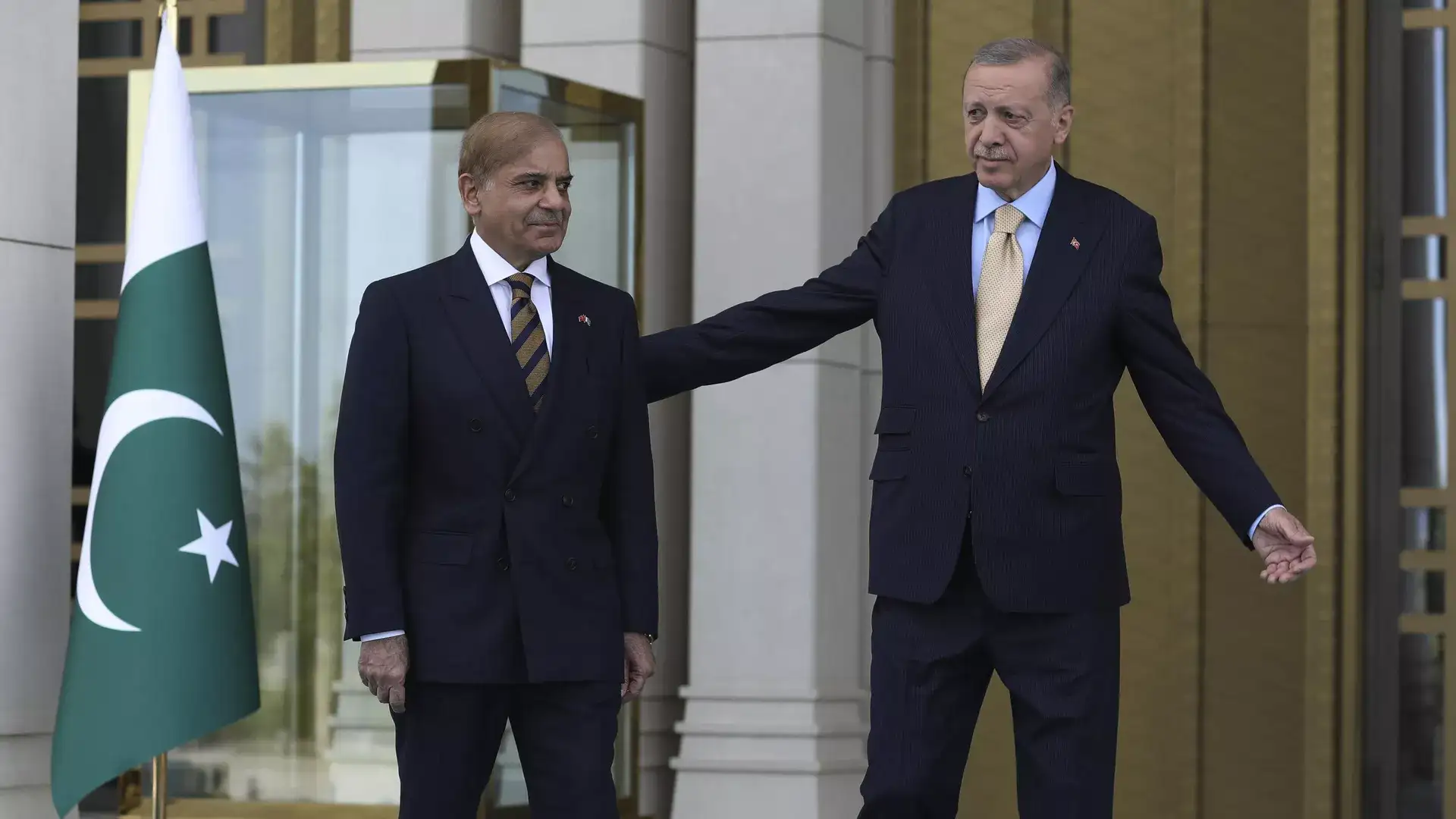
Source: https://www.google.com/url?sa=i&url=https%3A%2F%2Fsputniknews.in%2F20230221%2Freturn-to-sender-aid-fiasco-stokes-troubled-relationship-between-pakistan-and-turkiye-948598.html&psig=AOvVaw0W7eIAbfEmJqq6efvhSZzD&ust=1729931681455000&source=images&cd=vfe&opi=89978449&ved=0CBQQjRxqFwoTCLiAnPmPqYkDFQAAAAAdAAAAABAJ
Under domestic pressure for their inertia in going to the aid of their Muslim brethren in Gaza and Lebanon, Türkiye hosted a “Global Palestine Conference” last month attended by over 50 countries, mostly from the Islamic umma.
Since October 7th last year, when Israel launched its military operation in Gaza, Türkiye has inexorably been drawn into a leadership position for the Muslim umma despite its close economic and military ties with the West. For some time now, President Erdogan has been advocating the formation of an Islamic alliance against what he calls “the growing threat of expansionism” from Israel. The response so far has been lukewarm.
Under an identical predicament domestically, Pakistan has also been under fire for lack of any concrete action on Gaza apart from a few aircraft loads of humanitarian assistance material. In fact, the jailed leader of PTI, Imran Khan, has been using the stick of Gaza to consistently beat the military-imposed government of the Pakistan Muslim League, which won a highly controversial election through dubious means. Senator Mushahid Hussain Sayed represented Pakistan at the conference and presented a “Three Point Plan” at the gathering.
The Three-Point Plan
The first step of the action plan is to cobble together a delegation of global leaders from the Global South, including Pakistan, Indonesia, Malaysia, South Africa, Algeria and Brazil. The proposed delegation would seek the intervention of the U.S. President-elect to stop supporting Israel.
The second step envisages Muslim nations with credible navies- Turkey, Pakistan and Indonesia-leveraging their naval assets to set up a joint flotilla to deliver humanitarian assistance to Gaza in violation of Israel’s blockade. This brings to mind the Gaza Freedom Flotilla of 2010 launched by the Turkish Foundation of Human Rights and Freedoms and Humanitarian Relief. The small fleet of small ships carrying humanitarian aid and construction material with the intention of breaking the Israeli blockade of the Gaza Strip was intercepted by Israeli special forces; nine activists were killed in the subsequent scuffle, straining Israel-Turkey relations and forcing Israel to ease the blockade.
The third step suggestedthe launch of a global media initiative to represent the Muslim Ummah through ideas and narratives, given that Western media had been biased in its coverage of Gaza. The overarching idea being to show that the Muslim Umma has the will and capability to undertake concrete steps.
Will it Cut Ice with Israel?
The proposal appears to be more an exercise in assuring domestic public opinion than an actual coming together of like-minded nations to exert military/ stroke diplomatic pressure on Israel as a united front.
However, it did serve the purpose of sending a message to Israel and its supporters in the West that there is rising impatience, anger, frustration and the desire to stop the ongoing carnage in West Asia. Therefore, as part of overall signalling, the joint declaration plays its role along with the numerous declarations promulgated by OIC and the Arab bloc from time to time.
The reality remains that after having exploited all international fora-the UNGA, UNSC, the ICC, etc, the Muslim Ummah is at a loss how to bring about a cessation of hostilities in Gaza and now in Southern Lebanon. Under the overarching umbrella of the U.S. and major EU members, Israel is all but impervious to any pressure to stop the war. This is clearly visible with even Qatar, which has been hosting a Hamas delegation since the beginning of the war, has called an interim halt in all negotiations. Calling the talks a 'political football' and claiming that its efforts were generating criticism towards Doha, it announced a halt. It blamed both Hamas and Israel for refusing to negotiate in good faith. This is yet another blow to the already half-hearted efforts to get both sides to sign for a ceasefire.
In any case, all sides are watching keenly how Trump will activate his much-vaunted plan to “stop both wars in a day” once he assumes office in January next year.
National Compulsions
It is interesting that the Three Point Plan was introduced by Pakistan, which continues to hold on to its longstanding position on Israel, wherein it refuses to recognise the country. While Pakistan attributes this to Islamic solidarity, many Arab countries have recognised Israel and set up formal diplomatic ties with the country. Following in the footsteps of countries like Egypt and Jordan, the UAE and Bahrain recently forged formal diplomatic ties with Israel, effectively normalising relations with Israel. Saudi Arabia also had a normalisation deal in the works.
This ties into the country’s wish to portray itself as a flag-bearer of Muslims. It also gives it a moral high ground and a basis to criticise India for its close strategic ties with Israel. As per the Pakistani Press, there is an element in the Pakistani Establishment that seeks to establish a relationship with Israel so as to get some concession from the West. Allegedly, the previous Army Chief, General Bajwa, was one such 'closet supporter' of Israel. However, due to the strong sentiments linked with the Palestine issue dating back to the declaration made by its founder, Mr Jinnah, who is on record calling Israel 'the illegitimate child of the West," any overt move to normalise relations with Israel would be considered a political hara-kiri in the Pakistani political landscape.
The Pakistani public has a long-running sympathy with the Palestinian cause. Religious extremist groups have a lot of clout in Pakistan, and this is reflected in the nation's foreign policy, precluding the possibility of a normalisation with Israel.
Turkey historically has a love-hate relationship with Israel. Both enjoyed close military and trade ties for years, with Ankara being the bigger benefactor. However, a more extremist regime under Erdogan has gradually turned the orientation; Erdogan recently called for an alliance of Islamic countries against the “threat of Israeli expansionism”. Turkey has taken a clear stance and delivered scathing criticism against Israel’s war on Gaza. Moreover, Erdogan and his conservative base view Hamas as a legitimate political actor. For instance, after Hamas won the 2006 elections in Gaza, Ankara invited its leader for an official visit.
More importantly, Turkey is keen to portray itself as a regional leader in what is referred to as “neo-Ottamanism”. Erdogan wants to reinforce his image as a leader of the Islamic world and sell it to the Turkish public. It works well with domestic voters as Erdogan emerges as the only leader standing up to Israel and the West. Yet, Erdogan’s inability to effect a change in Israel’s onslaught on Gaza has weakened Erdogan's standing and stoked hardline Islamic sentiment in the country. While Erdogan would be happy to play the role of mediator, his harsh stance on Israel has likely offended it, making it difficult for Turkey to contribute to the negotiations with Hamas.
There is no denying that the Turkish public is very sensitive to this issue, sympathises with the Palestinians, and is critical of the United States for its perceived support for Israel. Erdogan is no doubt leveraging popular opinion to build his image and describing the war as "crusader vs. crescent" to emphasise his role as an Islamic leader. The Palestine cause is not just a matter of foreign policy but an important factor in domestic politics.
The Gaza conflict could push Turkey away from the West, a contingency for which Ankara seems to be preparing. This is displayed in its bid to join BRICS. It would like its determination to stay non-aligned and maintain an independent foreign policy.
It must also be noted that all is not posturing. Ankara may have the ability to amplify criticism of Israel and the United States in the Global South and increase domestic pressure on Arab leaders to take a tougher stance against Israel. Turkey’s position on the Gaza war has made it a leading member of the non-aligned Global South.
India is cautious about Turkey’s close ties with Pakistan and has a mixed response to Turkey joining BRICS. Turkey supports Pakistan in its Kashmir dispute with India. Given this, it's not certain whether India will approve Turkey's membership. India might seek closer ties with Western powers, particularly the US and European countries, to counterbalance growing Pakistan-Turkey ties.
It is not surprising that Pakistan secured a platform to give voice to its Three Point Plan in Turkey. Pakistan and Turkey have historically had close and amicable ties as two important powers in the Islamic world. At its peak, the Ottoman Empire was a pillar of Muslim power and a centre for arts, sciences, and culture. During its final years, such as during World War I and the following Turkish War of Independence, the people of the Indian subcontinent (now Pakistan, India, and Bangladesh) supported the Ottoman Turks, and there was a sense of religious brotherhood. Signs of this friendship are still visible today. For example, Lahore has an Allama Iqbal Road named after the well-known philosopher and poet who dreamed of a unified Muslim ummah and saw the Ottoman Caliphate as its fulcrum.
Both nations, being influential players in the Muslim world, have shown solidarity on issues concerning the Islamic community. These include the Palestine issue, Kashmir, and global Islamophobia. This has strengthened the socio-political foundations of their ties.
Assessment
After decades of aligning with the West, it is unlikely that Turkey will distance itself from its Western allies. Yet, moves like joining the BRICS and spearheading a pro-Palestine response in the Muslim world could gain Turkey more global standing. It is also a response to the slight of the EU rejecting Turkey’s bid to become a member.
For both Pakistan and Turkey, it would be an opportunity to gain soft power and position themselves as leading members of the Global South, particularly the Islamic world
,
as larger Muslim countries like Saudi Arabia and the UAE refrain from taking a
stringent
stance against Israel.
These moves by Turkey could also reflect its dissatisfaction with its Western allies and NATO, where it faces differences with other members over key issues. Turkey's stance on the Gaza war is a way to highlight its independent foreign policy and non-aligned, multipolar approach. Setting itself apart from its Western allies could be a way to appease conservative Muslim elements in its public.
References
https://tribune.com.pk/story/2504075/mushahid-hussain-calls-for-global-action-on-palestine-at-ankara-conference
https://www.mei.edu/publications/pakistans-israel-dilemma
https://moderndiplomacy.eu/2023/09/25/pakistan-turkey-defense-ties-and-policy-options/
https://www.bbc.com/news/world-europe-67861266
https://www.reuters.com/world/middle-east/turkeys-erdogan-calls-islamic-alliance-against-israel-2024-09-07/
https://www.brookings.edu/articles/the-sultans-ghost-erdogan-and-the-israeli-palestinian-conflict/
https://www.brookings.edu/articles/understanding-turkeys-response-to-the-israel-gaza-crisis/
#WestAsia #MiddleEast #SouthAsia #Turkey #Pakistan #Gazawar #Israel #Gaza #Diplomacy #Security #Geopolitics #Foreignpolicy #GlobalSouth #Internationalrelations #Insights
Mushahid Hussain calls for global action on Palestine at Ankara Conference
Mushahid Hussain urges Erdogan to lead a 3-point plan for Palestine, emphasising unity and action among Muslim nations