
SECURING THE INDO-PACIFIC
Why are we shy of calling ourselves a ‘net security provider’?
By Rear Adm Monty Khanna
India occupies a central and prominent position in the Indian Ocean. Our centrality has been historically recognized in that the Indian Ocean is the only ocean in the world named after a country. While in contemporary terms, we may accuse ourselves of sea blindness, the same has not always been true. There have been periods in our history where the maritime domain has occupied a predominant position, not only for trade but even for culture and geopolitics. The Cholas, for instance, made extensive use of this domain to expand their empire. Culture and religion also travelled with seafarers to distant locations such as Thailand, Indonesia and Cambodia. The lasting effects of such civilizational intermingling are clearly evident even today in these countries.
Indian dynasties, not unlike anywhere else, have followed sinusoidal trajectories. The last of these dynasties, the Mughals, commenced their geo-political descent after the death of Aurangzeb. Wracked by inept leadership, infighting and plundering chieftains from Persia such as Nader Shah, their downfall was rapid, and they steadily seeded space to colonial entities such as the East India Company. As these companies were multinational in nature, they had interests in countries well beyond the Indian subcontinent. Given India's enormous human resources, it was not long before the gains that could be made by shifting labour from India to scantily populated resource-rich colonies became evident. Thus started the indentured labour movement to countries such as Mauritius, South Africa, Fiji and Guyana amongst others. This had the collateral impact of intermingling of cultures on an industrial scale.
More recently, many countries have looked at India's enormous human resource pool to meet their white—and blue-collar job requirements. As a consequence, the Indian diaspora now numbers close to thirty million.
It can thus be seen that trade, religion, labour shortfalls, and Indian dynamism have all played a role in the movement of Indians overseas and the consequent intermingling of cultures. In no region is this more evident than in the island nations in our periphery, Sri Lanka, Maldives, Mauritius and Seychelles. Our cultural overlap with these countries, though varying from nation to nation, is large. This gives us a deeper insight into their lifestyles, business environment, opportunities and challenges, and decision-making dynamics. Coupled with this insight is our geographical proximity, thereby reducing the tyranny of distance. These advantages put us in a unique place to engage these countries to our mutual advantage.
One common thread amongst all these nations is the limitation of capacity to administer and police the enormous maritime resources that each is blessed with. A simple comparison between Mauritius and India illustrates this point. With a population of 1.42 billion, India exceeds the Mauritian population of 1.26 million by more than a thousand times. When it comes to territory, the disparity is even starker, with India being 3.2 million sq km and Mauritius 2040 sq km, i.e. more than fifteen hundred times. However, when it comes to our Exclusive Economic Zones, we are almost at par with Mauritius, each country having an EEZ of about 2.3 million sq km. When India is at times challenged to police its own EEZ, one finds it difficult to imagine the challenges faced by Mauritius. The situation is no better in the other island states. Maldives, with a population of a little over half a million, has an EEZ of nearly a million square kilometres. The situation in Seychelles is even more telling. The country has a population of just 107,660 and an EEZ of 1.37 million square kilometres!
It is, therefore, natural that these island nations will be constrained in their capacities to address their maritime security challenges, be they smuggling, drug pedalling, gun running, human trafficking, IUU fishing, HADR, maritime pollution, maritime terrorism, piracy and safe navigation amongst others. To add to this complex cocktail are the growing security challenges related to climate change, many of which may acquire an existential dimension for smaller island states.
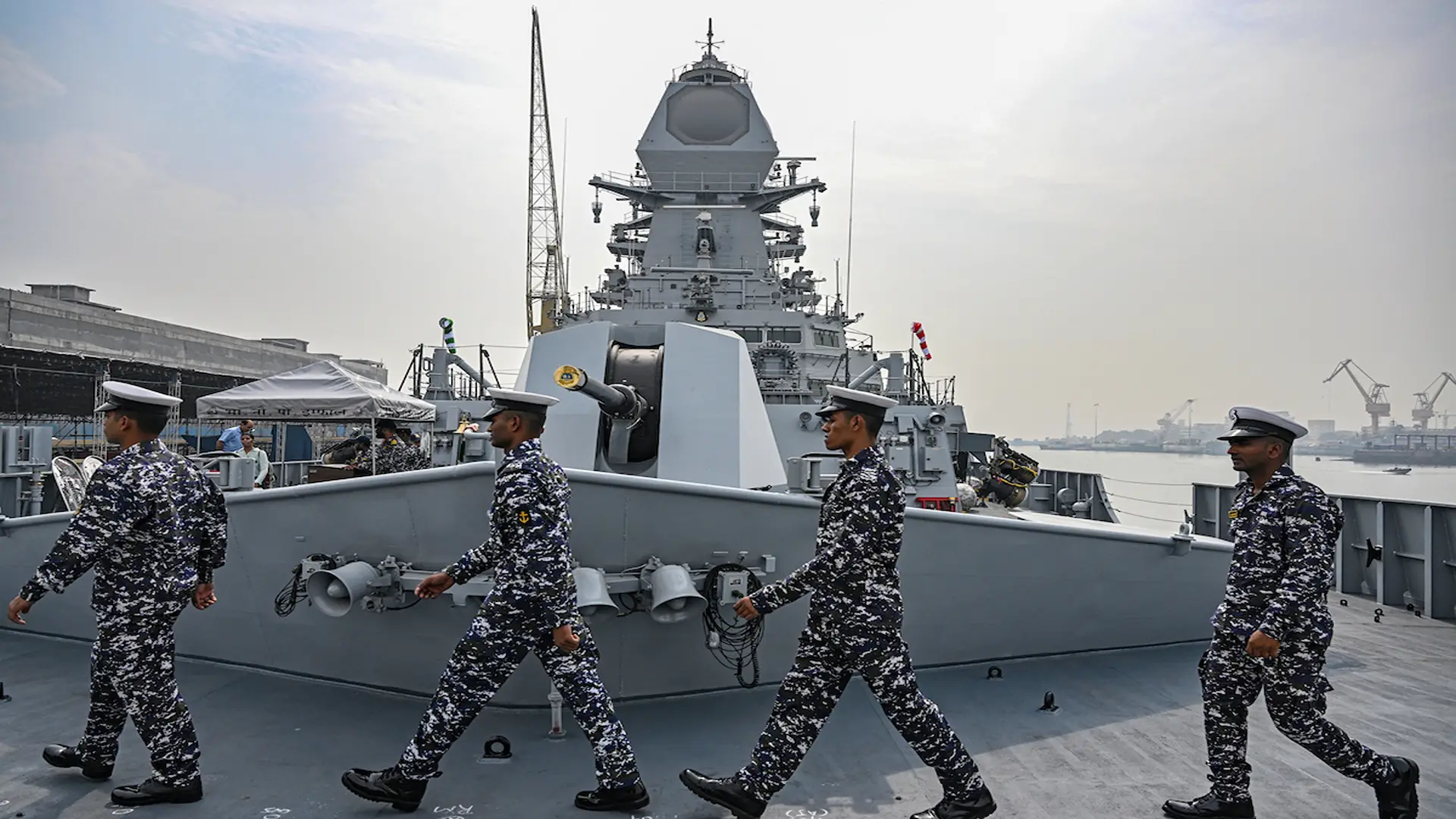
While India has a vast coastline and associated EEZ, the administration and policing of which is challenging, we are fortunate to have large and growing capacities to do so. With some deft planning, there are periods during which we can generate excess capacities beyond domestic requirements. These are often deployed in support of our island partners. As our contribution to the police these waters exceed our domestic requirements (demands); on a hypothetical balance sheet, we are net security positive and, therefore, a 'Net Security Provider'. The term has been mainstreamed by several nations and in no way pontificates that this is a self-mandated role. All our contributions towards capacity building and capability enhancement with these island nations are based on mutual discussions, understanding and trust. In addition, when it comes to the global commons, we have so ably demonstrated our capability to provide a global good in the surge of deployments that have recently taken place off the horn of Africa to curb the resurgence of piracy.
Insofar as the island nations are concerned, we need to recognize that internal politics will give rise to administrations with varying degrees of affinity towards India. They will also leverage geo-political fault lines to obtain the maximum possible benefit for their people. In doing so, it will be best if they remain cognizant of our security concerns as we remain of theirs. However, some things will remain unchanged. These are our geographical proximity and our cultural overlap. These are key parameters that throw open enormous opportunities that need to be leveraged to the greatest possible extent for our mutual benefit. Our island partners must be reassured that we will be there for them whenever they need us.We will always be a trustable ‘Net Security Provider’!