
The future of conflict will be severe once we introduce autonomous capability.
Professor Suresh Sundaram – Professor, IISC Bangalore & Associate Professor School of Computer Science and Engineering, NTU Singapore
Introduction
There is a common perception that artificial intelligence will greatly empower higher commanders in decision-making. But that is not the only thing. The overarching influence of artificial intelligence is that it covers all the dimensions—that is, consciousness, knowledge, information, resources, and the mind.
China is reportedly leading the pack in actually deploying artificial intelligence on the battlefield. Chinese strategists are on record stating that artificial intelligence's value for decision-making will cause future warfare to become a competition over which states can produce computers with the quickest computing capacity. Wartime commanders will be armed with supercomputers that will surpass humans' decision-making capabilities. This is what they call ‘algorithmic warfare”. The same strategists predict that frontline combatants will be gradually phased out and replaced with intelligent swarms of drones that will give operational-level commanders complete control over the battle. They expect that over time,the tactical level of warfare will become a function of competition between robots and, therefore, in some ways, largely become a game.
However, those of us who were brought up on a steady diet of the Terminator series of movies need no telling what happens when artificial intelligence goes terribly wrong.This is leading to a concept called AI assurance. In simple terms, it means an AI-enabled system is trustworthy to the extent that, when used correctly, it will do what it is supposed to do. When used correctly, it will not do what it is not supposed to, andhumans can dependably use it correctly and control it.
The last one considers human-machine teaming. This teaming will be one of the most crucial issues we must address in defining the enduring interdependencies, responsibilities, and roles between machines and humans over the next decade.
UnderstandingAutonomous Systems
The innovation in autonomous systems over the last decadeis changing the world, just as electricity did when it was invented. Like electricity, anything can be electrified once you add intelligence to it!
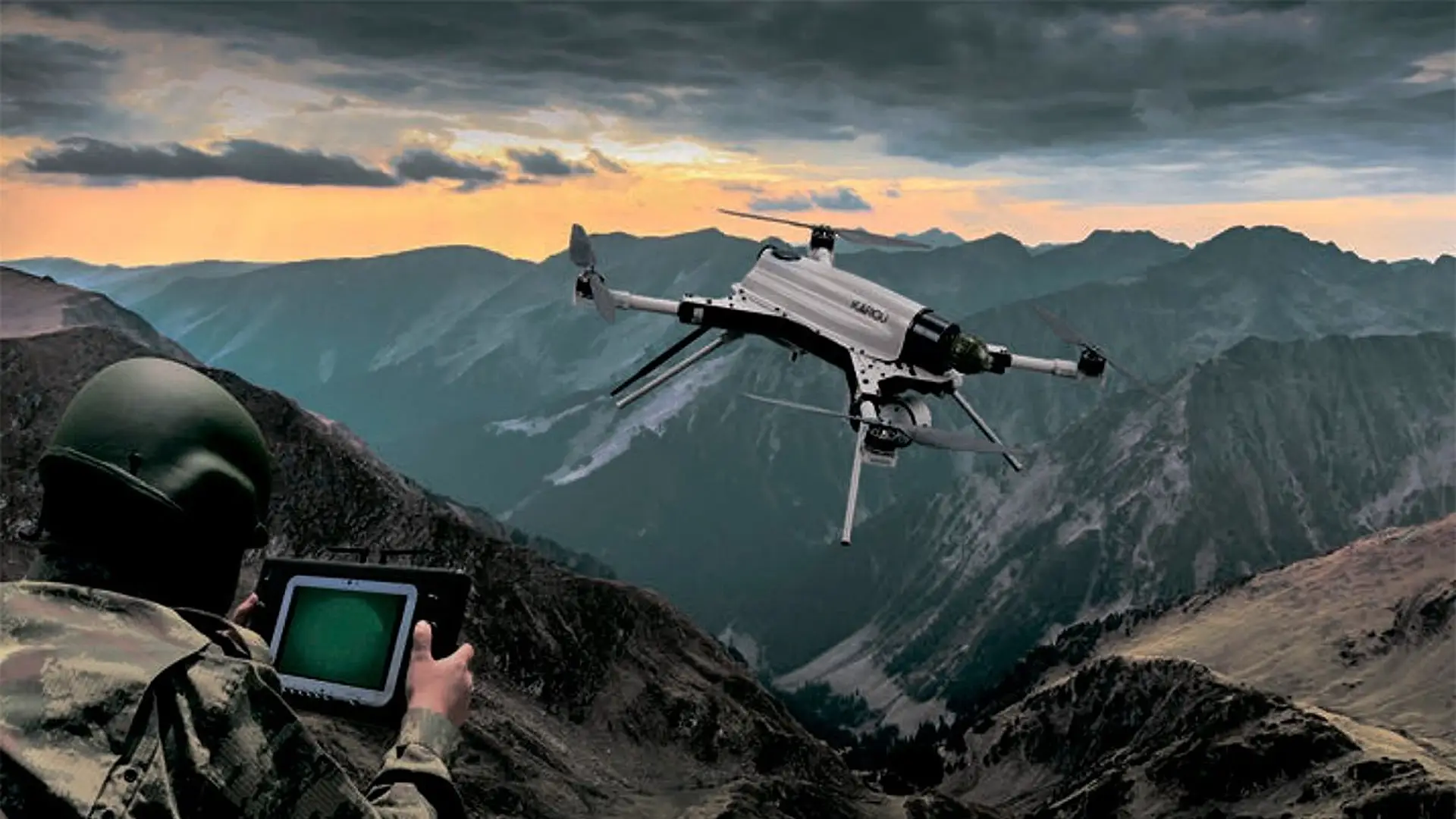
The future of conflictwill be severe once we introduce autonomous capability. There is a difference between automation and autonomy. Automation is something like the autopilot in a modern aircraft, which can help take off, climb to a particular altitude and maintain a bearing, all under the watchful eyes of a pilot. On the other hand, an autonomous system can make its own decisions based on the context to which it belongs.So, we are looking at autonomous machines, which could be underwater, ground, or aerial vehicles. They have some capability to make decisions in the context in which they operate, not like what is going to transform future warfare.
Future autonomous systems will change the control, command, communication and the computing system. Take, for example, surveillance and reconnaissance missions. These systems must ensure the authenticity of the data they collect, enabling commanders to make the correct decision. Information one can collect through any network or even from our friends and allies- the requirement is correct information. The second critical requirement is establishing the ground truth based on the best available information. It could be textual, sample images or video in a multi-domain space. The crux is how to interpret and interrelate them in bringing the information in a form that we can interpret to make the decision much faster. Humans find it difficult to operate in all kinds of environments, which may have to be done autonomously by AI.
A distributed decision-making process emerges in autonomous systems that need a communication link, which is one of the key aspects when designing such a system. Autonomous systems are built for collective behaviour, cooperation, and collaboration among themselves. We can enable them from a broader perspective of the future warfare scenario.
Then, there are autonomous sensing systems, which have information represented in different forms, from visual to thermal. Visually, you may see a texture that you may not see in thermal, and thermally, a heat source may be shown, but you cannot determine if it is being emitted from a car engine. Then there is spectral sensing and radar; if you add textual information to all of them, it represents different information about the same object present in the situation and how they are interconnected in a hyperspace.
Multi-domain representation comes from how this information exchange occurs between various systems collaborating and collating so that they intuitively take the right decision to perform a task. This is something a human does without giving the action a second thought through what is termed in scientific language as dynamic sensing. Autonomous systems should be able to look at the response they see or the force they obtain, and based on these inputs, they organise themselves. This kind of decision capability will play an important role in the future of warfare. There are both non-combat and combat applications of such a technology.
There are some common features needed for both non-combat and combat systems. First is the physical system itself, which will be used, while humans will focus on the information that will be fed to the autonomous system to make it work. Then is predictive planning- what time to start, reach a destination, etc. This includes mechanisms to look at future decisions that enable the safety and security of the system. Data analytics will play an important role in this. What knowledge base does the autonomous system possess that will impact its decision-making process? Since any decision-making process is invariably confronted with uncertainties, real-time data analysis is going on all the time, and it has to be excellent rather than just a high-end computing decision to arrive at the right decision instantly.
In an integrated battlespace, these systems cannot exist independently. They have to be together. It could be your battle tank, a fighter jet, a foot soldier, or even a sensing mechanism. Hence, there is a need for reliable and resilient networks.
But these resources are not infinite. Therefore, there is a challenge for the decision maker to understand which one to deploy, why, and when to deploy. These decisions are based on the information space based on surveillance and shared information from other platforms or mechanisms. It could be verbal, textual, or contextual to the situation. Awareness is more important. The commander may look at a larger picture being beamed from space, but it may not be real-time. Therefore, the information being supplied must be integrated from all sources, which an autonomous system with a cognitive domain can perform.
The Human Hand in Autonomous Systems
At the end of the day, the autonomous system has the resources and information but still has to decide. Humans need help to make the correct decision because the decision has to be reactive and consider the counter-action initiated by the enemy. The environment in which the system is operating will not be static but very dynamic. So, the system has to evolve a strategy based on uncertain information like intake data, physical information, etc. Here again, the cognitive space is very important. Also, in decisions affecting human lives, psychological resources are critical. This is the reason why human-machine teaming is becoming so important. Admittedly, the machine is very good in skill, speed and accuracy- a surveillance camera can keep an eye on an area 24 x 7 without rest, food or break.
But warfare is full of uncertain data, and the fuel for autonomous machines is data when we do not know what, how, or how much the enemy is going to deploy. Everything is uncertain and unknown in a combat environment. For this reason, human-machine teaming plays a very important role.
To reduce uncertainty, machines can be taught using a scenario-building mechanism to learn from synthetic to real. The skill lies in transforming information from the synthetic world and translating that information to the real world. You will have to train the autonomous systems in various possibilities of situations it is likely to face by creating numerous scenarios. These scenarios embed data on what will happen in an uncertain environment.
Another important aspect of military autonomous systems is what we call “explainability.” Can it explain the action it is performing in a space evolving very fast? And can it learn while on the go? This would require a reliable evaluation system.
Reward-basedlearning (RL) helps to minimise perception uncertainty, which is an important aspect. This is a key area where we are moving towards distributed RL because uncertainty has to be minimised.
Then comes the actual engagement of targets by autonomous systems. They need to identify the primary target, which is to be neutralised. Now, the targets will not always be neutralised by a single entity; it may be by two or even more. They may have to act simultaneously. Sometimes, they may have to act one after another. For example, a bunker buster weapon may have to hit the bunker sequentially to create the damage. In certain cases, the systems may have to act simultaneously –how will this decision be made with limited information and no communication? These are going to be the challenges for autonomous systems in future warfare.
Conclusion
Resiliency and multiple perception are some scenarios where AI is helping future warfare. Another important aspectconcerning these systems is how scalable they are from a large perspective—do they have consensus in cooperation when they have to go en masse to neutralise the enemy? How can they do it in real-time?
Most autonomous systems today are at the early ‘narrow intelligence' stage. They can perform tasks that humans cannot do, but they can, under certain circumstances, understand multi-domain data representation, play games like chess, and win against humans. Or they can do a mundane task repeatedly with high speed and high accuracy. This is general intelligence.
Once distributed AI comes into the picture, it can plan, solve, think, comprehend any complex decision-making task, and learn quickly in real time. Distributed AI is critical when autonomous systems operate in swarms and ensure survivability in a hostile conflict environment because, as we see in Ukraine, both sides are knocking drones from the sky as soon as they become airborne.
The final stage would be 'superintelligence.' A few years back, we never thought of how large a language model would impact, starting from education to what we are today. Now, we are building large, efficient models. As soon as a large vision model can interpret and other AI visual cortexes mature, which provides information in a hyperspace, things may change rapidly, even in two to three years. So, we are not far away to see some superintelligence, at least in certain scenarios.