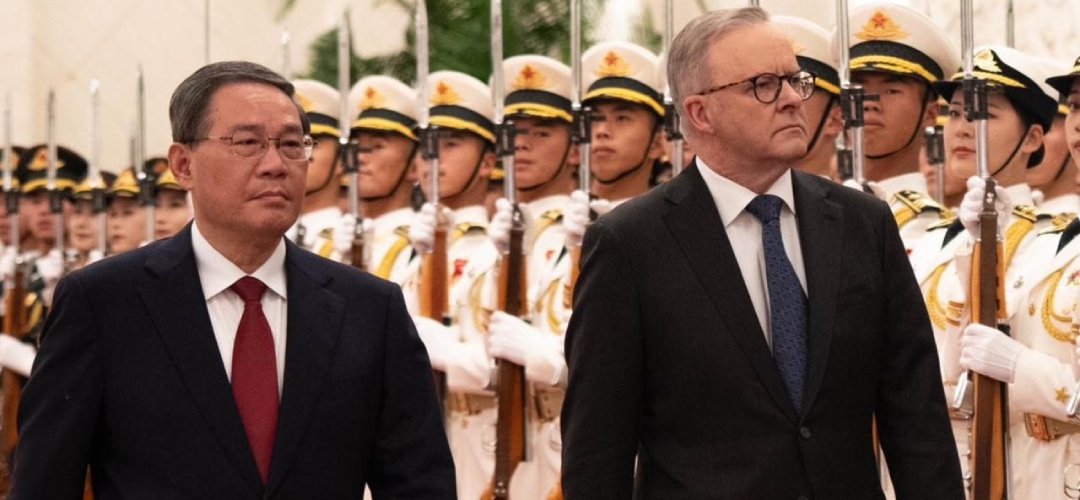

Chinese premier’s ice-breaking Australian visit promises hope after years of trading accusations.
In the annals of modern geopolitics, the relationship between China and Australia has experienced significant ebbs and flows. Over the past few years, the bilateral ties between these two nations have been strained, marked by trading insults, accusations, and a series of retaliatory actions.
Does the recent visit of Chinese Premier Li Qiang to Australia mark a potential turning point, signalling the first signs of a thaw in the frosty relations?
Background
The tensions between China and Australia escalated significantly from 2017 onwards. Several key events contributed to the deterioration of the bilateral relationship. Australia’s introduction of laws to counter foreign interference in 2017-2018, widely seen as targeting China, sparked the initial wave of diplomatic friction. These laws aimed to curb perceived Chinese influence in Australian politics and academia. Following this, Australia was one of the first countries to ban Chinese telecom giant Huawei from its 5G network in 2018 over national security concerns, a decision met with strong opposition from Beijing.
The situation further deteriorated in 2020 when Australia called for an independent investigation into the origins of COVID-19, a move perceived by China as a direct attack. This led to a series of economic retaliations, including tariffs on Australian barley, wine, and coal. Additionally, Australia’s vocal stance on human rights issues in Hong Kong and Xinjiang further strained relations. Beijing accused Canberra of meddling in its internal affairs, while Australia continued criticising China’s human rights record.
In 2020, Zhao Lijian, a familiar face in international media as the Chinese Foreign Ministry spokesperson, tweeted a gruesome picture of a grinning Australian soldier holding a knife to an Afghan child’s neck. Apparently, this was a “doctored, computer-generated image, but a real event inspired it. An Australian Special Air Services unit was found guilty of alleged crimes of brutality by Australian Army investigations earlier.
The visit aims to lay the groundwork for rebuilding trust and cooperation on mutual interests. Additionally, stability in the Indo-Pacific region is a shared interest.
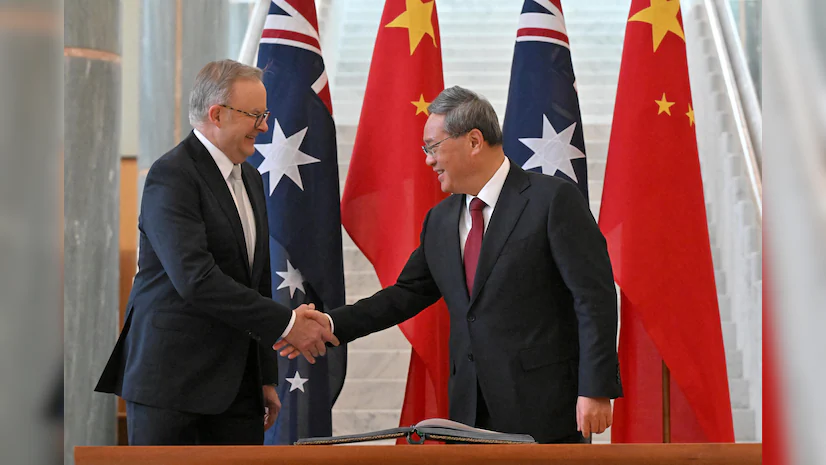
Several economic agreements were signed during the visit, signalling a commitment to revive and expand trade and investment ties. These included agreements on agricultural exports, mineral resources, and technology cooperation. Sensitive issues, including human rights, cybersecurity, and foreign interference, were also discussed. While significant differences remain, both sides agreed to establish working groups to address these issues in a structured manner.
Analysis
At this juncture, both China and Australia have compulsions to bridge the divide. China remains a lucrative market for Australia’s products, mainly minerals and agricultural produce, and it is a profitable destination for Chinese students. China, too, would like to breach the Western unity in which Canberra is an equal ally, going by the formation of the AUKUS. Both nations recognise the need for a diplomatic reset to prevent further deterioration of relations.
The visit itself is a powerful symbol of reconciliation. After years of public insults and accusations, the willingness of both sides to engage in dialogue marks a positive shift. The economic agreements highlight the pragmatic approach both nations are taking. The decision to address sensitive issues through working groups indicates a more mature approach to managing differences. This mechanism allows for ongoing dialogue without derailing the broader relationship.
The economic agreements signed during the visit will likely boost bilateral trade and investment. On the other hand, politically, the visit signals a potential reset in bilateral relations.
While significant challenges remain, establishing dialogue mechanisms provides a platform for constructively managing disputes. This move could also influence domestic political dynamics in both countries, with leaders potentially gaining support for their efforts to stabilise relations.
Strategically, the visit underscores Australia’s efforts to balance its alliance with the United States and its economic interests in China. It reflects a nuanced approach to navigating the complex dynamics of the Indo-Pacific region. The visit demonstrates China’s willingness to engage with Western countries and address mutual concerns through dialogue rather than confrontation. The U.S., which has been extending the olive branch to Beijing recently, maintained a studied silence on the visit.
Assessment
- The thaw in China-Australia relations may influence global perceptions of China’s foreign policy approach. It demonstrates China’s willingness to engage in dialogue and compromise, potentially affecting its relations with other Western nations.
- After years of tensions, the meeting marks the first signs of a thaw, driven by economic pragmatism and a mutual recognition of the need for dialogue. The thaw in China-Australia relations could have broader implications for the Indo-Pacific region. Improved bilateral ties contribute to regional stability.
- While challenges remain, the visit sets the stage for a more constructive and stable relationship, with positive implications for both countries and the broader Indo-Pacific region.